
In one sentence
The book frames Marilyn Manson as a self-created weapon against conformity: Brian Warner turns alienation, fear, religious anxiety, and humiliation into an artistic persona powerful enough to dominate popular culture. Yet the supposed escape from “hell” remains incomplete; the persona becomes another prison built from excess, self-loathing, and spectacle.
Overview
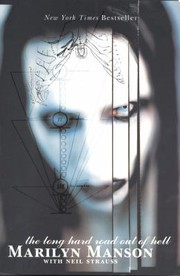
Published in 1998 by ReganBooks, the memoir is credited to Marilyn Manson and Neil Strauss. Its structure is modeled on Dante’s Inferno, with a movement from childhood and family history through adolescent alienation, the formation of the band, escalating theatricality and substance use, and the rise surrounding Antichrist Superstar. Later editions include a bonus chapter absent from the original hardcover.
Core ideas
Identity as construction
“Marilyn Manson” is presented less as a mask hiding Brian Warner than as a deliberately engineered identity. The name, imagery, stage behavior, and public controversies combine beauty, violence, celebrity, religion, and transgression into one cultural character.
Alienation becomes artistic material
The narrative repeatedly links childhood fear, bullying, religious conditioning, family unease, and outsider status to the later artistic project. Rejection is not merely endured; it is converted into style, provocation, and control over the audience.
Shock is a method of power
The memoir treats offensiveness as strategic rather than accidental. By forcing audiences, journalists, parents, and religious authorities to react, Manson makes their outrage part of the performance and enlarges his cultural presence.
The performer and the person blur
The book’s central tension is whether the extreme persona is an instrument Brian Warner uses or a role that increasingly governs him. The narrative often celebrates amorality and excess while also revealing dependence, insecurity, and emotional damage.
Fame does not equal freedom
Commercial success, notoriety, and control over his image do not resolve the underlying conflicts. The Washington Post review interpreted the ending as deliberately unfinished: Manson has not clearly emerged from the psychological “hell” described by the book.
The memoir is also a performance
Its lurid anecdotes, elaborate imagery, photographs, Dantean design, and polished prose make the book function as an extension of the Marilyn Manson brand—not simply as neutral life documentation. Strauss’s co-authorship is important to remembering that the published voice is collaborative.
Practical takeaways
- Read the book as a hybrid of autobiography, origin story, and publicity artifact—not as an unfiltered record of events.
- When evaluating a provocative public persona, ask what audience reaction the persona is designed to produce and who benefits from that reaction.
- Creative transformation can give painful experiences form and leverage, but turning damage into an identity may also preserve the damage.
- Distinguish artistic transgression from ethical insight: the book’s ability to shock does not automatically make its explanations trustworthy or profound.
- Pay attention to the gap between the book’s promise of escape and its apparent ending in continued excess, contradiction, and self-mythologizing.
Caveats and counterpoints
- The memoir is highly sensationalized and should not be treated as independently verified history. Its promotional framing emphasizes shock, danger, and metamorphosis, while a contemporary review described it as both intelligent and confused.
- Some episodes and portrayals have been disputed by people connected with Manson; therefore, specific allegations should be checked against independent reporting rather than accepted solely because they appear in the memoir.
- The book ends during the period of Manson’s late-1990s fame and does not provide a later-life reassessment. It is most useful as a document of the persona and cultural moment surrounding Antichrist Superstar, not as a complete biography.
- The prose may reflect Neil Strauss’s editorial or ghostwriting contribution as much as Manson’s unaided writing; the published text should be understood as a collaboration.
Questions worth revisiting
- Where does Brian Warner’s self-analysis seem convincing, and where does it become another piece of stagecraft?
- Does the book critique Christian moral panic, exploit it, or depend on it for publicity?
- Which forms of suffering are treated as sources of creativity, and which are merely used as spectacle?
- Does the memoir offer evidence of transformation, or mainly document the successful construction of a marketable identity?
- How should a reader weigh a compelling narrative when its factual reliability is uncertain?
Return to this when…
Return to this book when thinking about celebrity self-invention, moral panic, shock-based marketing, the relationship between trauma and artistic identity, or the limits of autobiography as evidence.
Highlights
Like any good performance art, there was a message behind the violence. Most of the time, I wasn’t interested in inflicting pain on myself and others unless it was in a way that would make people think about the way they act, the society they live in or the things they take for granted. Sometimes, as a concrete lesson in making assumptions, I’d toss into the audience dozens of ziploc bags—half of them filled with chocolate chip cookies, the other half with cat turds.
He always reminded me of the professor on Gilligan’s Island: he was smart enough to build a TV out of coconuts, but he could never fix the boat to take everyone home.