
In one sentence
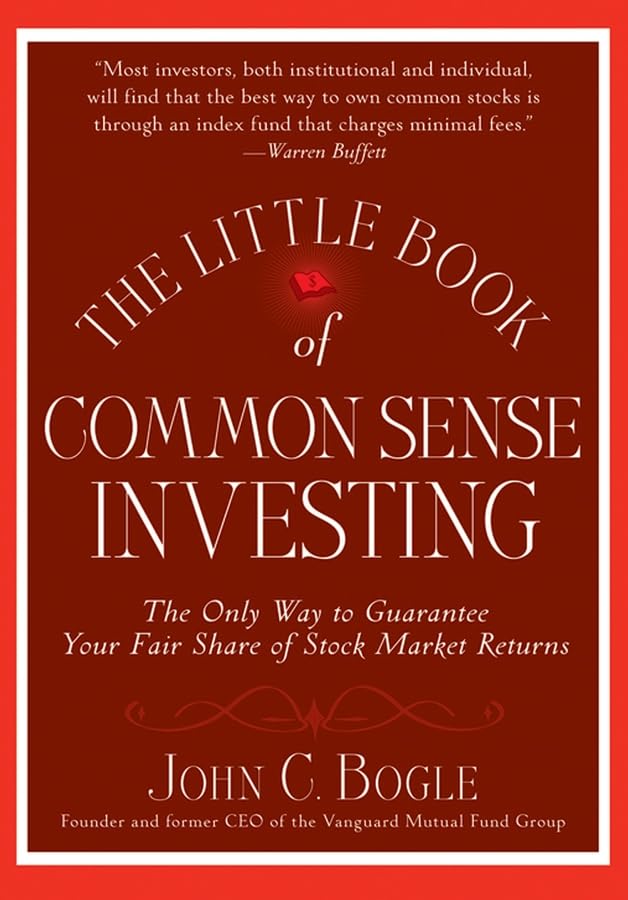
For the ordinary long-term investor, the most reliable way to capture a fair share of stock-market returns is to own a broadly diversified, capitalization-weighted index fund, keep costs and taxes low, and avoid trading, prediction, and performance chasing. Bogle’s “guarantee” means receiving the market’s return minus costs—not guaranteeing a profit or protecting against market declines.
Overview
Bogle builds a practical argument around simple arithmetic: before costs, investors as a group must earn the market return; after management fees, trading expenses, taxes, and other friction, investors as a group must lag it. Active investing can produce winners, but identifying them in advance is difficult, and success tends to attract assets and costs. The book therefore treats simplicity, patience, and low expenses as competitive advantages. The 2017 tenth-anniversary edition updates data and adds chapters on asset allocation and retirement investing.
Core ideas
The market is a winner’s game before costs, a loser’s game after costs
If investors collectively own the market, their aggregate pre-cost result is the market return. Active management, fund selection, and trading cannot improve the group result after fees and transaction costs; they merely redistribute pre-cost returns while reducing the total available to investors.
Costs compound against you
A small annual expense ratio, turnover cost, sales charge, advisory fee, or tax burden can remove a large share of long-term wealth because the forgone returns would themselves have compounded. Bogle’s memorable contrast is the “magic” of compounding returns versus the “tyranny” of compounding costs.
Own businesses, not forecasts
Stock returns ultimately reflect business fundamentals—especially dividend income and earnings growth—plus changes in valuation. Short-term prices may be driven by expectations and sentiment, but over long periods business reality matters more. This is why Bogle favors owning a broad slice of productive businesses rather than predicting which securities will outperform.
Indexing is disciplined humility
A broad index fund avoids the need to identify superior managers, sectors, stocks, or entry points. It accepts that the market already incorporates extensive information and that apparent past superiority may reflect luck, temporary conditions, or costs that later overwhelm the advantage.
Behavior is part of the investment strategy
The index is not sufficient if the investor repeatedly abandons it during declines, chases recent winners, or trades in response to headlines. Bogle’s approach requires patience, realistic expectations, regular saving, and a portfolio whose stock/bond mix matches the investor’s ability and willingness to bear risk.
Asset allocation comes before fund selection
The 2017 edition gives more explicit attention to choosing an appropriate stock/bond allocation and to retirement investing. The central indexing argument does not eliminate the need to decide how much volatility and loss an investor can tolerate, or how withdrawals will be managed.
Bogle’s preferred implementation is deliberately plain
The core vehicle is a broad, low-cost traditional index mutual fund, such as one tracking the S&P 500 or the total U.S. market. He is skeptical of fashionable products, unnecessary complexity, excessive trading, and indexing products designed more for marketing than for efficient market exposure.
Practical takeaways
- Treat low cost as a first-order investment decision, not a minor detail.
- Prefer a broadly diversified index fund over concentrated stock picking or repeated fund switching.
- Separate investing from speculation: investing owns productive assets for the long term; speculation depends on selling to someone else at a higher price.
- Set an asset allocation before a market panic forces the decision.
- Use new contributions and periodic rebalancing to maintain the chosen allocation rather than reacting to forecasts.
- Judge an investment strategy by its after-cost, after-tax, long-term result—not by an exciting recent period.
- The book’s most useful question is: “What return will I actually keep?”
Caveats and counterpoints
- The book is intentionally polemical. It makes a strong case against high-cost active management, but that does not prove that every active strategy, factor strategy, or specialist manager will underperform in every period.
- “Fair share” is relative to the market. A market index can fall substantially; indexing does not remove equity risk, inflation risk, sequence-of-returns risk, or the possibility that an investor needs money at a bad time.
- Bogle’s U.S.-centered preference and skepticism about international diversification are contestable. Research has found potential diversification benefits from investing across countries, so a modern investor may reasonably consider a global allocation rather than treating the U.S. market as the only core equity holding.
- Market-cap weighting is simple and broadly representative, but it automatically gives larger weights to companies whose market values have risen. Alternatives may have different risk, tax, turnover, and implementation characteristics; the book does not fully resolve those trade-offs.
- The advice is strongest for investors seeking a low-maintenance portfolio and weakest as a complete guide to personal circumstances such as pensions, insurance, debt, taxes, withdrawal design, or concentrated employer stock.
Questions worth revisiting
- What is my target stock/bond allocation, and could I hold it through a severe bear market?
- What total annual cost am I paying across fund expenses, advisory fees, trading, and taxes?
- Am I buying a diversified market portfolio or making an unacknowledged bet on a sector, country, theme, or recent winner?
- Do I need international stocks for diversification, and if I exclude them, what is my reason?
- What behavior—panic selling, performance chasing, frequent checking—could cause me to underperform my own portfolio?
- Is a simple index portfolio actually simple enough that I can maintain it for decades?
Return to this when…
Return to this book when investment news, fund rankings, market forecasts, or a recent winner makes investing feel complicated. Its refresher value is the arithmetic of costs and the behavioral reminder to keep the portfolio diversified, inexpensive, and aligned with a durable plan.
Highlights
This book will tell you why you should stop contributing to the croupiers of the financial markets, who rake in something like $400 billion each year from you and your fellow investors. It will also tell you how easy it is to do just that: simply buy the entire stock market. Then, once you have bought your stocks, get out of the casino and stay out. Just hold the market portfolio forever. And that’s what the index fund does.
Simply by buying a portfolio that owns the shares of every business in the United States and then holding it forever. It is a simple concept that guarantees you will win the investment game played by most other investors who—as a group—are guaranteed to lose. Please don’t equate simplicity with stupidity. Way back in 1320, William of Occam expressed it well, essentially setting forth this precept: When there are multiple solutions to a problem, choose the simplest one.8 And so Occam’s Razor came to represent a major principle of scientific inquiry. By far the simplest way to own all of U.S. business is to hold the total stock market portfolio.
“In the short run the stock market is a voting machine . . . (but) in the long run it is a weighing machine.”
References
- The Little Book of Common Sense Investing: The Only Way to Guarantee Your ... - John C. Bogle - Google Books
- The Little Book of Common Sense Investing: The Only Way to Guarantee Your ... - John C. Bogle - Google Books
- catalog.freelibrary.org
- cambridge.org
- bpl.bibliocommons.com
- journals.sagepub.com
- libris.kb.se
- en.wikipedia.org
- reiprime.com
- oreilly.com
- catalog.wake.gov
- oreilly.com
- openjournals.libs.uga.edu