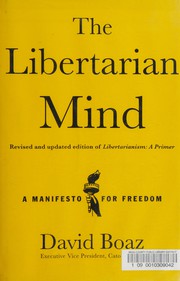

In one sentence
Liberty should be the default condition of human beings: individuals possess rights and dignity, while government must justify rather than presume its authority. Boaz argues that a largely voluntary civil society and market order usually coordinate human affairs better—and with less abuse—than expanding state control.
Overview
The book is a revised and retitled edition of Libertarianism: A Primer. Its progression is conceptual: define the libertarian promise, trace its roots, explain rights and individual dignity, defend toleration and constitutionalism, describe civil society and markets, then apply the framework to big government, contemporary controversies, and the future. The 2015 edition is listed at 417 pages; a further updated edition was published in 2025 with a new preface.
Core ideas
The presumption of liberty
People should generally be free to direct their own lives, provided they do not violate the equal rights of others. The burden of proof falls on those proposing coercion, not on individuals seeking permission to act.
Rights constrain political power
Boaz treats rights—especially life, liberty, property, free expression, and freedom of association—as protections against both majority rule and executive discretion. Government is legitimate only insofar as it protects rights rather than routinely overriding them.
Individual dignity and responsibility
Individuals are not merely units to be managed by experts or bureaucracies. Respecting their dignity means allowing choice, experimentation, error, and responsibility, rather than assuming officials possess superior knowledge of everyone’s needs.
Pluralism and toleration
A free society permits diverse beliefs, lifestyles, communities, and voluntary institutions. Toleration is not agreement; it is a way of limiting conflict by refusing to use political force to impose conformity.
Civil society as an alternative to state administration
Families, churches, charities, clubs, businesses, professional associations, and informal networks can solve problems through cooperation. Boaz’s broader claim is that social order does not require comprehensive governmental direction.
Markets as discovery processes
Markets are not simply mechanisms for distributing goods; they are systems for discovering information through prices, competition, entrepreneurship, and feedback. Decentralized decisions can coordinate knowledge that no central planner possesses.
The state’s tendency to expand
Boaz portrays government programs as difficult to contain: concentrated beneficiaries and organized bureaucracies have stronger incentives to preserve programs than dispersed taxpayers have to resist them. Deficits, regulation, surveillance, intervention abroad, and the welfare state are presented as expressions of this dynamic.
Policy applications
The libertarian framework points toward reduced regulation, freer trade, stronger civil liberties, less militarized foreign policy, drug-law reform, limits on surveillance, and greater reliance on private or voluntary provision. These are applications of the principles, not equally detailed empirical demonstrations.
Practical takeaways
- When evaluating a proposed policy, ask: What right is being protected, what coercion is being introduced, and who decides how it will be applied?
- Distinguish market failure from dissatisfaction with an outcome. A bad result does not by itself show that centralized intervention will produce a better one.
- Look for dispersed knowledge: who has the relevant information, and can a bureaucracy realistically obtain it before acting?
- Treat voluntary alternatives as part of the policy analysis rather than assuming the only choices are government action or neglect.
- Be skeptical of temporary emergency powers and narrowly targeted programs that create permanent constituencies.
- Apply the nonaggression principle consistently to civil liberties, economic regulation, foreign policy, and personal behavior.
- Remember that libertarianism is a family of positions: Boaz advocates limited government, but the book also engages with more radical arguments that approach or reject the state altogether.
Caveats and counterpoints
- The book is an advocacy-oriented introduction, not a neutral survey of political philosophy or public economics. Its organization and framing are designed to make the libertarian case persuasive.
- Boaz emphasizes the costs of state coercion and the advantages of voluntary order more than difficult boundary cases: externalities, public goods, extreme poverty, unequal bargaining power, discrimination, and collective-action problems.
- The market-process argument explains how decentralized coordination can work, but it does not automatically establish that every existing market outcome is fair or that every government remedy is worse.
- Rights-based arguments can conflict in practice—for example, property rights versus pollution control, or freedom of association versus antidiscrimination rules. The book’s principles do not eliminate these disputes.
- The political context is partly dated: the 2015 edition responds to the post-2001 wars, the 2008 financial crisis, executive expansion, and NSA surveillance. The 2025 edition updates the work, so details may differ by edition.
Questions worth revisiting
- Which functions, if any, does Boaz concede require a state rather than voluntary institutions?
- Does the argument rely more on natural rights, constitutional liberalism, consequentialist claims about prosperity, or some combination?
- Where does Boaz provide evidence that privatization or deregulation improves outcomes, and where does he mainly offer a priori reasoning?
- How should his framework handle people who lack the resources or bargaining power needed to exercise meaningful choice?
- Which of the proposed reforms are politically feasible, and which depend on a more fundamental transformation of public attitudes?
Return to this when…
Return to the chapter sequence when you need a compact map of mainstream American libertarian arguments: rights and dignity first, then toleration, constitutional limits, civil society, markets, and policy applications. Revisit the caveats when assessing the book as empirical economics or as a complete account of justice.