
In one sentence
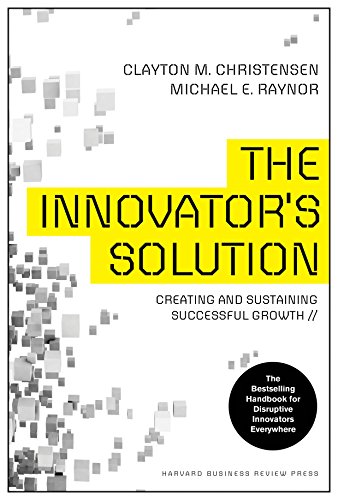
Successful growth is less a matter of visionary prediction than of matching a disruptive opportunity with the right customers, value network, business model, organizational capabilities, and capital. Innovation becomes more manageable when managers reason from the circumstances that shape outcomes rather than applying universal recipes.
Overview
The book moves from the growth imperative to a set of linked strategic decisions: how to attack strong incumbents, identify products customers will hire to do a job, choose initial customers, determine what to integrate or outsource, avoid commoditization, build organizations suited to new growth, manage strategy formation, and fund uncertain ventures. Its chapter structure reflects this progression.
Core ideas
Disruption is a specific path, not a synonym for innovation
Disruptive innovations typically begin either in an overlooked low-end segment or by creating a new market for people who previously could not or would not use the incumbent solution. They are initially simpler, cheaper, or more convenient—not necessarily technologically superior. Sustaining innovations improve existing products for established customers and require different competitive behavior.
Start with the job, not the product category
Customers effectively ‘hire’ products and services to make progress in particular circumstances. Segmenting only by demographics or product attributes can hide demand; studying the job, constraints, and trade-offs can reveal nonconsumption or dissatisfied users that are more receptive to disruption.
Target customers whose alternatives are limited
A disruptive entrant should seek customers who are overserved by existing products, unable to afford or access them, or currently solving the job with inadequate workarounds. These customers impose a more attainable performance standard and are less likely to trigger a strong incumbent response.
Business models must be coherent systems
A compelling product is insufficient. The value proposition, resources, processes, cost structure, revenue model, and distribution channels must reinforce one another. A model optimized for an established market can be structurally incapable of serving a disruptive one.
Choose integration and modularity according to the bottleneck
When performance demands are not yet satisfied, firms benefit from integrating tightly across components to optimize the whole system. Once performance becomes more than good enough, interfaces can standardize and value often migrates toward modular components or adjacent layers. Scope should therefore change with the basis of competition.
Capabilities can become disabilities
An organization’s resources, processes, and values determine what it can do reliably—and what it will systematically reject. Existing processes and financial expectations often favor sustaining projects, so disruptive growth may require an autonomous unit, different metrics, and a separate resource-allocation logic.
Strategy should be discovered through disciplined experimentation
For genuinely new markets, detailed long-range plans rest on guesses. Managers should make explicit assumptions, run small experiments, learn from market feedback, and revise the strategy. The goal is not to eliminate uncertainty but to convert uncertainty into knowledge before committing heavily.
Good money and bad money
Capital carries expectations. Funding that demands rapid scale, predictable margins, or near-term returns can distort an emerging business before its model is understood. Early disruptive ventures need investors and financial milestones appropriate to uncertainty; the book’s memorable discipline is to be patient for growth but impatient for profit.
Practical takeaways
- When evaluating an innovation, ask: Is it sustaining or potentially disruptive? If disruptive, is it entering from the low end or creating new consumption?
- Define the customer’s job and the circumstances surrounding it before specifying features or target segments.
- Look for nonconsumption, awkward workarounds, overserved customers, and markets incumbents are structurally motivated to ignore.
- Separate a disruptive venture when the parent company’s processes, margins, channels, or customers would suffocate it.
- Track learning milestones—validated assumptions, repeatable customer behavior, viable unit economics—not just revenue or market share.
- Review whether your organization’s current capabilities fit the new opportunity; do not assume a successful core business can automatically execute a different model.
- Use integration when system-level performance is inadequate; consider modularity when performance is already more than customers require.
- Treat ‘disruption’ as an analytical diagnosis, not as branding or a command to attack an attractive market.
Caveats and counterpoints
- The book’s theories are circumstance-based, not guarantees. Correctly identifying a disruptive pattern does not remove execution risk, timing risk, regulation, competition, or demand uncertainty.
- The term ‘disruption’ is frequently overextended to mean any rapid or impressive change. The authors’ framework is narrower: it concerns a particular entrant trajectory and the incumbent’s likely response. The Christensen Institute itself continues to emphasize this distinction.
- Critics argue that disruption theory can become overly deterministic or retrospectively fitted to business histories, and that it underplays factors such as managerial agency, complementary assets, institutions, and cases where incumbents adapt successfully. Jill Lepore’s critique is a prominent example.
- The book is strongest as a strategic diagnostic and organizational design tool, not as a complete theory of innovation. It gives less attention to social consequences, power, ethics, macroeconomic shifts, and innovations whose adoption depends on ecosystems or network effects.
Questions worth revisiting
- Which of my organization’s current customers are overserved, excluded, or relying on workarounds?
- What job are they trying to accomplish, and what would make a simpler solution ‘good enough’?
- Is this opportunity genuinely disruptive, or is it a sustaining improvement competing for existing customers?
- Which resources, processes, and values would help the new venture—and which would quietly prevent it from succeeding?
- What assumptions about customer behavior, pricing, channels, and costs are most dangerous, and how can we test them cheaply?
- Does the proposed capital source require a growth pattern the business cannot yet support?
- As the product improves, where will the basis of competition move: system integration, components, channels, or another layer of the value network?
Return to this when…
Return to this book when assessing a new-growth initiative, deciding whether to incubate it inside or outside the core business, choosing early customers, or diagnosing why a promising innovation is being managed with the wrong metrics and incentives.
Highlights
We could cite many cases of companies’ similar attempts to create new-growth platforms after the core business had matured. They follow an all-too-similar pattern. When the core business approaches maturity and investors demand new growth, executives develop seemingly sensible strategies to generate it. Although they invest aggressively, their plans fail to create the needed growth fast enough; investors hammer the stock; management is sacked; and Wall Street rewards the new executive team for simply restoring the status quo ante: a profitable but low-growth core business.
This is why the senior managers at the major toy company and at BIG can live in the same world and yet see such different things. In every sizable company, not just in the toy business, the set of ideas that has been processed and packaged for top management approval is very different from the population of ideas that is bubbling at the bottom.
The processes have in fact evolved to weed out business proposals that target markets where demand might be small. The problem for growth-seeking managers, of course, is that the exciting growth markets of tomorrow are small today.
The middle stage in this cycle—getting the categories right—is the key to developing useful theory. To see why, imagine going to your medical doctor seeking treatment for a particular set of symptoms, and before you have a chance to describe what ails you, the physician hands you a prescription and tells you to “take two of these and call me in the morning.” “But how do you know this will help me?” you ask. “I haven’t told you what’s wrong.” “Why wouldn’t it work?” comes the reply. “It cured my previous two patients just fine.” No sane patient would accept medicine like this. But academics, consultants, and managers routinely dispense and accept remedies to management problems in this manner. When something has worked for a few “excellent” companies, they readily advise all other companies that taking the same medicine will be good for them as well. One reason why the outcomes of innovation appear to be random is that many who write about strategy and management ignore categorization. They observe a few successful companies and then write a book recommending that other managers do the same things to be successful too—without regard for the possibility that there might be some circumstances in which their favorite solution is a bad idea.
Similar breakthroughs in management research increase the predictability of creating new-growth businesses. Getting beyond correlative assertions such as “Big companies are slow to innovate,” or “In our sample of successful companies, each was run by a CEO who had been promoted from within,” the breakthrough researcher first discovers the fundamental causal mechanism behind the phenomena of success. This allows those who are looking for “an answer” to get beyond the wings-and-feathers mind-set of copying the attributes of successful companies.
We can trust a theory only when its statement of what actions will lead to success describe how this will vary as a company’s circumstances change.23 This is a major reason why the outcomes of innovation efforts have seemed quite random: Shoddy categorization has led to one-size-fits-all recommendations that in turn have led to the wrong results in many circumstances.24 It is the ability to begin thinking and acting in a circumstance-contingent way that brings predictability to our lives.
References
- The Innovator's Solution: Creating and Sustaining Successful Growth - Clayton, Michael - Google Books
- summary.com
- supersummary.com
- shortform.com
- The Innovator's Solution: Creating and Sustaining Successful Growth - Christensen Institute
- books.google.com
- public.summaries.com
- businessfloss.com
- pulserevops.com
- getabstract.com
- shortform.com
- coursehero.com
- christenseninstitute.org
- newyorker.com