
In one sentence
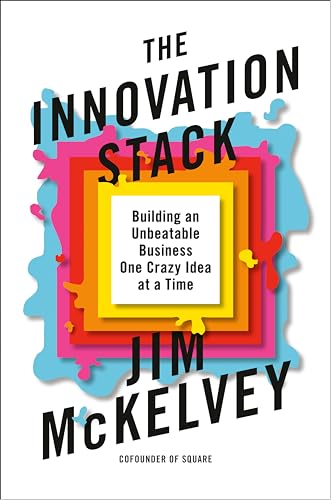
Entrepreneurial advantage often comes not from one brilliant invention but from an interdependent sequence of original solutions—an “innovation stack”—developed while addressing a problem existing systems have ignored. The resulting business is hard to copy because competitors must reproduce the whole system, not merely its visible product.
Overview
McKelvey begins with the practical frustration that led him and Jack Dorsey to create Square: small merchants struggled to accept credit cards. Square’s challenge was larger than designing a card reader; it involved pricing, hardware, software, onboarding, payments infrastructure, risk, and trust. When Amazon copied Square’s product, undercut its price, and promoted the alternative, McKelvey treated Square’s survival as evidence that the company’s real advantage lay in its connected solutions rather than in the reader alone.
The book broadens the argument through historical cases including A.P. Giannini’s Bank of Italy, IKEA, and Southwest Airlines. McKelvey presents these companies as examples of founders who served overlooked or excluded customers by inventing new ways to operate, thereby expanding markets instead of merely fighting for existing share.
Core ideas
An innovation stack is a chain, not a feature
A novel customer problem exposes secondary problems that established businesses have no reason to solve. Each answer creates the conditions for the next answer, producing a mutually dependent system. Individual components may be imitable; the complete sequence is much harder to reconstruct.
Start with the “perfect problem”
The most promising problems are both genuinely painful and poorly served by existing institutions. McKelvey emphasizes opportunities where solving the problem makes a product accessible to people previously excluded—such as small merchants, ordinary bank customers, budget-conscious furniture buyers, or underserved air travelers.
Necessity can generate better innovation than planning
The book’s innovators generally did not begin with a complete master plan. They encountered an obstacle, solved it, discovered another obstacle, and continued. Innovation is therefore portrayed as adaptive problem-solving under pressure rather than as a purely visionary exercise.
Competition is not always the right comparison
McKelvey distinguishes creating a new market from winning an existing one. If a company makes a previously inaccessible activity simple or affordable, its growth may come from expanding participation rather than taking customers from rivals.
Persistence is operational, not merely emotional
“Perseverance” in the book means continuing to address concrete constraints: regulatory, technical, financial, logistical, and cultural. The founder’s job is not simply to believe in the idea but to keep building the missing infrastructure around it.
The founder’s outsider position can be useful
McKelvey’s lack of traditional payments expertise is presented as an advantage because it made industry assumptions visible and questionable. Outsider status is not automatically beneficial, but unfamiliarity can help reveal rules that incumbents mistake for necessities.
Practical takeaways
- Choose a problem that matters to people current systems neglect, not merely a market that looks large.
- Map the adjacent problems your initial solution creates. Those dependencies may become the real source of defensibility.
- Ask whether you are improving an existing market or making participation possible for a new group.
- Treat industry conventions as hypotheses. Verify which constraints are technical, legal, economic, or simply habitual.
- Build the system required by the customer outcome, even when that means entering unfamiliar domains.
- When a large competitor copies the visible product, examine whether it can reproduce the underlying relationships, processes, trust, and infrastructure.
- Use historical analogies cautiously: identify the specific mechanism shared by the cases rather than copying their surface tactics.
Caveats and counterpoints
- The argument is based mainly on memorable founder narratives and retrospective interpretation, especially McKelvey’s account of Square; it is better read as a conceptual framework than as a tested general law. A serious review notes that the book’s stronger claims about innovation stacks being broadly “competition-proof” are not fully persuasive.
- The cases involve unusually capable founders, favorable timing, capital, networks, and market conditions. A stack may make imitation harder without making a business durable, profitable, or socially beneficial.
- Solving many interconnected problems can create complexity, regulatory exposure, and execution risk. The approach may fail when a simpler product, distribution advantage, or fast follower is more valuable than a deeply integrated system.
- The book’s inclusion-centered view of innovation is attractive but incomplete: expanding access can still produce harms, externalities, or unequal outcomes, and the narrative does not constitute independent evidence that every featured company improved its market in all respects.
Questions worth revisiting
- Which customer group is poorly served because incumbents consider it too small, difficult, or unprofitable?
- What secondary problems would appear if I solved the initial problem successfully?
- Which parts of my business are genuinely interdependent, and which are merely bundled features?
- Am I building a new market or competing for existing demand?
- What assumptions from the incumbent industry am I accepting without testing?
- Could a competitor copy my product without copying my operating system, trust mechanisms, or infrastructure?
- What evidence would show that my innovation stack is creating durable value rather than unnecessary complexity?
Return to this when…
Return to this book when evaluating a startup idea that serves an overlooked customer, when a competitor copies your visible product, or when you need to distinguish a defensible system from a clever but easily replicated feature. Revisit the caveats before treating the innovation-stack concept as a universal formula.
References
- Books by Jim McKelvey – The Innovation Stack
- The Innovation Stack by Jim McKelvey: 9780593086735 | PenguinRandomHouse.com: Books
- The Innovation Stack: Building an Unbeatable Business One Crazy Idea at a Time by Jim McKelvey | Goodreads
- publicissapient.fr
- fifthrevision.com
- studylib.net
- fool.com
- mukundmohan.blog
- befreed.ai
- app.thestorygraph.com
- allenc.com
- metisstrategy.com