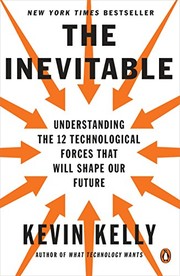

In one sentence
The future is more predictable at the level of technological direction than at the level of specific inventions. Kelly argues that digital networks generate persistent tendencies—toward more intelligence, access, sharing, interaction, measurement, and fluidity—and that understanding these tendencies is more useful than trying to forecast particular products or dates.
Overview
The book presents twelve forces as ongoing verbs rather than finished conditions: Becoming, Cognifying, Flowing, Screening, Accessing, Sharing, Filtering, Remixing, Interacting, Tracking, Questioning, and Beginning. They overlap: more connected devices create more data; more data enables better artificial intelligence; AI expands personalization and automation; abundant digital goods encourage access and sharing rather than ownership.
Core ideas
1. Becoming: permanent beta
Digital tools do not settle into final forms. Continuous upgrades make change normal and make everyone, including experts, an ongoing beginner. Adaptability becomes a more durable advantage than mastery of any fixed tool.
2. Cognifying: intelligence becomes cheap and embedded
Kelly expects artificial intelligence to spread into ordinary objects, services, and processes—not merely exist as humanoid robots. The important shift is the availability of inexpensive, specialized intelligence that augments human capabilities and creates new combinations of human and machine work.
3. Flowing: digital goods become fluid
Once information is digitized, it can be copied, updated, searched, recombined, and distributed continuously. Business models therefore move away from selling static units toward subscriptions, services, platforms, and ongoing relationships.
4–6. Screening, accessing, sharing
Screens become a primary interface to knowledge and culture; access increasingly matters more than possession; and sharing becomes a default social and economic behavior. The result is greater convenience and participation, but also dependence on platforms and attention markets.
7–9. Filtering, remixing, interacting
Abundance creates a filtering problem: recommendation, curation, reputation, and trusted judgment become valuable. Existing media are increasingly remixed, while interfaces move toward richer, more natural interaction, including virtual and augmented environments.
10. Tracking: measurement becomes pervasive
Sensors and connected systems make behavior, bodies, environments, and transactions increasingly measurable. Kelly sees feedback and personalization as benefits, but the force also raises questions about privacy, surveillance, ownership of data, and whether tracking will be reciprocal rather than imposed only on individuals.
11–12. Questioning and beginning
Technology expands the number of questions we can ask and destabilizes settled assumptions about identity, intelligence, work, and reality. Because the networked technological civilization is still early, Kelly treats the present as a beginning rather than an arrival.
The book’s governing attitude
Kelly is deliberately optimistic: he emphasizes possibility, experimentation, and abundance over technological dystopia. His central practical stance is neither resistance nor passive surrender, but informed participation in shaping systems whose broad direction may be difficult to stop.
Practical takeaways
- Think in trajectories, not isolated gadgets: ask what a technology makes easier, cheaper, more connected, or more measurable.
- Build skills around learning, judgment, creativity, collaboration, and asking better questions—capacities that remain valuable as tools change.
- Expect digital products to be services under continuous revision rather than finished possessions.
- Treat attention and trust as scarce resources in an environment of overwhelming abundance.
- When adopting data-rich systems, ask who can see the data, who benefits from it, and whether control is reciprocal.
- Use AI and automation to supplement human abilities, while recognizing that deployment choices—not just technical capability—shape social outcomes.
Caveats and counterpoints
- “Inevitable” is strongest as a claim about broad technological pressures, not specific outcomes. The book does not establish that any particular product, company, platform, or social arrangement must appear.
- The optimistic framing can underweight power, inequality, labor displacement, privacy loss, ecological costs, and the possibility that benefits accrue unevenly. Publishers Weekly describes the book as an attempt to define driving forces, while Kirkus notes that futurist predictions have often been wrong.
- The book’s 2016 horizon means some examples and forecasts should be read as conceptual prompts rather than current descriptions. Its durable value is the vocabulary of trends, not precise prediction.
- Kelly sometimes treats technological development as having a directional momentum. Readers who reject teleological accounts of technology will likely find this motivating but insufficiently attentive to institutions, regulation, conflict, and deliberate political choice.
Questions worth revisiting
- Which of the twelve forces feels genuinely structural, and which depends on business incentives or policy choices?
- Where does greater access improve life, and where does it replace ownership with dependency?
- What would reciprocal tracking look like in practice for employers, platforms, governments, and citizens?
- Which human abilities become more valuable when intelligence and information are abundant?
- What safeguards are needed so that “inevitable” technological trends remain contestable and broadly beneficial?
Return to this when…
Return to this book when evaluating a new technology at the level of second-order effects: not merely what it does, but what it makes normal, abundant, measurable, shareable, or difficult to avoid. Its twelve verbs provide a useful checklist for technology strategy, forecasting, and personal adaptation.
Highlights
Three generations ago, many a tinkerer struck it rich by taking a tool and making an electric version. Take a manual pump; electrify it. Find a hand-wringer washer; electrify it. The entreprenuers didn’t need to generate the electricity; they bought it from the grid and used it to automate the previously manual. Now everything that we formerly electrified we will cognify. There is almost nothing we can think of that cannot be made new, different, or more valuable by infusing it with some extra IQ. In fact, the business plans of the next 10,000 startups are easy to forecast: Take X and add AI. Find something that can be made better by adding online smartness to it.
Around 2002 I attended a private party for Google—before its IPO, when it was a small company focused only on search. I struck up a conversation with Larry Page, Google’s brilliant cofounder. “Larry, I still don’t get it. There are so many search companies. Web search, for free? Where does that get you?” My unimaginative blindness is solid evidence that predicting is hard, especially about the future, but in my defense this was before Google had ramped up its ad auction scheme to generate real income, long before YouTube or any other major acquisitions. I was not the only avid user of its search site who thought it would not last long. But Page’s reply has always stuck with me: “Oh, we’re really making an AI.”
This is not a race against the machines. If we race against them, we lose. This is a race with the machines. You’ll be paid in the future based on how well you work with robots. Ninety percent of your coworkers will be unseen machines. Most of what you do will not be possible without them. And there will be a blurry line between what you do and what they do.
When copies are free, you need to sell things that cannot be copied. Well, what can’t be copied? Trust, for instance. Trust cannot be reproduced in bulk. You can’t purchase trust wholesale. You can’t download trust and store it in a database or warehouse it. You can’t simply duplicate someone’s else’s trust. Trust must be earned, over time. It cannot be faked. Or counterfeited (at least for long). Since we prefer to deal with someone we can trust, we will often pay a premium for that privilege. We call that branding. Brand companies can command higher prices for similar products and services from companies without brands because they are trusted for what they promise. So trust is an intangible that has increasing value in a copy-saturated world.
Way back in 1971 Herbert Simon, a Nobel Prize–winning social scientist, observed, “In an information-rich world, the wealth of information means a dearth of something else: a scarcity of whatever it is that information consumes. What information consumes is rather obvious: it consumes the attention of its recipients. Hence a wealth of information creates a poverty of attention.” Simon’s insight is often reduced to “In a world of abundance, the only scarcity is human attention.”
mail from people she doesn’t know. She says, “Email is a system that lets other people add things to my to-do list.” Right now there is no cost for adding an email in
That leaves the big question in an age of cheap plentitude: What is really valuable? Paradoxically, our attention to commodities is not worth much. Our monkey mind is cheaply hijacked. The remaining scarcity in an abundant society is the type of attention that is not derived or focused on commodities. The only things that are increasing in cost while everything else heads to zero are human experiences—which cannot be copied. Everything else becomes commoditized and filterable. The value of experience is rising. Luxury entertainment is increasing 6.5 percent annually. Spending at restaurants and bars increased 9 percent in 2015 alone. The price of the average concert ticket has increased by nearly 400 percent from 1981 to 2012. Ditto for the price of health care in the United States. It rose 400 percent from 1982 to 2014. The average U.S. rate for babysitting is $15 per hour, twice the minimum wage. In big U.S. cities it is not unusual for parents to spend $100 for child care during an evening out. Personal coaches dispensing intensely personal attention for a very bodily experience are among the fastest growing occupations. In hospice care, the cost of drugs and treatments is in decline, but the cost of home visits—experiential—is rising. The cost of weddings has no limit.
In every life there is probably at least one moment that is freakish, so everyone alive is a world record holder for 15 minutes. The good news may be that it cultivates in us an expanded sense of what is possible for humans, and for human life, and so extremism expands us. The bad news may be that this insatiable appetite for super-superlatives leads to dissatisfaction with anything ordinary. There’s no end to this dynamic. Cameras are ubiquitous, so as our collective tracked life expands, we’ll accumulate thousands of videos showing people being struck by lightning—because improbable events are more normal than we think. When we all wear tiny cameras all the time, then the most improbable event, the most superlative achievement, the most extreme actions of anyone alive will be recorded and shared around the world in real time. Soon only the most extraordinary moments of 6 billion citizens will fill our streams. So henceforth rather than be surrounded by ordinariness we’ll float in extraordinariness—as it becomes mundane. When the improbable dominates our field of vision to the point that it seems as if the world contains only the impossible, then these improbabilities don’t feel as improbable. The impossible will feel inevitable. There is a dreamlike quality to this state of improbability.
Jeff Hammerbacher, a former Facebook engineer, famously complained that the “best minds of my generation are thinking about how to make people click ads.”
A good question is not concerned with a correct answer. A good question cannot be answered immediately. A good question challenges existing answers. A good question is one you badly want answered once you hear it, but had no inkling you cared before it was asked. A good question creates new territory of thinking. A good question reframes its own answers. A good question is the seed of innovation in science, technology, art, politics, and business. A good question is a probe, a what-if scenario. A good question skirts on the edge of what is known and not known, neither silly nor obvious. A good question cannot be predicted.
A good question will be the sign of an educated mind. A good question is one that generates many other good questions. A good question may be the last job a machine will learn to do. A good question is what humans are for.
This is the new platform that our lives will run on. International in scope. Always on. At current rates of technological adoption I estimate that by the year 2025 every person alive—that is, 100 percent of the planet’s inhabitants—will have access to this platform via some almost-free device. Everyone will be on it. Or in it. Or, simply, everyone will be it.