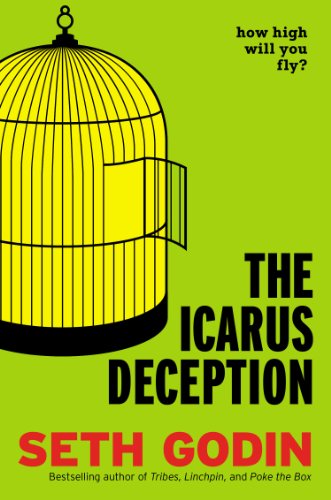

In one sentence
The industrial bargain—follow instructions, conform, and receive security—has weakened. Because creativity, judgment, trust, and human connection are harder to automate, people should choose the uncomfortable work of making art: creating something that matters to others, accepting vulnerability, and taking responsibility without a complete map.
Overview
Godin uses the Icarus story as a corrective to the conventional lesson of “don’t fly too high.” Icarus was also warned not to fly too low, where seawater would destroy the lift. Godin treats low ambition, passive compliance, and “good enough” work as a deceptively safe form of failure. His “art” is not limited to conventional artists: it means any generous, original, human act that creates connection or value. The book is structured as short, provocative reflections rather than a tightly developed linear argument.
Core ideas
The real deception is confusing safety with obedience
Rules and conformity were relatively useful in the industrial economy, where organizations needed predictable labor. Godin argues that the environment has shifted: standing out, exercising judgment, and creating relationships may now be safer career strategies than waiting to be told what to do. This is a strategic claim, not a guarantee of employment or income.
“Art” means courageous, human contribution
Art is Godin’s broad term for work involving intention, originality, emotional labor, and the willingness to make a choice without certainty. A marketer, manager, teacher, salesperson, or technician can make art when they solve a real problem in a distinctive and generous way.
Connection matters more than mass production
In the networked economy, value comes increasingly from trust, stories, audiences, and relationships—not merely from producing interchangeable widgets. The practical question becomes whether anyone cares about, shares, or is helped by what you make.
Resistance often appears as shame and fear
Godin presents fear of criticism, rejection, and embarrassment as mechanisms that keep people inside the safety zone. The answer is not eliminating fear but shipping work, learning from feedback, and treating vulnerability as part of the creative process.
Make, then make better
The book emphasizes beginning before certainty, producing work for real people, and improving through response. Creativity is framed less as a rare talent than as a practice of noticing, making, connecting, and persisting.
Practical takeaways
- Identify one part of your work where compliance is producing interchangeable results; redesign it around a specific person’s real need.
- Define the “art” of your role: the human judgment, taste, care, explanation, or connection that a process cannot easily standardize.
- Publish or deliver a small, useful version before you feel fully ready; use concrete feedback rather than imagined criticism.
- Aim higher and lower-risk at the same time: pursue meaningful originality, but test it through small experiments rather than one dramatic leap.
- Measure contribution by response and usefulness, not only by effort, credentials, or adherence to procedure.
- Build relationships around the work. In Godin’s model, an audience or community is not an afterthought but part of the value created.
Caveats and counterpoints
- The book’s economic diagnosis is broad and motivational; it can understate how much many jobs still depend on compliance, specialization, organizational politics, and material security.
- “Make art” is deliberately expansive, which makes it memorable but sometimes vague as an operating manual. The reader must supply the field-specific tactics.
- Taking creative risks is not equally affordable for everyone. Financial obligations, discrimination, unequal access to networks, and precarious employment can make experimentation costly.
- The advice can overvalue visibility and novelty. Distinctiveness is useful only when paired with competence, reliability, ethics, and a real audience need.
- A serious review found the book loose and blog-like, with ideas that may feel repetitive or less developed than in Godin’s more structured books.
Questions worth revisiting
- Where am I “flying too low”—choosing apparent security while becoming less relevant or less engaged?
- What part of my current role could become a distinctive contribution rather than a routine transaction?
- Who specifically would benefit from the work I want to make, and what evidence would show that it matters?
- What small act of generosity, originality, or leadership can I complete this week without waiting for permission?
- Which risks are genuinely necessary, and which can be reduced through a reversible experiment?
- Am I using the language of creativity to avoid the less glamorous work of practice, delivery, and improvement?
Return to this when…
Return when you are hesitating to share an unconventional idea, waiting for permission to begin, or mistaking low visibility and low ambition for safety. The central refresher is: do not merely avoid flying too high; notice when flying too low is quietly destroying your lift.
Highlights
settling for too little. It’s far more dangerous to fly too low than too high, because it feels safe to
It’s far more dangerous to fly too low than too high, because it feels safe to fly low. We settle for low expectations and small dreams and guarantee ourselves less than we are capable of. By flying too low, we shortchange not only ourselves but also those who depend on us or might benefit from our work. We’re so obsessed about the risk of shining brightly that we’ve traded in everything that matters to avoid it.
Scarcity and abundance have been flipped. High-quality work is no longer scarce. Competence is no longer scarce, either. We have too many good choices—there’s an abundance of things to buy and people to hire. What’s scarce is trust, connection, and surprise. These are three elements in the work of a successful artist.
Everybody is a genius. But if you judge a fish by its ability to climb a tree, it will live its whole life believing that it is stupid. —Albert Einstein
Malcolm Gladwell famously reported that most NHL players are born in January, February, or March. The reason, it turns out, is that when you’re eight years old, being nine months older than the other kids is a huge advantage. That advantage gets you a spot on the traveling team, more ice time, and better coaching, and it compounds. In some ways, certain Canadian boys are born to play hockey, if born means the right country and the right birthday. If your goal was to be in the NHL one day, then your zodiac sign matters a great deal. Fortunately for the rest of us (all of us?), art is not only possible; it’s inevitable if we allow it to happen.
The Assets That Matter Successful organizations have realized that they are no longer in the business of coining slogans, running catchy ads, and optimizing their supply chains to cut costs. And freelancers and soloists have discovered that doing a good job for a fair price is no longer sufficient to guarantee success. Good work is easier to find than ever before. What matters now: Trust Permission Remarkability Leadership Stories that spread Humanity: connection, compassion, and humility And here’s the thing: All six of these are the result of successful work by artists.
REMARKABILITY: The same bias toward art exists in the way we choose which ideas we’ll share with our friends and colleagues. No one talks about the boring, the predictable, or the safe. We don’t risk interactions in order to spread the word about something obvious or trite. The remarkable is almost always new and untested, fresh and risky.
The Kitten and the Monkey When a kitten gets into trouble, his mother comes and gently picks him up by the neck, rescuing him and taking him to safety. A baby monkey, on the other hand, has no choice but to grab onto the back of his mother if he wants to make an escape. One is rescued; the other rescues himself. In Japanese, tariki is the name for choosing to be helped, seeking a higher authority to select you, move you forward, and endorse you. Tariki is the helpless kitten. Jiriki, alternatively, is self-selection, self-authorized art. Jiriki is the monkey who saves himself. The industrial economy insisted on tariki. It treated workers like kittens and abhorred anyone who would add innovation or individualism to the system. The connection economy opens the door for jiriki.
Connection Doesn’t Play the Short Game Do not expect applause. Accept applause, sure, please do. But when you expect applause, when you do your work in order to get (and because of) applause, you have sold yourself short. When your work depends on something out of your control, you have given away part of your art. If your work is filled with the hope and longing for applause, it’s no longer your work—the dependence on approval in this moment has corrupted it, turned it into a process in which you are striving for ever more approval. This is tricky, so bear with me. There’s a huge difference between the shallow pleasure of instant applause and the long-lasting impact of true connection. It’s easy to market and manipulate your way into the quick smile or the Broadway-theater obligatory standing ovation. What’s more difficult is to do the less-congratulated work of getting under someone’s skin, of changing the conversation, and of being missed when you’re gone. Who decides if your work is good? When you are at your best, you do. If the work doesn’t deliver on its purpose, if the pot you made leaks or the hammer you forged breaks, then you should learn to make a better one. The purpose of your art is to connect, just as the purpose of the hammer is to strike the nail. But we don’t blame the nail for breaking the hammer or blame the water for leaking from the pot. If the audience doesn’t like this work enough to connect, there’s a mismatch. Perhaps this is the wrong work for the wrong group. Don’t fix it by pandering for a quick ovation. Fix it by going deeper. “Here, here it is; it’s finished.” If it’s finished, the applause, the thanks, the gratitude are something else. Something extra and not part of what you created. If you play a beautiful song for two people or a thousand, it’s the same song, and the amount of thanks you receive isn’t part of that song. The connection that comes after the art is appreciated lasts far longer than applause ever could and opens the door for you to work to create ever more connection, as opposed to seeking to repeat the evanescent thrill of an ovation.
Six Daily Habits for Artists Sit alone; sit quietly. Learn something new without any apparent practical benefit. Ask individuals for bold feedback; ignore what you hear from the crowd. Spend time encouraging other artists. Teach, with the intent of making change. Ship something that you created.
The Japanese term kamiwaza, like most great words for which we have no equivalent, is difficult to translate. The shortest version is “godlike.” When we strip away self-doubt and artifice, when we embrace initiative and art, we are left with kamiwaza. The purity of doing it properly but without self-consciousness.
Even Orwell was embarrassed by the egoism in his writing: “The great mass of human beings are not acutely selfish. After the age of about thirty they abandon individual ambition—in many cases, indeed, they almost abandon the sense of being individuals at all—and live chiefly for others, or are simply smothered under drudgery. But there is also the minority of gifted, wilful people who are determined to live their own lives.”
We make the art and then we get the feedback, but the art must happen first. If we’re in love with the feedback and trying to manipulate the applause we get, we’ll cease to make the art we’re capable of. When the critic pushes you to make better art, art that you are capable of, then her response is worth cherishing. But the critic who pushes you to fit in or dumb down your work—take that criticism with caution.
Attachment Kills Art It’s easy to become attached to potential outcomes. We want the cake to come out just so, or the audience to clap at this particular spot, or every single person on Yelp to like our pizza. As we become attached to these positive outcomes, we start to imagine what will happen if they don’t occur. So we alter what we make to increase the chances that they will occur. And when they don’t (and the things we get attached to never happen every time), we start to question our art and to alter it even more. And then we’re no longer making art. We’re a marionette controlled by those in power.
The Invention of Writer’s Block The term “writer’s block” was coined by Edmund Bergler less than a hundred years ago. Here’s how the affliction has become an epidemic: At this rate, there will be more stuck writers than gumshoes in just a few years. Joan Acocella reports that the resistance took over for writing just as writing became important. A hundred years earlier, it wasn’t unusual for writers like Trollope and Dickens to write forty or more books over a career—while keeping a day job. You sat down and you wrote and then you were done. Starting in the 1950s, though, when writing became godlike, when creating the great American novel had a lot of kamiwaza associated with it, the drinking started and so did the blocking. It was easier to talk about making art than it was to actually do it. And that’s where we are today, except that everything we’re counted on to do that’s important is also fraught with risk, because it flies in the face of the easy path of obedience and blame. Everything that matters is like writing, because it’s all art.
To make art, you need to remove these three external things: Control, because external control is the factory. Control means doing what you’re told, being part of the machine, a reliable cog. Control abhors grit because it gets in the way of effortless synchronization. Motivation, because if you rely on external motivation to be your best self, then you will have ceded responsibility and authority to someone else. You will be judged by how well your boss does at motivating you, not based on who you are. And approval, because the crowd is always wrong. The crowd wants bread and circuses; it wants lions and gladiators; it wants The Beverly Hillbillies and Justin Bieber. You can do better than the crowd. You can seek your own approval.
I haven’t sought out and read a review or a tweet since. This is not cowardice; it’s the act of someone who wants to keep writing and is determined to do it for an audience of his choosing.
Interact with the audience if it helps you learn to do better next time, but not if it gives the resistance an excuse to destroy your future art. Only a self-negating artist reads his Amazon reviews and the Twitter feedback on his work. He will learn nothing and will amplify his lizard brain’s certainty of his worthlessness. Figure out who your art is for, get better at connecting with that audience, and ignore the rest.
The resistance is a symptom that you’re on the right track. The resistance is not something to be avoided; it’s something to seek out. That’s the single most important sentence in this book.
Gambling with People I had a gambling addiction with people’s opinions of me. When someone says, “I don’t like that guy,” I like to sit down and talk to him, and make sure he’s not misunderstanding me, and sometimes you can save it. So it only makes sense that I would scale that up to a million. And as soon as I’d get it back to even, I started making big bets again. What I didn’t realize was that one of the best things you can do is walk away. I’ve arrived at something that I wish I’d known a long time ago, which is that I have to let people not respect me. —John Mayer, Rolling Stone, 2012
“Make good art” is Neil Gaiman’s prescription for whatever ails you. If the job market isn’t there, if your boss doesn’t respect you, if the world doesn’t get you—make good art. If it’s not working, then make better art. If you don’t know how to make better art, learn. If the people around you are sabotaging your art, ignore them. If your boss stops your art, make different art. If he stops it again, take responsibility and make different art. Keep doing it until your art gets better or you get fired, whichever happens first. And then make more art. Your art at first will be timid. It might not be based on a truly clear awareness of the world, because the lizard brain will cloud your sight in order to protect itself. But day by day, project by project, you can train yourself to ship. Ship small art. Then ship medium art. Then ship world-changing, scary,
Your art at first will be timid. It might not be based on a truly clear awareness of the world, because the lizard brain will cloud your sight in order to protect itself. But day by day, project by project, you can train yourself to ship. Ship small art. Then ship medium art. Then ship world-changing, scary, change-your-underwear art.
Steve Martin embraced the three steps. He saw, over decades behind the magic counter at Disneyland, on the stage at Knott’s Berry Farm, and traveling from club to club, how audience members interacted with one another, with the venue, and with him. He made. He kept obsessive journals. He tested and measured and repeated. Three shows a night was normal, hundreds of shows a year, year after year. Most of all, he relentlessly stuck to his blank slate. Theft was so rare for him that in his autobiography he singles out each and every time he borrowed a line from a mentor—always with their permission first. The rest of his act, the rest of his work, was determinedly original. Martin’s routine seems obvious now, trivial even, but when he created it, it was brave and new.
Don’t think! Thinking is the enemy of creativity. It’s self-conscious, and anything self-conscious is lousy. You can’t try to do things. You simply must do things. —Ray Bradbury
Learn your field, of course. Excel in domain knowledge. Have empathy for your customers, and care deeply about how your work will affect them. Yes, yes, and yes. But . . . But make what you will make. Not in anticipation of or dependence on the applause of others, and not because you are totally entangled in the results. No, make it because you are committed to making it. The commitment works because you can be sure of your intent, sure of your skills, and sure of your compassion for those who will encounter what you make. Only when you make art that isn’t for everyone do you have a chance to connect with someone. And when you connect with someone, amazingly, you increase the chances that you’ve made something that many will want.
When It’s Not Good Enough Beat This! might be the best cookbook I’ve ever read. And you will have trouble finding it, because it’s out of print. Terrific recipes, very funny . . . just the thing cookbook readers love. And yet it didn’t sell a million copies and it hasn’t been as commercially successful as it could be. So, is it not good enough? Artists need to think hard before they tag their work with labels like “unsuccessful” or “lousy” or even “great.” Is Justin Bieber a great musician? I think it depends on what we’re measuring. There’s no question that if the metric is pop hits, he’s far better than Jill Sobule or Dale Henderson. The danger is in using someone else’s ruler to measure your art. If you’re not achieving the results you seek, your definition of good might be wrong, or your art might not be as good as you think it is. Or you might not have gotten lucky this time around. So learn to see even better. Make ever better art. And do it again.
Talker’s Block No one ever gets talker’s block. No one wakes up in the morning, discovers he has nothing to say, and sits quietly, for days or weeks, until the muse hits, until the moment is right, until all the craziness in his life has died down. Why, then, is writer’s block endemic? The reason we don’t get talker’s block is that we’re in the habit of talking without a lot of concern for whether or not our inane blather will come back to haunt us. Talk is cheap. Talk is ephemeral. Talk can be easily denied. We talk poorly and then, eventually (or sometimes), we talk smart. We get better at talking precisely because we talk. We see what works and what doesn’t and, if we’re insightful, do more of what works. How can one get talker’s block after all this practice? Writer’s block isn’t hard to cure. Just write. Write poorly. Continue to write poorly, in public, until you can write better. Everyone should learn to write in public. Get a blog. Or use Squidoo or Tumblr or a microblogging site. Use an alias if you like. Turn off comments, certainly—you don’t need more criticism; you need more writing. Do it every day. Every single day. Not a diary, not fiction, but analysis. Clear, crisp, honest writing about what you see in the world. Or want to see. Or teach (in writing). Tell us how to do something. If you know you have to write something every single day, even a paragraph, you will improve your writing. The resistance, of course, would rather have you write nothing, not speak up in public, keep it under wraps. If you’re concerned only with avoiding error, then not writing is not a problem, because zero is perfect and without defects. Shipping nothing is safe. Fortunately, the second-best thing to zero is something better than bad. So if you know you have to write tomorrow, your brain will start working on something better than bad. And then you’ll inevitably redefine bad and tomorrow will be better than that. And on and on. Write like you talk. Often.
The World’s Worst Boss That would be you. Even if you’re not self-employed, your boss is you. You manage your career, your day, your responses. You manage how you sell your services and your education and the way you talk to yourself. Odds are, you’re doing it poorly. If you had a manager who talked to you the way you talked to you, you’d quit. If you had a boss who wasted as much of your time as you do, she’d be fired. If an organization developed its employees as poorly as you are developing yourself, it would soon go under. I’m amazed at how often people choose to fail when they go out on their own or when they end up in one of those rare jobs that encourages them to set an agenda and manage themselves. Faced with the freedom to excel, they falter and hesitate and stall and ultimately punt. We are surprised when someone self-directed arrives on the scene. Someone who figures out a way to work from home and then turns that into a two-year journey, laptop in hand, as he explores the world while doing his job. We are shocked that someone uses evenings and weekends to get a second education or start a useful new side business. And we’re envious when we encounter someone who has managed to bootstrap herself into happiness, as if that were rare or even uncalled for. Before you had the world’s worst boss, it’s likely you were the world’s worst teacher. We can’t rely on others to be our teachers anymore, particularly after we turn ten. No, the future belongs to individuals who decide to become great bosses (and teachers).
On Good Taste Ira Glass understands how you feel: Nobody tells this to people who are beginners, I wish someone told me. All of us who do creative work, we get into it because we have good taste. But there is this gap. For the first couple years you make stuff, it’s just not that good. It’s trying to be good, it has potential, but it’s not. But your taste, the thing that got you into the game, is still killer. And your taste is why your work disappoints you. A lot of people never get past this phase, they quit. Most people I know who do interesting, creative work went through years of this. We know our work doesn’t have this special thing that we want it to have. . . . And if you are just starting out or you are still in this phase, you gotta know it’s normal and the most important thing you can do is do a lot of work. . . . It is only by going through a volume of work that you will close that gap, and your work will be as good as your ambitions.
But Yves Klein said, “My paintings are only the ashes of my art.” For him, the creation of the work was the art, and the canvas or the photo or the fake newspaper was merely the souvenir.
Tactic: The Focus Group Not that kind of focus group. This is a group loosely based on the classic Mastermind idea created by Napoleon Hill. Find exactly three other artists—who work in different fields, who come from different backgrounds, who pursue different goals—and connect with one another about the process of your art. The object of this group isn’t to help you see better or make better art. The object is to remind you of your commitment and to push you to make your art more original, personal, and successful. When you know that you need to meet every two weeks and look a respected artist in the eye and tell her what you did (or didn’t) make, it will raise your game.
You’re a Fraud and You Know It That’s at the heart of the artist’s fear of shame. Deep down, we’re worried that we will be discovered as the frauds that we know we are. You’re not typing at eighty-nine words per minute or mixing together the same chemicals you mixed yesterday. You are daring to fly close to the sun. You are doing the new thing, the thing no one has ever dared to do before. You are saying what hasn’t been said, touching what hasn’t been touched. Of course you are a fraud. What could possibly qualify you to do this? If you don’t stand out, you’ll never need to stand up. And no one will call you on what you say or what you do or what you believe. You’re back in your comfort zone, but as we’ve seen, there’s no safety left there. Everyone is lonely and everyone feels like a fraud. I feel like a fraud as I type this, as I brush my teeth, and every time I go onstage. This is part of the human condition. Accepted. Now what?
Complaining is stupid. Either act or forget. —Stefan Sagmeister
Worth Noting They will tell you that it’s easy (it’s not). They will tell you that it’s fun (it is, but only sometimes). They will tell you that you must be born with it (not true). And they will tell you that it’s not your turn (and they are wrong).
Isn’t it interesting that we never say, “I am a broken arm” or “I am cancer”? We understand that these are things that happen to us; they are not who we are. And yet we say, “I am afraid,” and “I am a failure.” Of course, afraid isn’t who we are; afraid is something that happened to us. Failure is an event, not a person. The only thing that’s clearly true is this: “You are an artist.”
The mythical Steve Jobs is often celebrated for his taste. He had, it’s said, an unerring ability to see quality, to understand what the right answer was, to consistently cleave any problem to find the one best answer. Except this isn’t at all true. Tim Cook, Apple’s CEO, recently said, “He would flip on something so fast that you would forget that he was the one taking the 180-degree polar [opposite] position the day before.” The magic of Steve Jobs wasn’t in being right. It was in being sure.
Mono No Aware Your art won’t last. And sometimes the most beautiful and important things are the ones we see fading away. Japanese scholar Motoori Norinaga coined the term mono no aware to describe the feeling we get when we see cherry blossoms wither and die, when we interact with a thing that’s important or beautiful and know that it is going away. It’s sort of a reverse nostalgia. It’s not that different from the essential concept of memento mori, a Latin term that reminds us that we’re all going to die. Understanding impermanence is the twin sister of understanding art. All art, as we’ve seen, brings something new into the world, but that newness can’t remain, or there would be no room for more art. Newness fades. The impermanence of art (and the impermanence of us, the creators of art) isn’t a bad thing, any more than the tail of a coin is a bad thing when you’re hoping for heads. You can’t have one without the other. The man who invented the ship invented the shipwreck. The creation of art also means the fading of art, and the realization that the act of making it last forever is also the act of destroying what made it work in the first place.
Learn to sell what you’ve made. Say thank you in writing. Speak in public. Fail often. See the world as it is. Make predictions. Teach others. Write daily. Connect others. Lead a tribe.
Bill Murray on Improv . . . You’ve gotta go out there and improvise and you’ve gotta be completely unafraid to die. You’ve got to be able to take a chance to die. And you have to die lots. You have to die all the time. You’re goin’ out there with just a whisper of an idea. The fear will make you clench up. That’s the fear of dying. When you start and the first few lines don’t grab and people are going like, “What’s this? I’m not laughing and I’m not interested,” then you just put your arms out like this and open way up and that allows your stuff to go out. Otherwise it’s just stuck inside you. The essential lesson from Bill’s riff is that you’re not going to die. Not really. It only feels that way. The resistance will manufacture whatever emotions it can to persuade you to avoid dying, or anything that feels like dying. It’s pointless to deny these emotions, but you can embrace them.
now. The apocryphal story about Columbus is that after he returned from a voyage, the naysayers in the elite were giving him a hard time about his trip, pointing out that if he hadn’t done it, well, someone else would have done it anyway. It was inevitable, no big deal. According to a book written in 1565, this is how he dealt with his critics: Columbus did not respond to these words but asked for a whole egg to be brought to him. He placed it on the table and said: “My lords, I will lay a wager with any of you that you are unable to make this egg stand on its end like I will do without any kind of help or aid.” They all tried without success and when the egg returned to Columbus, he tapped it gently on the table breaking it slightly and, with this, the egg stood on its end. All those present were confounded and understood what he meant: that once the feat has been done, anyone knows how to do it. Quit chasing. It’s easy, it’s ineffective, and you’re better than that.
And some (I won’t call them artists) will eagerly listen to every criticism and work to water down the art to pander to the largest possible audience. For this person, market share means more than art does. And so we see old Elvis become a Las Vegas parody and old Judy Garland hit bottom onstage. They started as artists intent on changing the status quo for a tribe who cared but grew into mass-market entertainers instead.
The Good Fail: How Does the Organization Get Boring? David Puttnam, exiled Hollywood chieftain, is credited with this law: “It is more acceptable to fail in conventional ways than in unconventional ways. And its corollary: The reward for succeeding in unconventional ways is less than the risk of failing in unconventional ways. In short, you can screw up with impunity so long as you screw up like everybody else.” When we talk about failure to those raised in the industrial age, they have trouble finding artistic ways to think about it. They understand the common failure, the acceptable failure, the easy failure because that’s the failure that has been done before, and they believe that this is the failure that’s being requested. But boring is the result. This is the failure of a new flavor of Domino’s pizza or a new variation of a Dell computer or the tepid reaction to the latest Corvette. They are boring failures because there wasn’t much risk in the first place. Remarkable comes from being able to risk an entirely new kind of failure, the failure that comes with a new risk. When you take the new risk, you open the door to an entirely new form of success.
My new favorite word in German is funktionslust. It describes the love of doing something merely for the sake of doing it, not simply because it’s likely to work. It’s the player who wants to come in off the bench even though it’s too late to win the game and the chef who puts extra care into an omelet that someone ordered for seven dollars from the late-night hotel menu. Not because it’s his job but because he can. Artists play. We don’t analyze our return on investment or seek shortcuts. We are playing, not working, and the long way is often the best way to get to where we’re going, because sometimes we’re not going anywhere.
Someone asked me what advice I would give to my twenty-two-year-old MBA self. Most people, apparently, tell their earlier selves to buy Google stock, marry the rejected boyfriend, or move to a certain town—things they could do that would change the course of their life if they had to do it over. I wouldn’t change a thing, even the epic professional disasters, because every one of them is responsible for what I get to do now, and I can’t imagine a better gig. But the one thing I wish I had known then was that whatever happens, things are going to be fine in the end, that the pain is part of the journey, and that without the pain there really isn’t a journey worth going on. It’s not all okay because everything works. As we all know, everything doesn’t work. No, it doesn’t all work, but you always get to dance. Win or lose, you get to play. I would tell myself not to put so much emotional baggage on every project and every interaction. The goal is to keep playing, not to win. Reassurance doesn’t scale, and being told that every project is going to work isn’t helpful. What is useful is knowing that the journey is the point, and that the day my laptop started on fire in the middle of a sales call, the time I was threatened with arrest by a vice president at AOL, the nearly missed payrolls and the empty stares—all of those things are part of the art. At the end of a project, the end of the day, and the end of the game, you can look yourself in the mirror and remind yourself that at least you got to dance.
ANXIETY is experiencing failure in advance. Tell yourself enough vivid stories about the worst possible outcome of your work and you’ll soon come to believe them. Worry is not preparation, and anxiety doesn’t make you better.
COMMITMENT is the only thing that gets you through the chasm. Commitment takes you from “That’s a fine idea” to “It’s done.” Commitment is risky, because if you fail, it’s on you. But without commitment, you will fail, because art unshipped isn’t art.
TETHER is the safety cable you refuse to use. Art feels fatal, because art makes us vulnerable. The Flying Wallendas, the legendary trapeze-swinging and tightrope-walking family, have a slogan: “If we fall, we die.”
References
- The Icarus Deception | Seth Godin | Soundview Summary
- books.google.com
- The Icarus Deception Summary of Key Ideas and Review | Seth Godin - Blinkist
- The Icarus Deception: How High Will You Fly? | Library Journal
- The Icarus Deception by Seth Godin: 9781591846079 | PenguinRandomHouse.com: Books
- The Icarus Deception Summary | SuperSummary
- bookbrief.io
- goodreads.com
- books.google.com
- public.summaries.com
- blog.ted.com
- libcat.arlingtonva.us