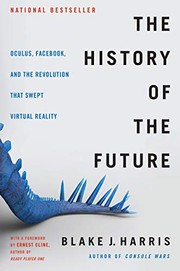

In one sentence
Harris’s central story is that Oculus revived virtual reality not through one breakthrough alone, but through the convergence of an obsessive prototype builder, unusually committed engineers, influential evangelists, community funding, and eventually Facebook’s capital and platform ambitions. The acquisition solved problems of scale while creating new tensions over independence, mission, ownership, and culture.
Overview
The book follows Palmer Luckey’s path from hobbyist VR experimentation to Oculus; the company’s formation around Brendan Iribe, Michael Antonov, Nate Mitchell, and others; its Kickstarter campaign and developer ecosystem; John Carmack’s involvement; the arrival of venture capital and manufacturing pressures; and the sale to Facebook. The documented edition is a 2019 first edition of about 500 pages, with a foreword by Ernest Cline.
Core ideas
Breakthroughs are often assemblages, not solitary inventions
Luckey’s prototype mattered, but Oculus became viable through many complementary contributions: optics, displays, tracking, software, industrial design, fundraising, public demonstrations, and developer relations. The practical lesson is to look for the network that turns a promising artifact into a usable platform.
Community validation can precede institutional legitimacy
The Kickstarter campaign helped demonstrate demand and attract attention before traditional technology companies fully committed. Crowdfunding functioned not only as financing but also as publicity, market evidence, and a recruiting mechanism for developers and enthusiasts. Later scholarship likewise identifies Kickstarter-backed Oculus as a major step in VR’s revival.
Evangelists can change an industry’s timetable
John Carmack’s public demonstrations and technical credibility helped make VR feel newly attainable rather than merely science fiction. His involvement connected Oculus to the game-development world and gave the project a powerful signal of seriousness; contemporary research identifies his 2012 DOOM 3 demonstration as a pivotal public moment.
Scaling a mission changes the mission
Facebook’s acquisition supplied resources for hardware, software, hiring, and distribution, but it also shifted Oculus from a focused gaming startup toward a component of a broader social-computing strategy. Later analysis describes Facebook’s VR framing as an extension of its platform and social software, rather than primarily a gaming product.
Founder control and corporate control are different kinds of power
The narrative highlights the gap between inventing a product, building a company, and retaining authority over its future. Equity, board structures, acquisition terms, executive relationships, and cultural fit can matter as much as technical merit. The book’s business-history value lies in showing those pressures through people rather than abstract corporate theory.
A future-oriented technology is also a political project
VR was repeatedly presented through promises of immersion, presence, empathy, and social connection. Critics argue that Facebook’s later vision also carries assumptions about data, platform control, moderation, and whose social norms become embedded in the medium. Those concerns are interpretations of Facebook’s post-acquisition trajectory, not necessarily Harris’s own thesis.
Practical takeaways
- When evaluating a startup story, separate the invention, the product, the company, and the platform; each requires different capabilities and creates different incentives.
- Treat early users and developers as infrastructure, not merely customers. Their experiments can reveal use cases, expose weaknesses, and create legitimacy.
- Watch what an acquisition changes: reporting lines, decision rights, product priorities, public identity, and the definition of success.
- For ambitious technology, ask two questions at once: Can it work technically? Who gains control if it succeeds?
- Use cinematic founder narratives cautiously. They make technological change memorable, but they can overemphasize charismatic individuals relative to teams, suppliers, standards, capital, and prior research.
Caveats and counterpoints
- This is a reported narrative history, not a neutral technical survey of virtual reality or a complete history of the field. Library descriptions identify its focus as Luckey, Oculus, Facebook, and the company’s early attempt to bring VR to consumers.
- The book was published in 2019, so it ends before much of the subsequent development of consumer VR, mixed reality, and Facebook’s later corporate evolution. Do not use it as a current account of the market.
- Harris relies heavily on interviews and reconstructive storytelling. Memorable scenes and sharply drawn personalities should be read as reported interpretation, not automatically as exhaustive or independently verified history.
- The book’s emphasis on Oculus can make the revival of VR appear more founder-centered than the wider technical history warrants; earlier research institutions, display advances, tracking work, game engines, and adjacent companies also mattered.
- Later academic criticism adds a perspective that the book cannot fully incorporate: Facebook’s social-VR vision may expand platform power and data extraction while presenting itself as connection and intimacy.
Questions worth revisiting
- Which parts of Oculus’s success were genuinely contingent on Luckey, and which were likely to emerge from broader advances in displays, mobile sensors, GPUs, and game development?
- Did Facebook provide the scale needed to make VR mainstream, or did its ownership constrain Oculus’s original gaming-centered identity?
- How much should a founder’s personal politics affect judgments about a company’s products, governance, and acquisition?
- What does the Oculus case suggest about whether crowdfunding preserves independence—or merely accelerates a startup toward acquisition?
- If VR becomes a social platform, what forms of bodily, spatial, and behavioral data should users control?
Return to this when…
Return to these notes when assessing founder-led technology histories, startup acquisitions, platform strategy, or claims that a new medium will transform everyday life. Pair the book with a later critical account of Facebook/Oculus to compare the company’s internal origin story with concerns about platform power, privacy, moderation, and data extraction.