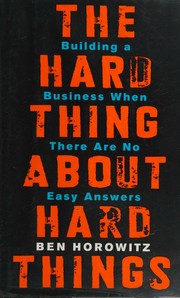

In one sentence
The defining work of a CEO is not applying a reliable formula; it is making consequential decisions when every option is costly, information is incomplete, and the organization is under pressure. Leadership therefore requires facing reality, choosing a path, communicating clearly, and sustaining the company through the struggle.
Overview
Horowitz combines autobiographical episodes from Loudcloud/Opsware with practical chapters on layoffs, firing or demoting executives, culture, hiring, communication, product decisions, and CEO psychology. The structure is closer to an operator’s field guide and collection of hard-earned cases than to a single systematic theory.
Core ideas
The struggle is the job
Periods of fear, declining performance, and apparent impossibility are not interruptions to leadership; they are where leadership is tested. The useful question is less “What is the perfect answer?” than “What action gives the company a path to survive?”
Tell it like it is
Employees need an accurate account of the situation, the decision being made, and what happens next. Candor is not emotional dumping: the leader must provide clarity and confidence without pretending the problem is smaller than it is.
People, products, profits—in that order
Horowitz treats strong people and a functioning product as the foundations that eventually produce profits. This does not mean ignoring economics; it means recognizing that short-term financial pressure can tempt leaders to damage the capabilities needed for recovery. The book’s contents explicitly foreground this ordering.
Match leadership mode to the situation
“Peacetime” leadership develops people, systems, and innovation under relatively stable conditions; “wartime” leadership concentrates authority, narrows priorities, and acts decisively against existential threats. The distinction is useful, but switching modes too often can create fear and suppress initiative.
Management systems must fit the company’s bottleneck
As a company scales, informal coordination fails. Leaders need explicit responsibilities, appropriate meetings, hiring standards, performance processes, and communication mechanisms—but should solve the actual constraint rather than install fashionable bureaucracy.
Use direct action when problems are existential
In crises, incremental improvements may be insufficient. Horowitz’s “lead bullets” idea favors multiple concrete product or operational improvements when there is no single silver bullet. The approach demands disciplined prioritization; otherwise, urgency becomes scattered activity.
Hard personnel decisions are managerial responsibilities
Layoffs, executive firings, and demotions should be handled directly and respectfully by the CEO or responsible manager. Loyalty, friendship, or past performance cannot substitute for current role fit, but decisions should be explained honestly and executed with dignity.
The CEO’s psychology affects the organization
Fear and uncertainty are contagious, but so are composure and determination. The leader must acknowledge difficulty while preventing private anxiety from becoming public paralysis. This is emotional regulation in service of organizational clarity—not forced optimism.
Practical takeaways
- When a company is in trouble, write down the actual constraint, the worst credible consequence, and the few actions that could materially change the outcome.
- Before hiring or promoting, define the capabilities required by the next stage—not merely the traits that worked in the previous stage.
- Ask what the organization is failing to do, not only what it is doing badly; neglected priorities often reveal the real bottleneck.
- Communicate bad news directly: what happened, why it matters, what has been decided, and what people should expect next.
- Separate friendship and loyalty from role performance. A person can be valuable and still be wrong for a particular job at the company’s current scale.
- Treat culture as behavior reinforced by leaders, incentives, and decisions—not as slogans or perks.
- In a crisis, reduce the number of priorities and increase the frequency and specificity of communication.
- Use the book’s cases as prompts for judgment, not as universal recipes; context determines whether a tactic is appropriate.
Caveats and counterpoints
- The advice is rooted heavily in venture-backed Silicon Valley technology companies and in Horowitz’s experiences at Loudcloud and Opsware; it generalizes less cleanly to nonprofits, public agencies, small lifestyle businesses, or heavily regulated industries.
- The book’s episodic, blog-derived structure can make its lessons feel more like forceful essays than a fully integrated management framework.
- Its wartime language and emphasis on decisive CEO authority may be useful during genuine existential threats but harmful if used to justify intimidation, secrecy, or permanent emergency mode.
- Personal experience supplies vivid evidence but not controlled proof. Horowitz’s successful outcomes do not establish that every recommended tactic caused success or will transfer to another organization.
- The book focuses more on surviving and operating through crises than on market discovery, finance, governance, labor law, or the broader social effects of company decisions.
Questions worth revisiting
- Which current problem is genuinely existential, and which merely feels urgent?
- What truth about the company are people already inferring but leadership has not stated plainly?
- Does the organization need more effort, a different product, a different leader, or a narrower objective?
- Which roles are failing because of the person, and which are failing because the role itself has changed?
- Am I using “wartime” behavior because circumstances require it, or because it is more psychologically comfortable than collaborative leadership?
- What would respectful execution of the necessary unpopular decision look like?
- Which lesson in the book depends most on a Silicon Valley funding, labor, or competitive context that my organization does not share?
Return to this when…
Return to the chapters on “The Struggle,” layoffs, executive performance, wartime leadership, organizational design, and CEO psychology when facing a painful people decision, a major product or strategy failure, rapid scaling, or a crisis in which no option is good. Use it as a reality check against polished startup narratives—not as a step-by-step operating manual.
Highlights
This was the first time that I started to understand the importance of founders running their companies.
References
- The Hard Thing About Hard Things by Ben Horowitz | Open Library
- The Hard Thing About Hard Things | Andreessen Horowitz
- books.google.com
- thecriticalthoughtlab.com
- pmnorthstar.in
- iffaglobal.com
- Review: The Hard Thing About Hard Things — Ben Horowitz
- inigomedina.co
- readever.app
- briansnotes.io
- glasp.co
- static1.squarespace.com