
In one sentence
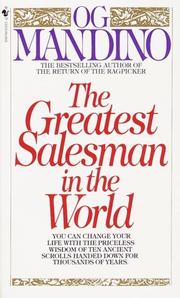
The book’s central claim is that effective selling begins with self-command and character: repeated habits, persistence, generosity, emotional balance, and purposeful action matter more than technique alone. “Greatness” is framed less as accumulating wealth than as becoming worthy of trust, love, peace of mind, and influence.
Overview
Set in a biblical-era trading world, the story centers on Hafid’s ambition and his relationship with the merchant Pathros. The narrative provides a fictional frame for ten scrolls of instruction, each emphasizing a way of living as much as a way of selling. Mandino asks the reader to treat the scrolls as practices rather than information: read, repeat, internalize, and act. The book is commonly presented as both a sales guide and a general philosophy of success.
Core ideas
Habits are stronger than intentions
The scrolls treat behavior as something deliberately trained. Instead of waiting to feel motivated, the reader is encouraged to repeat constructive actions until they become a new default. The book’s prescribed reading ritual reinforces this message by making consistency part of the method.
Persistence must become a temperament
Rejection and setbacks are treated as ordinary conditions of selling and of life, not as verdicts on personal worth. Hafid’s progress depends on continuing after disappointment while learning from experience rather than surrendering to it.
Emotional self-government
The salesman must avoid being ruled by alternating excitement, fear, anger, discouragement, or overconfidence. Mandino’s ideal is not emotional numbness but the ability to meet changing circumstances without letting temporary feelings dictate every action.
Selling is relational and ethical
The book broadens “selling” into persuading, communicating value, and offering something useful to another person. Its moral emphasis is important: success is linked to love, generosity, service, and being trusted—not merely to extracting money from customers.
Individual worth can be developed
Mandino repeatedly presents the self as raw material whose value can be multiplied through effort, imagination, discipline, and contribution. This is an empowering idea, but it also places heavy responsibility on the individual for outcomes that may depend on circumstance.
A fable of transmission
The scrolls make knowledge portable: wisdom is preserved through ritual and passed from mentor to student. The mentor–apprentice structure gives the book its mythic quality and suggests that achievement carries an obligation to transmit useful knowledge rather than keep it private.
Practical takeaways
- Identify one behavior you want to make automatic, and practice it consistently instead of collecting more advice.
- Separate a temporary result—especially rejection—from a judgment about your identity or potential.
- Before persuading someone, clarify what genuine value you are offering them.
- Notice which emotions most often control your decisions; name them before acting on them.
- Define success in terms broader than income: trust, usefulness, love, autonomy, and peace of mind all appear in the book’s value system.
- Revisit the book as a ritual or reflective text only if repetition helps you act; its method is intentionally more devotional than analytical.
Caveats and counterpoints
- The book is inspirational rather than evidence-based. Its claims about habit, persistence, and personal transformation are presented as moral wisdom and fable, not as findings from psychology or sales research.
- Its ancient setting, grand language, providential outlook, and idealized rise from poverty can feel emotionally powerful to some readers and simplistic or overly saccharine to others.
- The title and wealth-centered premise can suggest aggressive salesmanship, but the book’s stated ideal is broader and more ethical: becoming a better person who creates value and earns trust.
- The work is often catalogued and marketed as inspirational self-help or a sales parable, even though some collections place it under fiction because its instruction is embedded in a novella-like narrative. The classification depends on cataloguing emphasis, not on a wholly different text.
- This note covers the original book, first published in 1968, not Mandino’s later sequel, The Greatest Salesman in the World Part II: The End of the Story.
Questions worth revisiting
- Which of the ten scrolls’ principles still feels demanding rather than merely familiar?
- Where does persistence become wisdom, and where might it become refusal to accept useful feedback?
- Does the book’s idea of selling preserve the customer’s freedom, or does its motivational language sometimes blur persuasion and pressure?
- What does the book leave out about luck, structural inequality, market conditions, and unequal access to opportunity?
- Would the scroll-reading ritual change your behavior, or mainly create the feeling of commitment?
- How convincing is the book’s equation of personal worth with disciplined self-development and usefulness?
Return to this when…
Return when you want a short, ritualistic motivational read about habits, resilience, emotional discipline, and ethical persuasion—or when you need to examine whether your definition of success has narrowed to money and performance.
Highlights
The lad fell to his knees and grasped Pathros’ robe. “Sire, sire! How can I say the words to show my thanks?” Pathros freed himself from Hafid’s grip and stepped back. “I would suggest you withhold thy thanks for the present. Whatever aid I give thee will be as a grain of sand compared to the mountains you must move for yourself.”
“Failure will never overtake you if your determination to succeed is strong enough.”
Thus, the first law I will obey, which precedeth all others is—I will form good habits and become their slave.
If I persist, if I continue to try, if I continue to charge forward, I will succeed. I will persist until I succeed. I was not delivered unto this world in defeat, nor does failure course in my veins. I am not a sheep waiting to be prodded by my shepherd. I am a lion and I refuse to talk, to walk, to sleep with the sheep. I will hear not those who weep and complain, for their disease is contagious. Let them join the sheep. The slaughterhouse of failure is not my destiny. I will persist until I succeed.
Henceforth, I will consider each day’s effort as but one blow of my blade against a mighty oak. The first blow may cause not a tremor in the wood, nor the second, nor the third. Each blow, of itself, may be trifling, and seem of no consequence. Yet from childish swipes the oak will eventually tumble. So it will be with my efforts of today.
And most of all, I will laugh at myself for man is most comical when he takes himself too seriously.
Will my concern for this day not seem foolish ten years hence? Why should I permit the petty happenings of today to disturb me? What can take place before this sun sets which will not seem insignificant in the river of centuries? I will laugh at the world.
Never will I be of concern that my goals are too high for is it not better to aim my spear at the moon and strike only an eagle than to aim my spear at the eagle and strike only a rock?
References
- The Greatest Salesman in the World by Og Mandino: 9780593976746 | PenguinRandomHouse.com: Books
- en.wikipedia.org
- supersummary.com
- gradesaver.com
- The greatest salesman in the world. by Og Mandino | Open Library
- blinkist.com
- audible.com
- goodreads.com
- books.google.com
- bookrecap.net
- frozentoothpaste.com
- goodreads.com