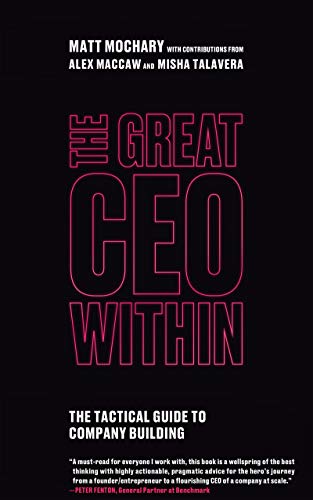

In one sentence
Great CEOs are not primarily born with exceptional judgment; they build systems that improve information flow, accountability, decision quality, feedback, and execution. The CEO’s job is to create an organization that can repeatedly make good decisions and operate effectively without depending on the CEO’s constant intervention.
Overview
The book is a compact field manual organized around eight areas: starting the company, individual habits, group habits, infrastructure, collaboration, business processes, functional departments, and appendices. It moves from principles to copyable processes to suggested language for recurring situations. Its strongest emphasis is operational discipline: write things down, assign ownership, define outcomes, measure performance, and resolve issues explicitly.
Core ideas
The CEO creates leverage through systems
The central shift is from personally solving every problem to designing repeatable mechanisms: clear responsibilities, written decisions, goal tracking, useful meetings, feedback loops, and documentation. The organization should become less dependent on tacit knowledge and individual heroics.
Write before talking
Important updates, proposals, issues, and decisions should be written before meetings. Writing improves thought quality, makes disagreement visible, lets participants prepare asynchronously, and turns meetings into decision-making sessions rather than information-dumping sessions. Mochary argues that this can dramatically shorten meetings while improving their effectiveness.
Decision rights must be explicit
Seek input broadly when it is valuable, but do not confuse consultation with consensus. The book’s RAPID-style process assigns roles for recommending, providing input, deciding, and executing; once the decision-maker decides, the outcome and next actions are documented and published. This prevents recurring debates and ambiguous accountability.
Accountability requires precise agreements
An agreement should specify what will happen, who owns it, and when it is due—precisely enough that an outside observer could determine whether it was fulfilled. Vague intentions create avoidable conflict because people can sincerely interpret them differently.
Feedback is a management infrastructure
Feedback should flow upward and downward, regularly and concretely. A recurring structure separates accountability, coaching, and transparency: review commitments, surface obstacles and proposed solutions, then discuss what the manager should continue or change. The CEO must actively solicit uncomfortable feedback and respond visibly to it.
Scale by clarifying ownership
Areas of Responsibility, directly responsible individuals, key metrics, and documented processes reduce coordination costs as the team grows. The goal is to avoid single points of failure and ensure every important outcome has a clear owner, even when several people contribute.
Hire, onboard, and exit decisively
Recruiting is only half the work: onboarding should include a written checklist, context, a 90-day plan, and early support. When someone continues to underperform despite clear expectations and feedback, prolonged tolerance damages morale and execution. The book favors decisive action, while noting the need for appropriate documentation and legal care.
Measure the company with a small set of KPIs
Each major function should have one or two meaningful indicators that reveal performance and problems quickly. Metrics are intended as management instruments, not decorative dashboards: they should prompt investigation, ownership, and action.
Practical takeaways
- Run a weekly review: identify the single highest-value goal, review commitments, and compare time spent with the work where you create unique value.
- Before a decision meeting, require a written problem statement, proposed solution, relevant evidence, and explicit decision-maker.
- For every recurring meeting, define its purpose, required preparation, attendees, cadence, and expected output.
- Give each major responsibility one clear owner, measurable outcomes, and a due date or review cadence.
- Use a written “like / wish” feedback format in one-on-ones and ask specifically for feedback the other person may be reluctant to give.
- Create a company wiki or shared folder containing strategy, goals, decisions, processes, onboarding material, and key metrics.
- For new hires, prepare a role scorecard, onboarding checklist, 90-day plan, and named buddy before or immediately after the start date.
- When a problem is raised, require a proposed solution or at least a next investigative step; do not let meetings become complaint repositories.
Caveats and counterpoints
- The book is optimized for young, technical, fast-growing, venture-backed startups. Its systems may be excessive for a small lifestyle business, a stable organization, or a team whose work depends more on craft and exploration than operational throughput. This limitation is also reflected in reader criticism that some recommendations assume hypergrowth conditions.
- Many recommendations are presented forcefully and with limited empirical qualification. Treat them as operating hypotheses to test, not universal laws—especially advice about co-founder splits, meeting overhead, hiring thresholds, and organizational design.
- Written processes improve clarity but can become bureaucratic. Use the lightest version that solves the coordination problem; do not turn every low-stakes decision into a document-heavy ritual.
- The book’s emphasis on accountability and decisiveness can underweight psychological safety, power differences, cultural context, and the possibility that poor performance reflects flawed role design or incentives rather than an inadequate employee.
- Mochary explicitly points readers toward other works for deeper treatment of entrepreneurship, management, productivity, and related topics; this book is best understood as a broad checklist and implementation guide, not a comprehensive treatment of every subject.
Questions worth revisiting
- Which recommendations fit the company’s current size and operating environment, and which are premature?
- Where does the organization currently rely on the CEO’s memory, availability, or personal relationships to function?
- Which recurring decisions lack a clear decision-maker or written record?
- Do the company’s KPIs measure meaningful outcomes, or merely activity that is easy to count?
- Is meeting and documentation overhead producing better decisions, or has process become an end in itself?
- What uncomfortable feedback would employees give if they believed it would be welcomed and acted upon?
- Which role, process, or customer relationship represents the greatest current single point of failure?
Return to this when…
Return to this book when a startup is moving from informal founder coordination toward a larger team; when meetings, ownership, or execution are becoming unreliable; when onboarding and feedback are inconsistent; or when the CEO is becoming the bottleneck. Use it as a diagnostic checklist and source of templates, not as a doctrine to implement wholesale.