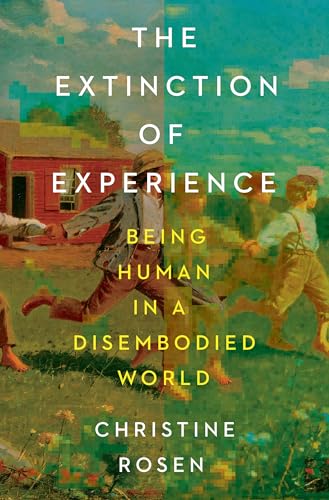

In one sentence
Rosen’s central claim is that convenience-driven digital mediation is causing important human experiences to wither—not because technology is uniformly harmful, but because platforms and devices increasingly replace direct, embodied, unpredictable encounters with personalized, frictionless substitutes. Recovering human flourishing therefore requires conscious limits and protection of experiences that technology cannot adequately reproduce.
Overview
The book examines a cluster of losses rather than one narrowly defined phenomenon. Its seven chapters move through being physically present, face-to-face interaction, handwriting and bodily skill, waiting, intuition and embodied perception, digitally mediated pleasures, and the role of place and serendipity. Rosen connects these changes to a broader cultural shift: people increasingly treat reality as customizable data and themselves as users of engineered experiences.
Core ideas
Mediation changes the experience, not merely the delivery system
A video call, app-mediated transaction, or quantified bodily metric may provide access to an activity while removing physical cues, friction, context, and unpredictability. Rosen’s concern is qualitative: replacing direct experience can alter what people learn to notice, value, and expect.
Convenience has become a cultural ideal
Digital systems promise seamlessness, speed, personalization, and control. Rosen argues that these benefits can make inconvenience appear pointless, even when inconvenience is the condition for patience, resilience, discovery, or richer attention. The danger is not efficiency itself but treating efficiency as the highest good.
Embodiment supports social understanding
Face-to-face encounters communicate through timing, gesture, expression, posture, shared space, and bodily presence. When interaction moves primarily through text, feeds, reactions, or avatars, people may lose practice reading these signals and may find mediated interaction easier precisely because it demands less vulnerability.
Boredom and waiting are formative experiences
Constant access to entertainment and information eliminates intervals in which attention wanders, anticipation develops, or thought becomes self-directed. Rosen treats waiting not simply as wasted time but as a discipline that exposes people to contingency and helps cultivate inner life.
Some human pleasures depend on resistance and risk
Eating, travel, sex, art, conversation, and exploration are diminished when they are optimized into predictable, trackable, or remotely consumable experiences. Their value often lies in sensory richness, shared presence, effort, and the possibility that events will not conform to a plan.
Technology is ambivalent, not neutral or automatically progressive
Rosen rejects the assumption that newer tools necessarily improve human life. Technologies embody incentives and assumptions; platforms optimized for engagement, surveillance, or monetization can reshape users’ desires while presenting that reshaping as personal choice.
The remedy is intelligent limitation
The conclusion is not total rejection of technology. Rosen calls for more critical, mindful use and for defending domains—physical presence, handwriting, public space, unrecorded experience, and unscripted interaction—that should not be surrendered simply because digital substitutes are cheaper or easier.
Practical takeaways
- Ask what a digital substitute removes, not only what it adds: bodily cues, memory, skill, patience, privacy, or shared context.
- Preserve activities that require physical presence and cannot be fully optimized: meals with others, handwritten notes, unmediated conversation, walking without audio, and time in unfamiliar places.
- Treat boredom and waiting as deliberate practice: leave some transitions unfilled rather than automatically reaching for a screen.
- Use metrics as information, not as a replacement for judgment or bodily awareness.
- Create personal and institutional defaults that protect attention and presence—for example, device-free meetings, classrooms, meals, and cultural experiences.
- When evaluating a new tool, ask whether it expands human agency or trains users to accept the platform’s preferred behavior.
Caveats and counterpoints
- The book’s category of “mediating technologies” is broad, encompassing smartphones, algorithms, wearables, virtual reality, platforms, and possible implants. This breadth gives the argument range but can make its causal claims less precise.
- Rosen’s examples are strongest as cultural warnings and illustrations; they do not always establish that technology itself caused the social or psychological outcome described.
- The book sometimes treats “real,” “direct,” and “embodied” experience as obvious goods without fully distinguishing beneficial mediation from harmful substitution. Reading, photography, telemedicine, and online communities can also deepen access and connection.
- A serious criticism is that the chapters can feel like a catalogue of related complaints rather than a single tightly demonstrated theory of embodiment. The Washington Post review also argues that the book offers too little sustained description of the sensory pleasures it urges readers to defend.
- The book’s “we” is intentionally collective, but experiences of technology vary substantially by age, disability, class, work, geography, and access. A general diagnosis can obscure cases where digital mediation is enabling rather than alienating.
Questions worth revisiting
- Which experiences are genuinely being lost, and which are merely changing form?
- When does mediation protect human flourishing—for example, by increasing access—and when does it replace a valuable form of presence?
- What evidence would distinguish technology’s effects from broader changes in institutions, economics, education, or family life?
- Which limits should be personal choices, and which should be built into schools, workplaces, public spaces, or platform regulation?
- Can a defense of embodied life avoid nostalgia for a past that was never equally shared or accessible?
- What would it mean to preserve serendipity and boredom in systems designed to predict and fill attention?
Return to this when…
Return to this book when evaluating a new convenience technology, designing device boundaries, or thinking about why an activity feels thinner after moving online. The most useful reminder is to inspect the experience being displaced—not just the task being made easier. The U.S. edition was published by W. W. Norton on September 10, 2024; the table of contents identifies the seven thematic chapters summarized above.
References
- THE EXTINCTION OF EXPERIENCE | Kirkus Reviews
- goodreads.com
- Christine Rosen’s ‘Extinction of Experience’ bemoans digital technology - The Washington Post
- goodreads.com
- discover.knoxcountylibrary.org
- boulder.marmot.org
- openlibrary.org
- steamboatlibrary.marmot.org
- openlibrary.org
- mitpressbookstore.mit.edu
- The Extinction of Experience: Reclaiming Our Humanity in a Digital World - Christine Rosen - Google Books
- leonardo.info
- cdn.penguin.co.uk