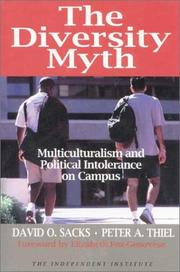

In one sentence
The authors’ central claim is that “diversity,” as implemented by universities in the 1980s and 1990s, often meant less viewpoint diversity and more enforced conformity. Using Stanford as its main case study, the book argues that multicultural programs displaced a shared Western curriculum with identity-based politics, weakened academic standards, and legitimized censorship or ideological discipline. The book’s position is explicitly adversarial, not neutral social-science analysis.
Overview
Core ideas
Diversity can conceal conformity
The book distinguishes demographic variety from intellectual or political diversity. Its recurring accusation is that universities celebrate difference in identity while narrowing acceptable opinions, especially on race, gender, sexuality, and the meaning of Western civilization.
Stanford as a case study
Rather than surveying American higher education systematically, the authors build an extended case around Stanford. They draw on student journalism, course materials, official publications, and campus controversies to show how administrative priorities, housing, curricula, and student activism interact.
Curriculum is a political institution
The authors argue that course requirements and academic fields are not merely educational choices: they communicate judgments about which traditions, identities, and historical narratives deserve authority. They portray the replacement of a common Western curriculum with identity-centered courses as a loss of shared intellectual standards.
Relativism and moral authority
A major concern is that multicultural rhetoric can reject universal standards while still treating some political conclusions as non-negotiable. In the authors’ interpretation, this creates a hierarchy in which claims associated with protected groups receive deference and dissenters are treated as morally suspect.
Administrative power amplifies activism
The book portrays university administrators as converting activist demands into durable rules, programs, speech restrictions, and institutional incentives. The result, it argues, is not simply student protest but an official culture that rewards ideological alignment.
The authors’ proposed alternative
Their implied remedy is a return to academic standards, open debate, viewpoint pluralism, and a more confident engagement with Western intellectual traditions. They favor genuine diversity of opinion over mandatory ideological inclusion, though the book gives less sustained attention to how universities should address real exclusion or historical injustice.
Practical takeaways
- Read the book primarily as a historical polemic and an archive of 1990s campus controversies, not as a balanced account of multiculturalism.
- When evaluating a diversity initiative, separate its stated goal from its mechanism: Does it broaden participation and viewpoints, or require adherence to a preferred analysis of race, gender, or power?
- Ask whether a common curriculum is being abandoned, revised, or supplemented. These are different changes with different educational consequences.
- Use the book’s distinction between demographic, intellectual, political, and economic diversity as a diagnostic tool; institutions may improve one while reducing another.
- Check whether claims about Stanford generalize to other universities. The book’s evidence is detailed but concentrated in one institution and one period.
- The book is useful for examining how speech rules, curriculum design, student activism, and administrative incentives can reinforce one another.
Caveats and counterpoints
- The argument is strongly ideological and often treats “multiculturalism” as a unified movement rather than distinguishing among pluralism, ethnic studies, anti-discrimination policy, identity-based scholarship, and speech regulation.
- Its evidence is largely a case study of Stanford in the late 1980s and early 1990s. It does not establish, by contemporary social-science standards, that the described patterns represent all American higher education.
- The authors tend to frame disputes as a conflict between Western civilization and anti-Western ideology, which can obscure legitimate criticisms of inherited curricula and unequal access.
- The book contains highly controversial arguments about sexual-assault allegations. In October 2016, Peter Thiel apologized for what he called insensitive and crudely argued statements, and David Sacks also expressed regret. This is a substantive limitation, not merely a reputational footnote.
- Because the book was written roughly three decades ago, its descriptions of campus policy and terminology should not be treated as descriptions of universities in 2026.
Questions worth revisiting
- Does the book convincingly demonstrate a decline in intellectual diversity, or mainly document conflicts selected by conservative student authors?
- Which of its criticisms concern academic freedom, and which concern disagreement with the political content of scholarship?
- Can universities maintain a shared intellectual tradition while also correcting exclusions within that tradition?
- What evidence would distinguish genuine ideological conformity from ordinary institutional consensus?
- How should the authors’ strongest arguments be separated from their claims about race, gender, and sexual assault that they later repudiated or qualified?
Return to this when…
Return to this book when examining the origins of modern campus culture-war arguments, especially debates over free speech, core curricula, identity-based scholarship, and viewpoint diversity. Pair it with a contemporary defense of multicultural education and empirical research on higher-education climate; on its own, it is best remembered as a forceful primary document of 1990s conservative campus criticism, not a final assessment of diversity policy.
Highlights
We wanted to illuminate that debate with hard facts. For example, “multiculturalism,” as practiced on today's college campuses, is hardly the source of cosmopolitanism and openness that the term connotes. In practice, it has nothing to do with the study of other cultures, and it actually has resulted in budget cuts for departments teaching foreign languages. Requirements that graduating students be proficient in a foreign language have also been gutted in recent years.12 The main purpose of multiculturalism, it seems, is to propagate intellectual conformity in the name of “diversity.” Indeed, it may come as a surprise that universities have limited diversity in a number of significant ways. At the same time, they have been very successful in promoting the myth that diversity is alive and well.
To university administrators, apparently, diversity means a chorus of voices all saying the same thing. Since myths tend to evaporate if people think about
Since myths tend to evaporate if people think about them, the new restrictions essentially are designed to stop people from thinking—or at least from expressing their suspicions. Thus, if “multiculturalism” is universities’ euphemism for the myth of diversity, “political correctness” may be defined as the sad reality. We called our book The Diversity Myth to summarize the uniformity that has occurred: campuses are full of people who look different but think alike. This is not real diversity, but pseudo-diversity. Real diversity requires a diversity of ideas, not simply a bunch of like-minded activists who resemble the bar scene from Star Wars.
The first step in thinking about “diversity,” both on and off college campuses, must involve an understanding of what is actually happening. It is for this reason that the two of us wrote this book. We need to have the courage to confront “multiculturalism” and “diversity” honestly. And once the rhetoric has been stripped away, our readers can decide for themselves whether they would prefer genuine diversity on our campuses and beyond, or merely the myth of it.
Once successfully constructed at Stanford, this new multicultural community would serve as a prototype for the nation. “If we cannot succeed here,” Kennedy declared, “we cannot succeed anywhere.”8 But President Kennedy never got the chance to report on the progress of the multicultural experiment at the graduation ceremonies for the class of 1993. In August 1992, Stanford's Board of Trustees forced his resignation. The immediate cause centered on a financial scandal in which the university had misappropriated millions of dollars in federal research monies. The real reasons for this crisis of confidence, however, went far deeper: Trustees, congressional representatives, alumni, and the general public had begun to perceive that the great multicultural experiment had brought the very opposite of higher learning. It had brought speech restrictions, a new kind of intolerance known as “political correctness,” a hysterically anti-Western curriculum, the increasing politicization of student life, and campus polarization along racial and ethnic lines. Like Columbus's multicultural journey, which turned from delight to disillusionment, the Stanford community had gradually soured on multiculturalism. Before doing so, however, multiculturalism had changed the outlook of a generation of American leaders, and because it is still deeply entrenched, it continues to graduate new disciples into society who will seek to implement multicultural policies.
the same observer described the same change in diametrically
Despite the obvious parallels between the Stanford of the late 1960s and the Stanford of the late 1980s, the debate over the canon pointed to one key difference—a distinction more telling than any of the similarities: Whereas the Western Civilization program of the 1960s was replaced with nothing at all, the Western Culture program of the 1980s was replaced with Cultures, Ideas, and Values. Whereas the protestors of the 1960s failed to replace the Western tradition with anything of their own, the protestors of the 1980s and 1990s would invent a new system to put in its place. Activists insisted that “new perspectives” were needed. In accordance with these new perspectives, the conception of the academy was revamped. No longer merely an impartial refuge for those pursuing enlightenment, the university would now actively seek to promote particular ideas and values in an effort to transform society. The word for these new perspectives—and for the brave new world towards which Stanford's social engineers hope to lead America—is “multiculturalism.”
Remarkably, however, Stanford's multicultural leaders have made clear that these commonsense answers are not the ones they have in mind. As understood at Stanford, multiculturalism has next to nothing to do with a thorough study of other cultures. Confucius and Solzhenitzyn are nowhere on the list of multicultural priorities. Chinese, Japanese, Slavic, Indian, Arabic, African, or Latin American cultures have nothing to do with the OMD's vision of an “interdependent, multi-racial/multi-ethnic” future, and neither do the non-Western world religions, such as Islam, Buddhism, or Hinduism. Nor are student and faculty activists ever found marching in favor of new language requirements. On the contrary, the study of other languages simply is unrelated to the multicultural “transformation.”
In just one month, multiculturalism was invoked to give a platform to a Guatemalan revolutionary, to redefine rape, to provide financial incentives for affirmative action, to ban grapes, and to determine proper etiquette at football games.
Grapes are politically incorrect fruit that must be excised from the cafeteria menu because the United Farm Workers (UFW) labor union claims that California's grape pickers are exploited by the people for whom they choose to work. The UFW, formerly led by the late Caesar Chavez, is part of the new left political coalition, and thus carries weight with Stanford's multiculturalists. This multicultural value is reached first by privileging the perspectives of poor Latino workers over those of rich white employers, and second by privileging the radical members of the Latino group (labor union leaders) over common workers (who, in spite of the boycott, continue to report for work). Although Stanford's dining services now import grapes from Chile, many occupants of Casa Zapata still deprive themselves of grapes and grape juice in symbolic observation of the protest.
Enjoying collegiate football, with all of its connotations of Americana, is not one of the highest priorities of political activists—particularly in contrast to the importance of undoing historical injustices (both real and imagined) to American Indians. Fans cheering with cardboard axes might remind Indians of the “tomahawk chop” and offend them. Therefore, students are not permitted to engage in such activity—even though Stanford's axe is merely a symbolic trophy without connection to anything Indian.
Multiculturalism as Conformity Yet multiculturalism is not exactly the same thing as a radical political program, since, at least on a superficial level, it is about something quite different. On a superficial level, multiculturalism seems to involve a theory that describes groups of people, the decision making within these groups, the interaction between these groups, and the possibilities for special insights by some groups. The multicultural rhetoric about “diversity” and “interactive pluralism” is not unimportant, because it serves the critical function of deflecting attention from the underlying value judgments.
Ben and Gus had to go because the multicultural community requires (as the substitute for objective truth) widespread agreement on underlying ideological values. At the same time, their punishment would also serve as a warning and deterrent to other would-be contrarians. Incidentally, the question of whether Beethoven actually was black, around which much of this debate ostensibly had revolved, was never resolved or even addressed.
On a deeper level, however, the need for a misleading idea like “multiculturalism” represents a colossal failure for the radical left. The need to engage in word games rather than an honest discussion of the real issues suggests that such an honest discussion would not lead to results that fit the desired agenda. In this respect, multiculturalism is a symptom of the retreat of the 1960s left, of its unwillingness—indeed, its inability—to participate in the marketplace of ideas that is the hallmark of a successful university and of a healthy society. As we will suggest in the second half of this book, multiculturalism may represent the last effort of a failed system of beliefs that could no longer be rationally supported—and that therefore required a conceptual framework that encourages its practitioners to retreat into a sort of cultural and intellectual regionalism, and, like the Ujamaa residents who suffered a collective nervous breakdown, perhaps to stop thinking altogether.
Of all the intensely politicized campuses in the republic—and there are many—Stanford is about the worst. Moreover, the politics that dominate are not simply the poisonous teachings of Marx, Lenin, the German mentors of Hitler or any of the other propounders of New Dawns this century. All those fanatics come across as teachers of genius and integrity compared with the infantile nitwits being taught on America's flagrantly politicized campuses.1 —Columnist R. Emmett Tyrrell,
couldn't have taught this class 10 years ago,” history professor Kennell Jackson declared to an overflowing classroom on the first day of the 1992 Spring quarter. “But people don't look at me like I'm crazy anymore—what history does has broadened considerably.”2 And Professor
In addition to discussing such topics as “the Rise of the ‘Afro’” and “Fade-O-Rama, Braiding and Dreadlocks” with local hairstylists, enrolled students viewed the 1960s musical Hair, read Willie L. Morrow's 400 Years Without a Comb and Dylan Jones's Haircults, and studied the lyrics of Michael Jackson's hit pop single “Man in the Mirror.”6 Towards the end of the quarter, Professor Jackson engaged students in “The Great Debate”—the dilemma over whether blacks should “straighten” their hair or remain “natural.” The “greatness” attributed to this debate (implying that one of the most important things a black student could think about is his hair) was an indication of just how far Professor Jackson and his multicultural followers had strayed from the color-blind “promised land” of Martin Luther King: They lived in a world where blacks were judged neither by the color of their skin nor by the content of their character, but rather by the straightness of their
An academic climate once intended to foster individual thought now promotes group therapy.
When everybody defers to everyone else's judgement, nobody thinks for himself. And so, perhaps the most unfortunate aspect of the trendy curriculum is that it trains students to think with the herd rather than to think critically. The new curriculum may be described as the product of an echo effect, in which different people in the Stanford community, faculty and students alike, repeat one another's claims until so many people make the same claims that everybody starts to believe them. Such conformity can be psychologically overpowering, but it does not promise to yield the truth or to communicate anything significant.
He particularly emphasized “institutional racism”—defined as the existence of social institutions that unconsciously reinforce racial divisions in our society. One class discussion on institutional racism culminated with Professor Manley's inquiry of his students: “How many of you attended high schools in which a majority of the students are white?”64 The number of raised hands indicated that an overwhelming majority of the 200 or so enrolled students had. Here, then, if there could be any doubt about Professor Manley's claims, was the clinching piece of evidence: Only those students who attended predominantly white high schools in our society would ever get into good universities, whereas the rest of the students in our racially segregated school system would be denied the educational opportunity to hear political science lectures at Stanford. And this sort of racism was all the worse for its insidious character: Students, and American society at large, might not even recognize the existence of such unconscious institutional racism, at least not until they had been enlightened by educators like Professor Manley. Whatever one's views on race relations in our society, the argument made by Professor Manley in Poli Sci 10 is simply an illogical assumption. On this occasion sophomore Jill Morganbesser broke his spell: “But, Professor Manley, since a majority of the high school students in America are white, wouldn't it follow that if our schools were perfectly integrated that you would expect everybody in class to have attended high schools in which a majority of the students are white?”65 Professor Manley had no response to this obvious objection. So committed was he to attributing America's social ills to racism that the broad range of alternative reasons why most Stanford students had attended mostly-white high schools had never occurred to him.
The gender studies classes hardly provide much better preparation for life after graduation. Director of Feminist Studies Sylvia Yanagisako, who was instrumental in pushing the Faculty Senate to accept the new requirement, defined feminist studies as the study of “how all institutions and relationships are shaped by gender…gender is not just what men and women do, it is a system, it is the culturally created differences between men and women.”71 This definition avoids the most important question, however—namely, what fraction of differences between men and women are biological in origin and what fraction are “culturally created.” Rather, this formulation adopts an extreme answer to a very complicated question: For feminists like Professor Yanagisako, there are no “natural” differences between men and women—all differences are culturally created.
This rather dubious premise drives the structure of the program: According to Professor Yanagisako, feminist studies investigates “how societies create gender differences as part of gender inequality.” For Stanford's feminists, all societies in which gender differences are manifest—that is, all currently existing societies—must have artificially created these differences, often with the intent of oppressing women. Consequently, any area of society in which such differences still exist must be unjust. The resulting political program has a revolutionary and utopian dimension: Only a society radically different from our own will be able to eliminate all gender differences.
Professor Yanagisako indicated that even a field as seemingly apolitical as athletics involves such unjust differences: “Money is directed into men's athletics, not into women's. Thus, it is not surprising that men tend to be the ones who excel in athletic disciplines.”72 Even these very brief observations suffer from two very significant mistakes—of the sort that are endemic to almost all of the pseudoscientific claims made in feminist studies. First, Professor Yanagisako's observation is not completely accurate factually: There are some sports (volleyball, for example) in which women's teams receive considerably more funding than men's. Second, and more important, correlation does not prove causation: It may be the case that money is directed into men's sports because men are the ones who excel in certain athletic disciplines. Only if one assumes that there are no natural differences—that men and women would perform equally well in football if they received equal funding, or that if enough money were poured into women's sports they would become as popular as men's football or basketball—could one infer that every difference is caused by the cultural bias.
History professor Estelle Freedman, who has taught the class, explained that because most scientists have been men, much of science has been warped by a “male perspective.”81 The demands for a “female science,” “women's organizations,” and a special “female perspective” point to a contradiction that permeates all of feminist studies. If there are no gender differences and men and women are completely fungible, then it would not matter who is doing what: The fact that all of the physicists of the 17th century, for instance, happened to be men should not discredit the theory of gravity. Nor is the revolution of Earth around the Sun sexist because the scientist who discovered this fact, Copernicus, happened to be a man. Had women studied these matters, presumably they would have discovered the same things. Feminism's egalitarian rhetoric does not square with its multicultural gnosticism.
Along these lines, it is worth noting that women happen to teach the overwhelming majority of these gender studies classes. Now, if there are no natural differences, then the very funding of these programs would be evidence of unjust gender discrimination—albeit one that favors women. By the very criteria feminists have defined, are we not long overdue for more of a “male perspective” on feminist studies?
In practice, of course, gender (or any other multicultural) studies do not require a great deal of internal coherence, because they are not concerned with truth. Rather, for the activists pushing these programs, the most important feature of these courses is that they suggest a political realignment in American society. Political theory is the major component of the gender studies classes, and it is here that the agenda becomes most apparent. A random and cursory glance through some of the books used for feminist studies courses produces the following insights into the human condition: If the professional rapist is to be separated from the average dominant heterosexual, it may be mainly a quantitative difference.82 Women's struggles must be directed immediately against male dominance. In order to do this…women must forsake heterosexuality, which divides women from each other and ties them to their oppressors…. [W]omen's bodies are socially constructed. Nothing about women is ‘natural': women are made not born…. [In the] new society, there will be only persons: both women and men will have disappeared…. [F]eminism is the theory and lesbianism is the practice.
If there is something to be learned from the new race and gender requirements, then perhaps it concerns the futility of multicultural victimology. Ironically, the basic tenets of multiculturalism should make it impossible to determine who victims are in the first place. This problem is caused by the necessary involvement of a third party: Besides the victim and victimizer, there must be a person assessing the victimization itself, the one awarding victim status. But multiculturalism denies the possibility of individual objectivity. In its view, each group is jostling every other for position in a giant power struggle, where the judgment of every individual is colored by his membership in, and allegiance to, a particular group. According to multiculturalism, it should be impossible to find impartial third parties to assess victim status. Because every individual seeks to promote the interests of his group, the very act of assigning victim status must also be seen in the context of a larger intergroup power struggle. The group that successfully obtains victim status—and the privileges of redress and proportional representation this status confers—may be seen as a victor in this power struggle. And yet, if it is a victor—that is, if it is a powerful group—then, by definition, its members can no longer be the “victims.”
The bulk of these affirmative action programs are directed at faculty recruitment, and closely resemble the CIV hiring clause, which urges “that race, ethnicity, and gender be considered as factors in the hiring of new faculty.” Consider the Stanford Daily's explanation of the hiring clause: The spirit of the hiring clause is not to simply consider a faculty applicant's pigmentation, accent, surname or chromosomes in their evaluation. What is meant is to consider the applicant's ethnicity, race and gender as it applies to their intellectual and academic perspective.
Consider the three-unit “Issues in Self-Defense For Women,” one of the more reasonable-sounding of the SWOPSI offerings, which later became a feminist studies class. Surprisingly enough, the class has remarkably little to do with physical education for women (there is a reason it is not offered through Stanford's athletics department, which offers a range of karate, judo, and other self-defense classes). Instructor Alyson Yarus explained: “It is less important that we teach individuals in our classes how to defend themselves than it is to change society.”95 Yarus said the class was an important step toward a “feminist utopia,” which would end sexism, starvation, classism, and hierarchy.96 “I guess a feminist utopia is probably a socialist world,” she explained; “I am a socialist at heart.” Jae Choi, another member of the Women Defending Ourselves Collective that teaches these classes, echoed these priorities: “What we've got right now is shit. We need to show people that there is an alternative…. Stanford provides lots of people who will be in positions where they can influence. The more they are aware of issues like this, the more they can influence.”97
One group research project, passed out to the class in Spring 1994 by Professor Laura Carstenson as an exemplar, studied “Gender Discrepancies in Pizza Consumption.” The students described their cutting edge experiment: We observed couples eating at a local pizza restaurant (Applewood Inn) and recorded the number of slices each individual consumed. The intent of the study was to show that men and women eat more when in the company of a same-sex partner than with an opposite-sex partner. The effect was expected to be greater for females than males because of issues related to body-image and societal gender-based etiquette rules. Toppings, age of each individual, and observed relationship were recorded.112 The group found that “gender discrepancies exist not only in quantity, but also in rate of consumption.” Of course, even if the results were accurate, they have almost no significance whatsoever, because they may be interpreted in a number of different ways. While a feminist researcher might interpret them as confirmation of the widespread oppression of women, one could just as readily conclude that it is men who are really oppressed because they are pressured to eat more than women. Or, perhaps these differences in pizza consumption reflect nothing more than natural physical differences between men and women. When even pizza can confirm multicultural dogma, it is unlikely that anything could disprove it.
Stanford is a trendy place and it responds to trends. Its shameless self-congratulation about this is sufficient to render it ridiculous in the eyes of serious people no matter what their political persuasion.1 —Professor Allan Bloom
Because men are the oppressors and women are the victims, all the blame can be shifted to the former. Concludes Stanford feminist Adrienne Rich: “Only through lesbianism and complete rejection of men can women reclaim their self-esteem and control over their own lives.”108
The multiculture is the means towards that new society. It determines what kinds of distinctions are important, defines groups according to these criteria, and then divides people into groups, each according to his victimization. Once people have been so identified, it is hoped, concrete remedies may be offered to ensure the equal treatment of the members of each group in relation to those of all other groups. This diverse collection of groups and the ways in which they understand themselves and interact with one another constitute the new multiculture.
Multiculturalism, they say, increasingly emphasizes differences over commonality, deconstructs cultural icons one by one, and defines groups in ever narrower and more precise terms. These critics have suggested that the logical conclusion of multicultural identification is a sort of extreme individualism. In the limiting case, each individual becomes his (or her) own multicultural group, judged by his own standards and evaluated on his own terms. Social life becomes either impossible or unbearable.
According to the critics, then, a “multicultural community” (at least of the sort envisioned at Stanford) involves something of an oxymoron, because no common elements are left in a society where every person is given free rein to be as different as he or she desires. And for these critics, conservative and liberal alike, the response to multiculturalism will require individuals to sacrifice parts of their identities into a collectivist “melting pot”—so that the larger American society can return to a more homogeneous, functioning whole.
But multicultural diversity is not natural in origin. The multiculture does not wake people up to long-ignored “diversity” that already exists within themselves and is just waiting to be discovered; it generates that diversity itself. The forging of this diversity is coeval with the genesis of the multicultural community. (As we shall see in the final chapter, this dangerous new culture is gradually reshaping American life and is increasingly becoming the dominant culture.) Ultimately, the conventional understanding of multiculturalism does not really come to terms with the problem of how something like the multiculture may exist or work, or even get off the ground in the first place. Although the multiculture appears to be organized around the fault lines of race, gender, and sexual orientation, its real problem lies not with excessive diversity or individuality, but with conformity. For the multiculture to operate, individuals must sacrifice the freedom to determine their own paths in life and become actors in a larger communal drama.
Most minority admits have led lives similar to those of other prospective Stanford students: relatively tough academic classes, sports, a range of school clubs, participation in student government. They watched the same movies and TV shows. “Studies were done…showing that something like two-thirds of the black students from Stanford went to predominantly white high schools,” explains Senior Hoover Fellow Thomas Sowell, “and so the notion that you've now got to create an enclave in which you're dealing with people who came from the South Seas or almost from another planet is just fraudulent.”
Ibarra's observation raises some interesting questions: If most minority students share backgrounds similar to those of most white students, then why is there a need for separate racial theme dorms? Why does orientation exaggerate differences that were almost nonexistent upon students’ arrival at Stanford? Along these lines, one begins to realize that Pedroza's causation is backwards: Multicultural minorities do not need to be separated because they are different, but can become different only after they have been separated. Creating Identity The accentuation
Creating Identity The accentuation of differences between groups has a counterpoint in the forging of identity within groups. Or, to frame the matter in Dr. Sowell's terms: If one is going to try to convince others that one is “dealing with people…from another planet,” then it would be helpful for all of the people from that other planet to be different in exactly the same way. Since not all minority members think or act the same, however, multiculturalists have found it necessary to redefine what it means to be a member of a minority group. This process can be quite Orwellian. The Real News, a student newspaper published intermittently by the Black Student Union, went so far as to declare that many people with black skin were not really “Black.” The editors explained that racial identity is “not a biological actuality.” Other criteria were also necessary to qualify for membership in the “Black” community (the newspaper used the uppercase “B” to distinguish from mere membership in the lowercase “black” community):
But when oppression is perceived as ubiquitous, the most unintentional slight towards someone who happens to be a member of a minority becomes a painful reminder of racism. To the extent that multiculturalists simply read too much into these episodes, the psychological wounds of these “daily daggers” are self-inflicted. But they also receive something in return: By turning each episode into testimony of the prevalence of oppression, they bolster their victim status. Since a belief in their own oppression is the cornerstone of the new racial identity, these self-created episodes thus serve the useful purpose of reaffirming their identities.
In the midst of this escalating process, the original meaning of “racism” becomes totally forgotten. As used by Phillips and other multiculturalists, “racism” does not really mean prejudice on the basis of somebody's skin color. Nor does it refer to a belief in false racial differences. If anything, “racism” has come to mean almost the exact opposite—namely, a failure to recognize racial differences and special racial identities. Precisely along these lines, a campus conference defined “racism” as the failure to celebrate the unique perspectives of racial minorities.33 This redefinition would solve the problem of students who were not receptive to the new racial identities: They could be dismissed as bigots.
In the spring of 1988, several leading members of the student government (ASSU) accused the organization of institutional racism because of “behind-the-scenes and closed-door movements” blocking minority students from receiving more appointments. Even so, 22 out of 36 appointments went to minority students, and 20 out of 36 went to women.39 Such numbers, however, did not convince everyone. Student Senator Lucky Gutierrez charged the ASSU with “institutional racism,” and President Roechelle Smith added that racial incidents occur “time and time again” in the ASSU.40 Not surprisingly, with all the accusations of “racism” flying around, junior Rachel Wiesen, who was denied a position, also became convinced there was a problem; she had heard “lots of rumors of racism.”41 The final report on ASSU staff hiring tied everything together: “Like most other institutions on this campus and in this society, we are troubled by the problem of institutional racism.”42 Because the problem was everywhere, the student government's own leaders decided, it must therefore also be in the ASSU.
Fincher's account suggests the opposite of what it explicitly states. Although she feels “denied legitimacy by society at large,” how terrible can this denial really be, if the very worst example she can cite is a lack of specific recognition on official documents? Even more strangely, while others “should rejoice in the diversity” created by HAPA, Fincher's own elation stems from the fact “that there are other people with backgrounds similar” to hers. If diversity is an absolute good, then what benefit is there for Fincher to be in an organization of people just like her?
Indeed, an ironic requirement of the new group identities is self-segregation. There is often great pressure to socialize only with people from the same group. Informal sanctions are most immediate for offenders from minority groups, since congregation with whites might reveal the nonexistence of important group differences. Dr. Bunzel's interviews reflected these results: Almost 70 percent of blacks talked of the pressure they felt from other black students to subscribe to a set of “black” positions and attitudes. “Oh yeah, that's everywhere,” said a black sophomore. “It involves certain standards you're supposed to adopt.”…. In the personal interviews with black students, over two-thirds of them indicated that social affiliation with whites reduces their acceptance by their peers. “If you hang around with just white people, you might get dropped in status.”44
In practice, racial politics tends to become a negative-sum game, in which people's energies are directed into trendy but ultimately futile directions. The new racial programming, justified as a response to pervasive but simultaneously hidden societal racism, may give racial minorities a temporary feeling of self-esteem. These efforts may even enable certain ideological coalitions to be sustained and provide the multiculture with a governing majority. But the new racial consciousness does not promise peace. These artificial racial identities and manufactured grievances have many serious consequences for the nation. As we shall see in the last chapter, America is gradually moving towards a culture of victimization and complaint, in which some people use their victim status to extract concessions and benefits from everyone else. Never are any time tables offered for success. It is never said whether racial theme houses or racial programming, to take but two examples, will be needed for the next 10 years, the next 20, the next 50, or the next 100. That racial barriers may have been overcome long before then scarcely matters to the advocates of these programs: Today, these programs are no longer designed to remedy past injustices, but, in the absence of a statute of limitations on grievances, have become a means to perpetuate the new racial identities indefinitely.
The fact that performance in the bedroom could be viewed as a predictor for performance as a law professor speaks volumes about the homosexual movement's desire not merely for equal treatment, but for special treatment.
For cultural feminists, women are different from men primarily because women have a unique consciousness that gives them special insights into reality. As in so many other contexts, this new consciousness primarily involves the awareness of oppression, in this case along a gender vector—oppression against women, by men. Men will never be able to understand women because they are not the victims of sexism. In the formulation of Anita Hill's supporters, men “just don't get it,” and perhaps never will. Like the new upper-case Black identity, the new gender identity has relatively little to do with biology. It is ideological in nature: Biological women can become real Women only when they recognize that they are being oppressed by men. The biology may be necessary, but it is not a sufficient condition.
Multicultural identification does not lead to extreme individualism, but rather promotes its exact opposite. Multicultural identities are interdividual—that is, multicultural distinctions and differences do not stand on their own, but exist only in relation to one another. Multiculturalists act as if each “victim” is endowed with some sort of independent essence, requiring special needs (hence, specialized deans) and separate space (hence, ethnic dormitories). But to describe this position is to refute it: “Victims” can exist only if there exist oppressors, in relation to whom victim status may be defined. One should not take the multiculturalists at face value when they claim to be recognizing individual identities that, like some sort of Platonic forms, preexist the multiculture—and that have been submerged (often for centuries) by oppressive Western society. The opposite is the case: Multicultural identities are constructed by the multiculture itself, which determines precisely what role each actor may play in the larger theatrical production. Without the Kennys, Bens, and Guses to play the role of Prospero, there can be no Calibans. Because the new identities are defined as a counterpoint to pervasive oppression, grievances and complaints must be recycled continuously. Without institutional racism or widespread homophobia, the new identities would cease to exist. “Disrespect for one community” must translate into “disrespect for us all” to ensure that there are enough examples of oppression to go around and, thereby, to magnify the claims of each. If necessary, episodes must even be manufactured. The most elaborate of productions are acted upon these stages of oppression. Perhaps the only difference from Broadway is the lack of a clear line between actors and spectators.
Multicultural victimology is so powerful because it taps into two base emotions that are not often found together—self-pity and self-importance. The self-pity comes from believing oneself a victim, the self-importance from casting oneself in a fantastical historical melodrama. But, however psychologically gratifying in the short term, the focus on victimization creates a double bind for multiculturalists in the long run: If they ever succeeded in their struggle to end oppression, then they would lose their identities. At the same time, to give up the struggle to end oppression would also force them to lose their identities—since the oppression (and, hence, their identity) is evidenced, in large measure, by the intensity of the struggle. “I can't see [sexism] ever being 100 percent eliminated from society,” remarked Women's Center Director Rebecca Bliss. “I think if sexism isn't there, there will be a new ‘ism’ to take its place, there will be a new something.”83 The “struggle continues unabated” (to borrow Dean Jackson's words) because it must never end. A successful outcome is absolutely precluded. It would be difficult to imagine a pursuit more sterile.
In a sense, multiculturalists like thinking of themselves as victims far too much to want to end their victimization. They need their imaginary oppressors to give their lives meaning. Consider, in this context, the response of MEChA member Gloria Sanchez to students’ booing the film No Grapes at Sunday Night Flicks: “I'm glad it happened. Thank God it finally happened and hundreds and hundreds of people woke up to what the climate is on this campus.”84 Of course, if the episode really had been as racist as MEChA members maintained, one would hardly expect them to thank the Deity for it. But the episode served the useful purpose of reinforcing their victim status (if only in their own minds) and, in turn, their interdividual racial identity. One
This double bind fuels a vicious cycle of what may be called multicultural ressentiment. Ressentiment is not merely resentment; it is resentment compounded by a frustration over not being able to relieve the source of that resentment. In a destructive circle, frustration breeds more resentment, which in turn exacerbates the frustration. For multiculturalists who have adopted fake racial and gender identities, the resentment of their oppression is compounded by a frustration over not being able to relieve its source. They cannot relieve their oppression both because it is largely imaginary (as in the Phi Delt protest mistaken for a KKK rally) and because this fantasy provides the backbone of their identity. Feminist Sally Kempton unwittingly summed up the dilemma: “It is hard to fight an enemy who has outposts in your head.”85 Like Cervantes's Don Quixote, who transfigured windmills into monsters so that he could play the role of knight in a postmedieval world, Stanford's multiculturalists struggle to break down racial and sexual doors that have been wide open for some time. At the end of each day's unabated struggle, multiculturalists have only succeeded in making themselves look rather silly.
If you cannot freely express your opinion…then you have lost what makes universities important…. I studied a country that thought that everyone would be better off if it controlled what people said and thought, and that nation just committed suicide.1 —Sovietologist and Stanford Provost Condoleezza Rice
From the inside, however, these roles are assumed with great seriousness of purpose. To question the validity of these grievances is to violate the most fundamental of taboos. Multicultural identification, depending on a never-ending cycle of oppression and resistance, entraps the very people it seeks to liberate within a narrowly constructed set of victimized identities. If there is any sense in which these people are “victims,” then perhaps they are largely their own. But there exists a more troublesome dimension to multicultural identification. As stressed in the last chapter, the new-found identities are interdividual, not individual. Oppression is relational. For every victim of racism, there must be a racist; for every victim of sexism, a sexist; for every victim of homophobia, a homophobe; for every Caliban, a Prospero. The multiculture cannot simply celebrate its new-found identities: They do not stand on their own. To affirm their victimization, multiculturalists must hunt down and eliminate their supposed oppressors. This expulsion of oppression does not occur once and for all, but must be periodically reenacted, to reconstruct victimized identities threatened with dissipation over time.
Of course, because the multicultural victims are largely mythical, the “victimizers” identified by the multiculture are similarly fictitious. By and large, these “victimizers” are innocent of the crimes of which they stand accused. And so, in a final paradox, the multicultural liberation of mythological victims necessarily will culminate with the generation of real victims, singled out for reprisal due to no fault of their own. The unfortunate reality is that Stanford's multiculturalists have become expert in generating enemies and dealing with them, and these same graduates will likely use similar strategies to punish the enemies they create in the outside world.
Although Stanford's code seemed to prohibit all vilification on the basis of sex, race, and these other characteristics, there was a catch. Only epithets targeted at so-called “subordinated” groups were considered “fighting words.” Those with a “superordinate” role in society were not protected. For these individuals, explained law professor Charles Lawrence, a supporter of the speech code, there were no “fighting words” in the English language that would “inflict injury.”4 In other words, those who were superordinate were so dominant that, by definition, they could never be hurt by others, and those who were subordinate were so powerless that they could never hurt others.
If there was no epidemic of offensive speech on campus, then why was there a need for a speech code? Its real purpose was not to protect students from racial fights, but rather to seal the door, once and for all, on any disruptive voices. The ambiguities in the code reflected this goal. A comprehensive list of disruptive speech could not simply be banned, because to the extent such a list is explicit (and enumerates the forbidden words and ideas) the list itself would be subversive. The code would actually be more effective in discouraging speech if it were not precise about exactly what words were forbidden. And so, the speech code ignored the precise definitions so essential to a legal framework and only hinted and suggested that there were forbidden ideas and suspect people. Students wishing to avoid the fate of the Otero seven would do best to err on the side of silence. Thus, although Stanford's speech code (along with others like it) would not be comprehensive enough to stifle dissent within the letter of the law, it nonetheless had a chilling effect on student speech—an effect far too comprehensive to avoid suggesting that such a result was not desired.
Over the long term, a speech code that is never applied may be more useful than one that is applied vigorously. Every time a code is officially invoked, after all, there would be a new controversy concerning the invocation itself—over whether the speech at issue really was so terrible, whether the punishment was appropriate, and whether the ideas were clearly mistaken. A vigorous application of a speech code would have the important side effect of drawing further attention to particular instances of the speech that the code was designed to prohibit. By contrast, a code that is never applied may still discourage speech, but will never draw additional attention to subversive ideas. In the case of speech codes, the threat is greater than the execution.
Because the freedom of speech has been enshrined in the First Amendment of the U.S. Constitution, any direct attempt to limit speech draws criticism from across the ideological spectrum. No matter how narrowly drawn, campus speech codes are a red flag, indicating that something has gone very badly askew in the nation's colleges and universities. But campus speech codes are merely a symptom of the underlying problem—of the multicultural regime's need to prevent people from challenging its fundamental premises. Speech codes may be the most obvious way to approach this issue, but they are not the only way, and they are only the tip of the iceberg. The formal code points to the existence of a whole set of informal, but far more powerful, prohibitions and taboos.
By year's end, Keith had transferred to another law school. For all practical purposes he had been expelled. But before he left, Keith offered some reflections of his own: When all the resources of the multicultural agenda are directed against you, you quickly find out who your real friends are. In this way, this has been one of the most valuable experiences of my life…. It has certainly not been fun. But if my serving as the personification of “evil” allows the rest of campus to reassure itself that it is “good,” so be it. Others know better.26
In the absence of obvious or compelling targets, others that are less obvious will be found. The multiculture's demand for oppressors will be met. Along these lines, it is worth stressing that the initial degree of differentiation from the prevailing orthodoxy can be very small indeed. So long as there is that initial difference, even if only in the minds of some of the observers, the violence that drives multicultural ressentiment can do the rest, transforming the mildest nonconformist into an enemy of the multicultural state. The multicultural targets often have no idea what hit them: A bad joke, a slightly inappropriate comment, or the wrong turn of phrase can all generate a massive surge (and focusing) of multicultural anger. It is difficult to predict who the next targets will be. And although most individuals are careful not to give offense, not everybody will behave with perfect diligence all of the time. It only takes a spark to set off the multicultural explosions.
Within the multicultural framework, it is expected that a white male will say something inappropriate every now and then; white males “just don't get it” (and are not really expected to, at least not on their own). On balance, their contretemps probably reassure multiculturalists, reminding them that there will always be ignorant people for them to reeducate and oppressors for them to despise. Traitors, on the other hand, like conservative blacks or pro-life women, cannot simply be dismissed as ignorant, since multiculturalists claim that these categories of people possess special knowledge. Because the very existence of such traitors threatens the foundations of the multicultural state, they must be dealt with in an especially harsh way. If they cannot be gotten rid of entirely, they must be muzzled at the very least.
Thus, for several years in the late 1980s, the Black Student Union kept a “blacklist” of black Stanford students who were insufficiently “Black”—that is, students who did not subscribe to the radical positions multiculturalism claims that all blacks must hold. One Stanford Daily columnist described how the “blacklist” worked: One thing that I won't forget is the “blacklist” that circulated around campus my freshman year, and that still exists today. It was a “list” of black students who were judged (by whom I don't know) to be oreos, pseudo, whitewashed. Apparently, those on the list didn't fit the mold of a typical black person, whatever that is. My friend was one of the students who was included on this list. Ironically, my friend is one of the “blackest” persons I know, in the sense that she is very proud of her African heritage, and she and her family reflect a strong African culture. More than that, my friend is also proud of her American culture. She's not down with baseball, apple pie and all that, but she has embraced her American culture, including its aesthetic, language and intellectual tradition. And for this, I suspect, she made the blacklist.
The problem with these myths is not exactly that they ignore cause and effect, but that they require an excess of cause and effect. Causal links are perceived even where none exist, or where only the most tenuous correlations can be drawn between an offense and the offending person. In Salem, old women identified as witches were blamed for all sorts of individual misfortunes and social problems. In that case, the mythical causal link between the women and the problems was that the witches had supposedly been casting evil spells on people.
Multiculturalists invent myths of causation when they blame Copeland's for contributing to the oppression of blacks or Jan Kerkhoven for contributing to the oppression of women. Certainly, a sporting goods store would appear to have no link to a police beating hundreds of miles away. But by creating an elaborate web of connections and arbitrarily focusing on a small subset of these connections, multiculturalists are able to isolate particular culprits as the parties responsible for societal ills. This mythical victimology is not falsifiable: If any links in the causal chain were shown to be fanciful, then new and circuitous routes of causation would spring up to replace them. For the most part, the multiculture's “oppressors” are never quite sure what hit them, because they never could have imagined their actions to have all of the ramifications perceived by the multicultural community.
Busy Doing Nothing While the specific details vary from episode to episode, the larger storyline always seems very much the same. Individuals or organizations embody or espouse views that are incompatible with the multiculture: a defense of traditional morality, of the free-enterprise system, or of Western civilization, or perhaps merely a minor dissent from the multicultural orthodoxy. The community finds this challenge (however miniscule and seemingly insignificant) intolerable, regardless of whether the challenge is presented seriously or humorously, is framed positively or negatively, or is advanced by a 70-year-old professor or a 19-year-old sophomore. The multicultural response seeks to achieve a unanimous (or near unanimous) condemnation of the critics, as the initial incident becomes the excuse for “educational” opportunities and a springboard for other “multicultural events.”
These “multicultural events,” more reminiscent of totalitarian show trials or medieval inquisitions than of the rational pursuit of truth, raise an important but troubling question: Do Stanford's faculty and administrators have nothing better to do with their time? Even if their causes were worthwhile, the extent of the effort still seems excessive.
The Western religious tradition seeks to redeem all of humanity, not just select subgroups. Multiculturalists, by contrast, are interested in the rehabilitation only of those of a particular race, gender, class, or sexual preference who happen to share their ideological commitments. This difference is critical. For multiculturalists, the elimination of victimage has become a rhetorical means whereby one group of people can transform their historical mistreatment (both real and imagined) into a political program to oppress other groups of people in the present day. Multiculturalism provides a sort of counterfeit religion for those who do not want to stop hating particular groups of people (men, the bourgeoisie, whites, etc.) even if their hatreds are dressed in the guise of “compassion” and “sensitivity” towards others (women, the poor, racial minorities, etc.). Rather than breaking the cycle of human history, multiculturalism merely represents another link in the long chain of victimization and revenge.
Though the loss of this framework cannot readily be translated into dollars and cents, it will be felt keenly nonetheless, by a generation of students increasingly alienated from an incoherent and senseless world, unable even to diagnose the source of their troubles.
The Borgesian library simultaneously contains all the information in the world and none at all. And it provides a useful image for what the multicultural university has become: a vast repository of information, taken from all the corners of the planet, but with no framework to distill the information, to determine what is true and what is false, or even what is important and what is trivial. If one tries to find one's way around this intellectual Byzantium, one will only become ever more lost.
None of this melodrama would be quite so problematic if the culture of victimization did not lead to a culture of blame. But to maintain his identity, each multicultural actor requires a second, interdependent, yet antagonistic half. To reassure themselves that they are “victims,” multiculturalists must constantly seek out “victimizers.” As soon as multiculturalists vanquish their most recent enemy, a new one appears on the scene. This feature is not contingent—that is, a result of our not having tried hard enough or waited long enough for all the nonmulticulturalists to disappear—but a necessary consequence of the way multiculturalism works. What is true for each particular multicultural actor is true of the multiculture as a whole: In order to exist, Caliban's kingdom must be divided against itself.
Just as multicultural attitudes towards sex are turning America's genders against one another, multicultural attitudes towards economic matters focus people's unhappiness with their current income levels outwards. The target of these resentments are rich people, and capitalism more generally. In the multicultural allegory, the wealthy are per se oppressive, because their success creates misfortune for others. The other two possible causes of poverty—bad fortune or bad choices—are rejected a priori. Quite naturally, multiculturalists conveniently overlook the fact that without productive people paying taxes, there could be no welfare for the poor.
Only a very different interpretation can explain the progress achieved by the West. There is no need to invoke esoteric modes of knowledge, but there is a need to acknowledge a fundamental breakthrough that occurred in the history of the Western world. The breakthrough involved a single revolutionary idea: that individuals exist and have rights, and that these rights are independent of the cultures these individuals happen to inhabit. This idea provided the Archimedean lever with which to move the world. The Declaration of Independence, at the time of the American Founding, was one of the first documents to make all of this perfectly clear: “We hold these Truths to be self-evident, that all Men are created equal, that they are endowed by their Creator with certain unalienable Rights, that among these are Life, Liberty, and the Pursuit of Happiness.” These rights are grounded in nature, and do not depend on whether one is British, French, Zulu, or Aztec. The concept of the individual, with rights that transcend any particular cultural system, is the cornerstone of civilization.
Liberation from the multiculture must occur one individual at a time, outside the politico-cultural realm. The true human subject (or person or individual) will not emerge as the object of some collective, utopian experiment, but only in the rejection of all such pretensions. Individuals must strike out and set their own destinies, free from both the historical cultures of the past and the newer multiculture. Instead of a “great experiment,” a better metaphor for the history of our age might be a “great adventure,” consisting of the unique stories of the lives of countless individuals. This adventure cannot be reduced to a mere formula or verbal description. It is far richer, more exciting, interesting, and wonderful than anything dreamt in the philosophy of social scientists or totalitarian bureaucrats. If a comprehensive account exists anywhere, then it does so only in the mind of God. By rejecting all utopian delusions, we will embrace this truth, and it will set us free.
References
- The Diversity Myth: Multiculturalism and Political Intolerance on Campus - David O. Sacks, Peter A. Thiel - Google Books
- ERIC - ED446478 - The Diversity Myth: Multiculturalism and Political Intolerance on Campus. Second Edition., 1998
- books.google.com
- simonandschuster.com
- The Diversity Myth: Multiculturalism and the Politics of Intolerance at Stanford - David O. Sacks, Peter A. Thiel - Google Books
- search.worldcat.org
- eric.ed.gov
- play.google.com
- openlibrary.org
- books.google.co.uk
- independent.org
- books.google.gr
- forbes.com