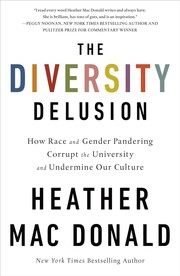

In one sentence
Mac Donald’s central claim is that universities have replaced liberal education with an ideology of group identity, oppression, and institutional guilt. In her view, this ideology converts unequal outcomes into evidence of discrimination, justifies bureaucratic intervention, narrows acceptable speech, and eventually exports grievance-based thinking from campus into workplaces and the broader culture. The book’s positive alternative is a university organized around truth-seeking, merit, free12? [
Overview
The book is organized around race, gender, bureaucracy, and finally the purpose of the university. Mac Donald examines affirmative-action practices and academic preparation gaps; campus sexual-assault debates and Title IX enforcement; implicit-bias training, diversity offices, and identity-based hiring; and controversies involving speakers and professors whose views challenge prevailing orthodoxies. She concludes that education should transmit knowledge, cultivate judgment, and expose students to difficult ideas rather than primarily assigning moral status by group membership. The publisher describes the book as a call to recover open inquiry and expression as routes toward a common humanity.
Core ideas
Diversity as an ideological project
Mac Donald distinguishes ordinary pluralism from what she sees as institutional diversity ideology. The latter treats demographic representation as a primary measure of justice and interprets disparities largely through presumed systemic bias. She argues that this framework makes contrary evidence difficult to acknowledge because disagreement can itself be classified as prejudice.
Mismatch and the costs of lowered standards
Her argument is that admitting students substantially below an institution’s usual academic preparation can undermine confidence, performance, and graduation prospects for the intended beneficiaries—a version of the ‘mismatch’ critique. She favors equal standards and earlier educational improvement rather than compensating for weak preparation at the point of selective admission. A reviewer identifies this as a major part of the book’s race section.
Gender politics and due process
Mac Donald argues that universities amplified exaggerated claims about campus rape and responded with disciplinary systems that could weaken procedural fairness. Her broader concern is that institutions adopt expansive definitions of harm under political pressure, then build constituencies and offices that benefit from maintaining the crisis narrative.
Bureaucracy creates self-reinforcing demand
Diversity offices, compliance requirements, training programs, and identity-based administrative structures are presented as both consequence and cause: once established, they need continuing evidence of discrimination to justify their budgets and authority. This can turn ambiguous incidents or outcome gaps into recurring institutional emergencies.
Speech codes and institutional cowardice
The book treats speaker disinvitations, protests, investigations, and pressure on dissenting professors as evidence that universities increasingly protect students from challenging ideas rather than protecting inquiry. Mac Donald places special responsibility on tenured faculty, whom she sees as failing to defend academic freedom when administrators or student activists threaten it.
The university’s proper purpose
Her constructive conclusion is not simply ‘remove diversity programs.’ It is to restore the university’s older liberal purpose: disciplined study of inherited knowledge, exposure to competing arguments, individual rather than group-based evaluation, and the search for standards that can be shared across identity lines.
Practical takeaways
- When evaluating a diversity initiative, ask what problem it defines, what evidence would count against that definition, and whether the intervention improves learning or merely expands administration.
- Separate equal opportunity, representative outcomes, and equal treatment; they are related but not interchangeable goals.
- Test claims about discrimination against baseline data, preparation levels, alternative explanations, and actual outcomes for the people the policy intends to help.
- Treat due process as a substantive safeguard, not an obstacle to compassion—especially when allegations can damage education, employment, or reputation.
- Defend the difference between discomfort and coercion. A serious educational setting should expose students to difficult arguments while prohibiting threats and harassment.
- Read Mac Donald as an argument for classical liberal education, not as a neutral survey of diversity research or a comprehensive account of racial and gender inequality.
Caveats and counterpoints
- The book is polemical and selective. It assembles cases supporting a broad indictment of campus diversity practices rather than offering a balanced review of the full empirical literature on affirmative action, implicit bias, sexual violence, or the educational effects of demographic diversity.
- Mac Donald often moves from documented controversies at particular institutions to claims about universities or culture as a whole. The inference may be suggestive, but the examples do not by themselves establish prevalence or causation.
- The mismatch argument is important but contested; readers should compare it with research on affirmative action, student support, campus climate, and the benefits or costs of learning in diverse environments.
- Her criticism of identity-based politics can understate the continuing effects of historical exclusion and structural inequality. Rejecting a policy mechanism does not settle the underlying moral or empirical question it was intended to address.
- The book’s use of terms such as ‘diversity bureaucracy,’ ‘campus rape myth,’ and ‘victimhood’ frames the debate strongly. Those labels clarify her position but should not be mistaken for neutral scholarly categories.
Questions worth revisiting
- Which of Mac Donald’s examples demonstrate a general institutional trend, and which are exceptional controversies selected for rhetorical force?
- What policy would preserve rigorous standards while addressing unequal K–12 preparation and persistent discrimination?
- When does attention to group disparities reveal real barriers, and when does it become an unfalsifiable ideology?
- Can a university pursue demographic inclusion and classical liberal inquiry simultaneously? What institutional rules would make that possible?
- How should claims about campus sexual violence be tested while preserving both survivor support and due process?
- Does Mac Donald’s proposed common humanity require a shared canon, shared standards, or merely shared rights and procedures?
Return to this when…
Return to these notes when assessing arguments about DEI, affirmative action, campus speech, Title IX, academic freedom, or the purpose of higher education. The most useful memory cue is: Mac Donald sees diversity ideology as a system that turns group disparities into proof of oppression, then uses that premise to justify bureaucratic control and restrict dissent; her alternative is merit, due process, open inquiry, and common standards.
References
- books.google.com
- goodreads.com
- goodreads.com
- discover.merrimacklibrary.org
- The Diversity Delusion
- books.apple.com
- diversity.social
- academic.macmillan.com
- Book Review: The Diversity Delusion: How Race and Gender Pandering Corrupt the University and Undermine Our Culture, By Heather Mac Donald
- librarycatalog.cityofkeller.com
- bloomsbury.com
- goodreads.com