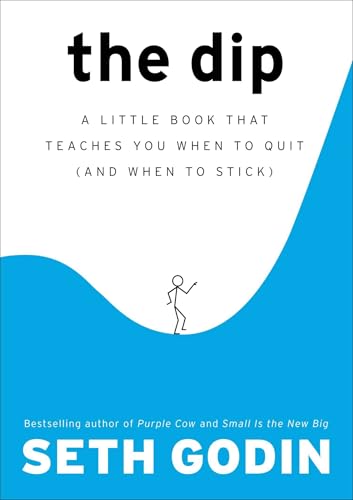

In one sentence
Quitting is not inherently failure. It is strategically useful when it frees resources from a dead end; persistence is valuable when a temporary, predictable difficulty separates ordinary performance from meaningful advantage. Godin’s decision rule is to choose pursuits where focused effort can plausibly make you exceptionally valuable.
Overview
Godin describes three broad patterns. The Dip is the frustrating stretch between beginning and mastery: progress slows, novelty disappears, and the work becomes harder. A Cul-de-Sac is a path with no meaningful improvement regardless of effort. A third pattern, sometimes described as a brief peak or “wrong-way” curve, can create early rewards that disguise a poor long-term direction. The practical challenge is diagnosing which pattern you are experiencing before emotion or sunk costs decide for you.
Core ideas
Quit strategically, not reactively
Godin separates a planned exit from panic, boredom, fear, or a bad day. Decide in advance what evidence would justify quitting, and avoid making the decision at the emotional low point unless the underlying path is clearly a dead end.
The Dip is a filter
The hard middle is not merely an obstacle; it keeps casual participants from reaching advanced competence. If the eventual reward is worthwhile and the difficulty is temporary or conquerable, continuing through the Dip can create scarcity and advantage.
Aim for a specific form of excellence
The book repeatedly frames success as becoming “the best in the world,” meaning the best choice for a defined market, audience, or situation—not necessarily globally superior at everything. Narrowing the field can make excellence attainable.
Strategic quitting reallocates resources
Stopping one project is valuable only if the recovered time, attention, money, or reputation is redirected toward a better opportunity. Quitting without a superior destination can become avoidance rather than strategy.
Pre-decide before commitment
Before entering a difficult project, identify the likely Dip, the skills or resources needed to cross it, the expected payoff, and the conditions that would make the effort a Cul-de-Sac. This prevents temporary pain from being mistaken for evidence that the goal is wrong.
Marketing implication: differentiation matters
For businesses and professionals, average effort in crowded markets is often poorly rewarded. A deliberate choice of niche, audience, or problem can make persistence through the Dip more valuable because fewer competitors are willing or able to continue.
Practical takeaways
- List current commitments and label each one: worthwhile Dip, likely Cul-de-Sac, or uncertain.
- For every major project, write a quit criterion before the next crisis: a date, metric, budget limit, or missing strategic condition.
- Ask whether the difficulty is producing capability, access, reputation, or evidence of progress. If not, question the path.
- Do not quit merely because the work is uncomfortable; do not persist merely because you have already invested heavily.
- Concentrate effort on fewer pursuits where becoming unusually good—or unusually relevant to a particular audience—is plausible.
- When quitting, specify what the freed resources will fund next.
Caveats and counterpoints
- Godin’s “best in the world” standard is powerful for competitive markets but too narrow for many legitimate goals: learning, relationships, health, service, play, and projects whose value is personal rather than winner-take-all.
- The framework can encourage premature optimization. Early evidence about a market or capability is often noisy, and some opportunities become viable only after experimentation.
- The book’s compact, aphoristic style favors decisive rules over detailed diagnosis. It offers less guidance for obligations where quitting affects dependents, collaborators, or vulnerable people.
- Critics have found the message somewhat repetitive and the premise overstated; the useful distinction is strategic persistence versus strategic exit, not a universal endorsement of quitting.
Questions worth revisiting
- Which of my current struggles are generating durable capability or leverage?
- If I succeed, what specifically improves—and is that reward large enough to justify crossing the Dip?
- What evidence would show that this path is a Cul-de-Sac rather than a temporary setback?
- Am I continuing because the opportunity is good, or because I dislike admitting a prior decision was wrong?
- If I quit, where exactly will the recovered resources go?
Return to this when…
Return when you are stuck between perseverance and sunk-cost thinking. The most useful refresher is the distinction between a difficult path that becomes more valuable as competitors drop out and a path whose underlying economics, fit, or prospects will not improve with additional effort.
Highlights
Just about everything you learned in school about life is wrong, but the wrongest thing might very well be this: Being well rounded is the secret to success. When you came home from school with two As, a B+, and three Bs, you were doing just fine. Imagine the poor kid who had an A+ and four Cs. Boy, was he in trouble. Fast-forward a few decades from those school days, and think about the decisions you make today—about which doctor to pick, which restaurant to visit, or which accountant to hire. How often do you look for someone who is actually quite good at the things you don’t need her to do? How often do you hope that your accountant is a safe driver and a decent golfer? In a free market, we reward the exceptional.
The next time you catch yourself being average when you feel like quitting, realize that you have only two good choices: Quit or be exceptional. Average is for losers.
The businesses we think of as overnight successes weren’t. We just didn’t notice them until they were well baked.
The market wants to see you persist. It demands a signal from you that you’re serious, powerful, accepted, and safe. The bulk of the market, any market, is made up of those folks in the middle of the bell curve, the ones who want to buy something proven and valued.
I think the advice-giver meant to say, “Never quit something with great long-term potential just because you can’t deal with the stress of the moment.” Now that’s good advice.
Sergey Brin, cofounder of Google, told me, “We knew that Google was going to get better every single day as we worked on it, and we knew that sooner or later, everyone was going to try it. So our feeling was that the later you tried it, the better it was for us because we’d make a better impression with better technology. So we were never in a big hurry to get you to use it today. Tomorrow would be better.”
Here’s an assignment for you: Write it down. Write down under what circumstances you’re willing to quit. And when. And then stick with it.
Here’s a quote from ultramarathoner Dick Collins: Decide before the race the conditions that will cause you to stop and drop out. You don’t want to be out there saying, “Well gee, my leg hurts, I’m a little dehydrated, I’m sleepy, I’m tired, and it’s cold and windy.” And talk yourself into quitting. If you are making a decision based on how you feel at that moment, you will probably make the wrong decision.
Consider the bicycle tire. The first ten pounds of pressure you put into a completely flat tire do no good at all. And adding ten extra pounds to a full tire will burst the tire, defeating the entire purpose of your effort. No, it’s just the last ten pounds, the ones that get it to full that really pay off.
If you enter a market that’s too big or too loud for the amount of resources you have available, your message is going to get lost. Your marketing disappears, your message fails to spread. Think twice before launching a mass-market brand of chewing gum. Like adding just a few pounds of air to a flat tire, launching a product into too big of a market has little effect. You can’t create pressure and you never reach the Dip. When Sara Lee tried to enter the market for home coffee machines and pods with their Senseo coffeemaker, they didn’t have enough resources to get through the Dip…not in the United States, anyway. In the Netherlands, a much smaller market, Senseo has reached a 40-percent market share of all households. They have the right amount of pressure for the “tire” that is that (tiny) market. In the United States, on the other hand, they report that only 1 percent of households have a Senseo. Too big a market, too few resources. Stuck in the Dip. Since few Americans have a Senseo, few talk about it. Few stores promote the pods. The word doesn’t spread and Senseo can’t reach critical mass—there are too many places for the message to go and not enough resources to get it there. Figure out how much pressure you’ve got available, then pick your tire. Not too big, not too small.
You’re Astonishing How dare you waste it. You and your organization have the power to change everything. To create remarkable products and services. To over deliver. To be the best in the world. How dare you squander that resource by spreading it too thin. How dare you settle for mediocre just because you’re busy coping with too many things on your agenda, racing against the clock to get it all done. The lesson is simple: If you’ve got as much as you’ve got, use it. Use it to become the best in the world, to change the game, to set the agenda for everyone else. You can only do that by marshaling all of your resources to get through the biggest possible Dip. In order to get through that Dip, you’ll need to quit everything else. If it’s not going to put a dent in the world, quit. Right now. Quit and use that void to find the energy to assault the Dip that matters. Go ahead, make something happen. We’re waiting!
References
- The Dip: A Little Book That Teaches You When to Quit (and When to Stick) - Seth Godin - Google Books
- venkatbooks.com
- Excerpt: Seth Godin's "The Dip," on the benefit of "strategic quitting" - CBS News
- Book review: The dip, by Seth Godin
- winchellhouse.com
- en.wikipedia.org
- directionjournal.org
- literarynachos.wordpress.com
- tubarksblog.com
- ricardorosero.com
- visualfoodie.com
- readthinkact.com