
In one sentence
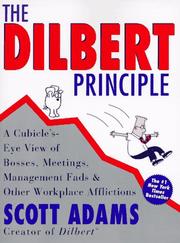
Organizations often reward visibility, political safety, and conformity rather than competence. As a result, ineffective employees may be promoted into management, where they can obstruct work at a greater scale—the book’s deliberately exaggerated “Dilbert Principle.”
Overview
Published by HarperBusiness in 1996, with a 1997 HarperCollins reprint, the book combines essays, cartoons, reader-supplied workplace stories, and mock-practical advice. Its 25-chapter structure moves through absurdity in business, management communication, management myths, office politics, employee survival strategies, performance reviews, technical workers, change, budgeting, sales, meetings, projects, ISO 9000, and downsizing.
Core ideas
Organizations can promote incompetence upward
The central joke is that poor performers are moved into management because management is treated as a safe destination for people who should no longer be doing specialized work. The useful underlying question is: what behaviors does the promotion system actually reward?
Corporate language can conceal rather than clarify
Mission statements, management fashions, acronyms, and polished communications often substitute the appearance of coordination for concrete decisions. Translate abstractions into owners, actions, deadlines, and observable outcomes.
Meetings and reviews become rituals
Meetings, performance reviews, and project procedures can persist even when they do not improve decisions or output. Their hidden functions may be signaling participation, distributing blame, documenting activity, or protecting hierarchy.
Visibility is not the same as value
Employees who speak confidently, manage impressions, or attach themselves to fashionable initiatives may be judged more favorably than people doing difficult technical or operational work. Evaluation systems should test results, reliability, and downstream effects.
Bureaucracy protects itself
Processes such as budgeting, quality programs, and downsizing can become self-justifying systems. A procedure that began as a tool may turn into the goal, especially when nobody is clearly accountable for its costs.
Humor is a way to recognize systemic dysfunction
The cartoons make recurring workplace patterns memorable by exaggerating them: incompetent bosses, passive employees, cynical consultants, and technology treated as a magical solution. The book’s primary contribution is recognition and vocabulary, not a validated theory of organizations.
Employee survival may conflict with organizational health
Adams often frames office life from the worker’s defensive perspective: minimize exposure, avoid unnecessary risk, and understand political incentives. These tactics can protect individuals, but widespread cynicism can also reinforce the dysfunction being mocked.
Practical takeaways
- When a promotion is proposed, ask whether the candidate is being rewarded for leadership or merely removed from a role where they are inconvenient or ineffective.
- For every meeting, define the decision required, the participants who can make it, and the next action with an owner.
- Replace management jargon with measurable statements: what will change, by how much, by when, and for whom.
- Treat performance reviews as hypotheses, not truth. Compare ratings with delivered results, team effects, customer outcomes, and work that is hard to observe.
- Audit procedures periodically: what problem does this process solve, what does it cost, and what evidence shows that it works?
- Distinguish satire from advice. The book is strongest as a diagnostic lens for incentives and absurdity, not as a complete operating manual for management.
Caveats and counterpoints
- The Dilbert Principle is intentionally satirical and anecdotal; it generalizes from recognizable office failures rather than presenting systematic organizational research.
- Its target is especially the late-20th-century corporate office—management fads, ISO 9000, downsizing, and early Internet culture—so some examples are historically dated even when the incentive problems remain recognizable.
- The cynical employee perspective can overstate managerial incompetence and understate legitimate coordination, compliance, safety, and accountability needs.
- The book’s comic framing encourages a simple villain-versus-victim interpretation. In practice, dysfunctional outcomes may arise from incentive structures, resource constraints, unclear authority, or conflicting goals rather than individual stupidity.
- Later public controversy surrounding Scott Adams is separate from the arguments and humor of this 1996 book; it is still relevant context when evaluating the author, but not evidence for or against each organizational observation.
Questions worth revisiting
- Which incentives in my organization reward appearing busy, agreeable, or strategic over producing useful results?
- What recurring meeting, report, or review would disappear if nobody had to perform busyness?
- Where are technically strong people being pushed into management without evidence that they want or fit that role?
- Which process is currently treated as an objective rather than as a tool?
- When have I used cynical survival tactics that protected me but made the system worse?
Return to this when…
Return to this book when an organization is adopting a new management fashion, multiplying meetings and metrics, reorganizing without clear goals, or promoting people for political convenience. Use it as a fast pattern-recognition checklist, then verify the diagnosis with actual incentives, outcomes, and evidence.