
In one sentence
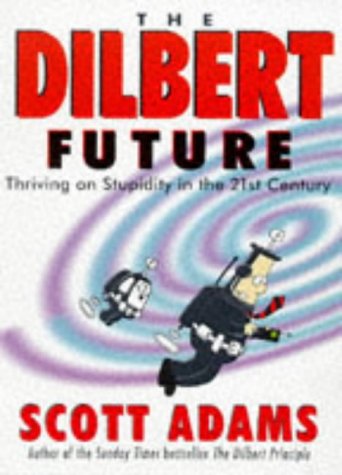
The future will be shaped less by technological brilliance than by persistent human incentives: greed, status-seeking, sexual behavior, bureaucracy, incompetence, and the tendency to mistake novelty for progress. Technology may change the setting, but organizations and institutions will continue reproducing familiar absurdities. This is a comic thesis, not a rigorously evidenced forecast.
Overview
Published in the late 1990s, the book mixes short essays, cartoons, and 65 predictions. Its sections cover aging, technology, extraterrestrial life, democracy and capitalism, gender relations, work, future jobs, social life, news, euthanasia, food, persistent problems, and a concluding “new view of the future.”
Core ideas
Technological progress does not equal human progress
New devices and networks expand what people can do, but they do not make people wiser, less selfish, or more competent. Adams repeatedly turns technological optimism into a joke about old irrationalities operating at greater scale.
Prediction is partly entertainment
The book presents forecasting as a mixture of extrapolation, intuition, exaggeration, and absurdity. Some predictions are plausible extensions of visible trends; others are intentionally ridiculous. The reader is meant to notice how confidently people talk about an unknowable future.
Organizations convert individual foolishness into systems
Corporate and institutional stupidity becomes especially durable when embedded in procedures, jargon, incentives, and layers of management. The book extends the satirical logic of The Dilbert Principle from office life to business, government, media, and technology.
The future of work may be more fragmented, not more secure
Adams anticipates a workforce containing more freelance specialists and contract-based work. That insight is presented alongside anxiety about downsizing, telecommuting, automation, and the possibility that efficiency gains will benefit organizations more reliably than workers. Publishers Weekly identified the freelance-expert prediction as one of the book’s more accurate forecasts.
Consumers face manufactured confusion
The term “confusopoly” names markets in which competing companies make prices and service options difficult to compare, even when their underlying offerings are similar. The useful mental model is that complexity can function as a competitive strategy rather than an accidental inconvenience.
Satire can expose bias while also reproducing it
Adams’s targets include managers, experts, politicians, marketers, men, women, children, and “ordinary” people. The humor depends on broad stereotypes and a posture of superior cleverness. A serious reader should separate the book’s observations about institutional absurdity from its more contemptuous generalizations.
Practical takeaways
- Treat confident forecasts as arguments about incentives, not as descriptions of destiny.
- When evaluating a new technology, ask: who gains power, who bears the cost, and which old behavior will the technology amplify?
- Look for “confusopolies”: situations where needless complexity prevents comparison and weakens accountability.
- In workplaces, distinguish genuine innovation from new terminology, new software, or reorganized bureaucracy that leaves incentives unchanged.
- Use the book as a prompt for scenario thinking: identify the plausible trend, the comic exaggeration, and the conditions that would make each outcome more or less likely.
Caveats and counterpoints
- This is primarily humor and cultural commentary, not a sourced work of futurism; many claims are intentionally half-serious or facetious.
- The book’s late-1990s technological frame dates it: some references and assumptions concern the early Internet, emerging digital video, and workplace technology of that period.
- Its cynicism is productive when aimed at incentives and institutions, but less reliable when it treats broad groups of people as inherently stupid, selfish, or ridiculous.
- The concluding advice about writing down wishes repeatedly sits uneasily beside the book’s observational satire; Publishers Weekly specifically regarded this self-help element as bizarre rather than well integrated.
- Predictions that appear accurate should not automatically be treated as evidence of strong forecasting; short, flexible predictions and selective attention can make coincidence look like method.
Questions worth revisiting
- Which predictions are genuine extrapolations, and which are constructed mainly for comic effect?
- Does technological change alter institutional behavior, or mostly give existing incentives new instruments?
- When does simplifying a system improve accountability, and when does it hide important trade-offs?
- Is Adams criticizing stupidity itself, or the structures that reward confident incompetence?
- How much of the book’s appeal depends on the reader sharing its late-1990s office-culture assumptions?
Return to this when…
Return to the technology, future-of-work, and “confusopoly” sections when thinking about hype, platform-mediated work, organizational jargon, or systems that make comparison unnecessarily difficult. Return to the caveats before treating any prediction as evidence.
References
- The Dilbert Future: Thriving on Business Stupidity in the 21st Century - Scott Adams - Google Books
- obnb.uk
- The Dilbert Future: Thriving on Stupidity in the Twenty-First Century by Scott Adams
- forums.spacebattles.com
- yes24.com
- openlibrary.org
- kirkusreviews.com
- books.google.com.jm
- wiredal.wordpress.com
- books.google.com
- books.google.com
- goodreads.com