
In one sentence
When people struggle with a product, designers should first inspect the product’s communication and structure—not blame the user. Good design makes possible actions discoverable, connects controls to effects clearly, provides timely feedback, and builds a usable mental model of how the system works.
Overview
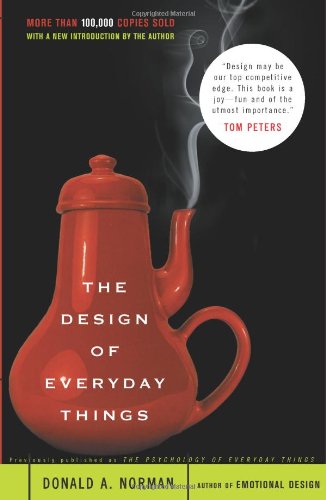
Originally published in 1988 as The Psychology of Everyday Things, the book uses everyday objects and interfaces to explain human action, cognition, and design. The revised and expanded 2013 edition adds newer examples, clarifies terminology, and includes expanded treatment of design processes and business constraints.
Core ideas
Design is communication
A product communicates what it can do, how it should be operated, and what state it is in. Confusing doors, controls, and interfaces usually reflect a mismatch between the designer’s intended model and the user’s mental model.
Affordances and signifiers
An affordance is an action possibility created by the relationship between a person and an object; a signifier is the perceivable cue that indicates where and how to act. Norman’s 2013 revision emphasizes signifiers because possible actions are not useful if users cannot perceive them.
Discoverability, feedback, and conceptual models
Users need to discover available actions, see the results of those actions, and understand enough of the system’s structure to predict what will happen next. Feedback closes the action loop; a good conceptual model reduces guesswork and memorization.
Mapping matters
Controls should correspond clearly and preferably naturally to their effects. Poor mapping forces users to learn arbitrary relationships; good mapping lets spatial layout, sequence, or convention suggest the outcome.
Constraints prevent errors
Physical, cultural, semantic, and logical constraints narrow the set of possible actions. The best constraint is often better than an instruction because it prevents an incorrect action rather than explaining it afterward.
The seven-stage action cycle
Norman analyzes action as a loop: form a goal, plan an intention, specify and perform an action, then perceive, interpret, and evaluate the result. Design failures occur when users cannot translate goals into actions or cannot tell whether the result matches the goal.
Errors are part of normal use
People forget, misperceive, interrupt tasks, and form mistaken hypotheses. Robust products make errors easy to detect, reversible, and recoverable. Designers should distinguish slips—well-intended actions carried out incorrectly—from mistakes—incorrect goals or plans.
Human-centered design is iterative
Design should begin with users’ real activities and needs, not with a preferred technology or preconceived solution. Observation, prototyping, testing, and iteration reveal problems that specifications and internal assumptions miss.
Practical takeaways
- When evaluating a product, ask: What actions are possible? Which are visible? What does each control affect? What feedback confirms success or failure?
- Separate the user’s goal from the interface action required to achieve it; redesign the translation if it feels arbitrary.
- Prefer prevention and recovery over warnings and manuals: constrain dangerous options, make states visible, and provide undo or other safe reversal.
- Put frequently needed knowledge in the world through labels, layout, defaults, conventions, and feedback instead of requiring users to remember it.
- Test with representative users performing realistic tasks. Watching where they hesitate, misinterpret, or recover is more informative than asking whether they like the design.
- For digital products, treat icons, affordances, status indicators, loading states, error messages, and navigation structure as parts of one explanatory system.
Caveats and counterpoints
- The book’s principles are durable, but many original physical-product examples are dated; the revised edition updates the discussion without making every example contemporary.
- “Affordance” is often used loosely in design. Norman’s later distinction between affordances and signifiers is important: an action may be possible without being perceptibly indicated.
- Norman’s ideal design process can conflict with budgets, schedules, organizational incentives, and market research practices; a serious review identifies these implementation constraints as a limitation of the book’s prescriptions.
- Human-centered design does not eliminate all complexity. Safety, accessibility, expert functionality, competing goals, and unavoidable system complexity may require instruction, training, or deliberate trade-offs.
Questions worth revisiting
- Where does a product I use make me blame myself for a design problem?
- What is the product’s implied conceptual model, and where does the actual system contradict it?
- Which errors should be prevented, which should be made recoverable, and which are acceptable consequences of flexibility?
- Am I using “affordance” to mean a real action possibility or merely a signifier that suggests an action?
- What would direct observation of users reveal that analytics, surveys, or stakeholder opinions would miss?
Return to this when…
Return when designing, critiquing, or troubleshooting a product or interface—especially when users are making repeated errors, relying on instructions, memorizing arbitrary steps, or asking what the system is doing. Revisit the action cycle, signifiers, mappings, constraints, feedback, and conceptual-model sections first.
References
- The Design of Everyday Things: Revised and Expanded Edition - Don Norman - Google Books
- search.worldcat.org
- search.worldcat.org
- guptadeepak.com
- The Design of Everyday Things, Revised and Expanded Edition – Don Norman's JND.org
- Review: The Design of Everyday Things by Don Norman
- kuniga.me
- en.wikipedia.org
- productbookshelf.com
- obnb.uk
- principles.design
- designreview.byu.edu