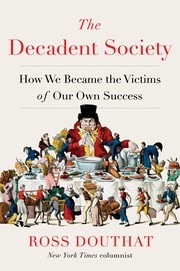

In one sentence
Douthat’s central claim is that the West has not primarily entered an age of collapse, but an extended period of stagnant prosperity. A society can remain wealthy, powerful, and technologically capable while losing the confidence, energy, fertility, creativity, and institutional dynamism needed to move toward a compelling future.
Overview
The book interprets contemporary Western life through four recurring symptoms: stagnation in economic growth and transformative technology; sterility in falling birth rates and weakened family formation; sclerosis in political polarization, institutional gridlock, and bureaucratic expansion; and repetition in popular culture’s recycling of earlier styles and ideas. Douthat calls the resulting condition “sustainable decadence”: comfortable enough to endure, but directionless enough to produce malaise. He applies the diagnosis to American politics, the European Union, the post-space-age technological imagination, social media, pornography, drugs, video games, and virtual-reality escapes. The concluding possibility is not a detailed reform program but a fork in the road: decadence may end in renaissance, catastrophe, or a long period of drift. Religion matters in his account because material abundance alone cannot supply a durable sense of purpose.
Core ideas
Decadence means stagnation at a high level of prosperity
Douthat uses “decadence” less to mean luxury or moral corruption than a society that has achieved great wealth and power but no longer advances decisively. Its institutions still operate, yet increasingly through inertia, maintenance, and crisis management rather than ambitious collective action.
The Four Horsemen: stagnation, sterility, sclerosis, repetition
These are the book’s most useful diagnostic shorthand. Economic and technological progress feel weaker; fewer children are born; politics and institutions become harder to change; and culture repeatedly reworks familiar material instead of opening genuinely new horizons.
The future has been replaced by managed distraction
When societies cannot imagine or build a transformative future, they compensate with consumption, entertainment, digital immersion, drugs, pornography, and social-media intensity. These provide novelty and stimulation without necessarily producing direction, community, or durable achievement.
Apparent turbulence can conceal deep stasis
Trump-era political conflict, online outrage, and constant media novelty create a strong subjective sense of change. Douthat’s counterclaim is that much of this agitation leaves underlying economic, demographic, and institutional arrangements intact; spectacle can coexist with structural immobility.
“Sustainable” does not mean harmless
Decadence can be comfortable: it preserves prosperity and avoids the risks of radical transformation. But comfort can also reduce the pressure to reform, normalize low expectations, and make decline gradual enough to evade recognition. Douthat warns that unresisted drift eventually leads somewhere darker.
Renewal requires more than technical fixes
Douthat treats the crisis as partly spiritual and civilizational, not merely economic. Higher growth or new inventions might help, but renewal also requires a reason to sacrifice, create families, pursue truth, and build institutions oriented toward a future beyond consumption. His own religious perspective gives faith a privileged role here.
Practical takeaways
- Use the four-part framework—stagnation, sterility, sclerosis, repetition—to distinguish visible political drama from deeper social conditions.
- When evaluating a proposed solution, ask whether it creates genuine capacity and purpose or merely delivers another form of consumption, distraction, or symbolic conflict.
- Treat demographic decline and family formation as central political questions, not secondary lifestyle issues.
- Look for “frontiers” that demand real commitment—scientific, civic, artistic, familial, or spiritual—rather than merely offering more immersive entertainment.
- Remember that a society can be materially successful while becoming psychologically and culturally unambitious.
- For personal reflection, ask where your own routines offer stimulation without progress, and where you are helping build something that outlasts immediate gratification.
Caveats and counterpoints
- The book is a broad cultural diagnosis rather than a tightly demonstrated social-science argument. Reviews note that its synthesis is often provocative and insightful but not always empirically convincing.
- “Stagnation” is contestable: digital technology, biotechnology, energy, and global development have produced major changes, even if they do not match the author’s preferred image of heroic, society-transforming progress.
- The framework can romanticize earlier eras and treat cultural recycling as exhaustion when repetition may also reflect democratized access, remix culture, or new forms of creativity.
- Douthat’s conservative and Christian commitments shape both his diagnosis and his proposed remedy. His argument about religion is therefore best read as a substantive interpretation, not a neutral conclusion.
- The book appeared in 2020, before the full consequences of the COVID-19 pandemic, subsequent political developments, generative AI, and later economic changes. Its framework may still be useful, but some examples and forecasts require updating.
- The four-part model risks becoming too elastic: many negative trends can be classified as evidence of decadence, while counterexamples can be treated as superficial or exceptional.
Questions worth revisiting
- Is the West truly stagnant, or has its dynamism shifted into domains—software, medicine, finance, biotechnology, and global networks—that Douthat undervalues?
- Does falling fertility primarily reflect decadence, or can it also reflect greater education, autonomy, urbanization, and improved control over reproduction?
- Are political conflict and cultural repetition symptoms of decline, or normal features of a pluralistic society undergoing rapid change?
- Can secular liberal institutions generate shared purpose without religious revival?
- What would count as evidence that a society has moved from sustainable decadence into genuine renewal?
- Which parts of Douthat’s diagnosis still fit the post-2020 world, and which have been challenged by pandemic disruption, AI, or new technological investment?
Return to this when…
Return to these notes when assessing claims that society is “in decline,” especially when dramatic events may be masking slower structural trends. The Four Horsemen framework is the most memorable tool; the strongest caution is to test it against evidence of genuine innovation, social improvement, and alternative explanations.
References
- The Decadent Society | Book by Ross Douthat | Official Publisher Page | Simon & Schuster UK
- goodreads.com
- breakpoint.org
- THE DECADENT SOCIETY | Kirkus Reviews
- cbsnews.com
- The Decadent Society by Ross Douthat — A Review | Quillette
- openlibrary.org
- Book review of The Decadent Society: How We Became the Victims of Our Own Success by Ross Douthat - The Washington Post
- areomagazine.com
- delibris.org
- The Decadent Society: How We Became Victims of Our Own Success | The Banner
- wm.wts.edu