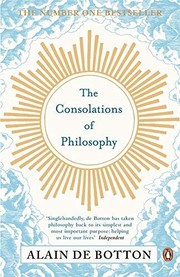

In one sentence
Philosophy is most valuable when it changes how we interpret and endure life’s recurring difficulties. De Botton argues that philosophical ideas can provide emotional perspective, expose false assumptions, and help us live by judgments more independent of fashion, status, wealth, and romantic disappointment.
Overview
The book is organized into six problem-centered sections, each associated with a philosopher: Socrates with unpopularity; Epicurus with insufficient money; Seneca with frustration; Montaigne with inadequacy; Schopenhauer with a broken heart; and Nietzsche with difficulties. Its method combines brief biography, accessible explanation, contemporary examples, and visual material.
Core ideas
Philosophy should console, not merely classify
De Botton rejects the picture of philosophy as an academic subject detached from life. A philosophical argument matters here insofar as it helps someone question an assumption, withstand misfortune, or identify what is genuinely worth wanting. This is the book’s governing standard, not a neutral history of philosophy.
Socrates: unpopularity can be the price of independence
Socratic questioning models resistance to majority opinion. Being disliked is not, by itself, evidence of being wrong; the more important test is whether one’s beliefs survive rational examination. The practical move is to distinguish social approval from intellectual or moral validity.
Epicurus: money solves fewer problems than we think
Epicurean consolation targets anxiety about poverty and status. Once basic needs, friendship, security, and modest pleasures are separated from luxury and prestige, the amount of wealth required for a satisfying life can shrink. The argument challenges desire inflation: wanting more can manufacture the feeling of not having enough.
Seneca: frustration comes from demanding control over the uncontrollable
Seneca is used to examine anger, disappointment, and setbacks, including loss of work. The useful distinction is between what depends on us—judgment, preparation, response—and what does not. Anticipating reversals can reduce shock, while accepting limits prevents a second injury caused by indignation.
Montaigne: inadequacy is partly a failure of perspective
Montaigne’s candid attention to bodily weakness, embarrassment, ignorance, and ordinary human inconsistency normalizes imperfection. The consolation is not that we are secretly flawless, but that many supposedly disqualifying defects are common features of embodied human life. Self-knowledge can replace humiliating comparison.
Schopenhauer: heartbreak reveals the instability of romantic idealization
Schopenhauer provides a deliberately pessimistic lens on romantic desire. Love can make one person appear uniquely necessary, but desire and projection distort judgment; after loss, the mind tends to treat a temporary attachment as though it were the condition of all future happiness. His account offers distance, though not necessarily optimism.
Nietzsche: difficulty can be interpreted as material for growth
Nietzsche is associated with adversity, loneliness, illness, and the need to create rather than merely seek comfort. Difficulty is not automatically beneficial, but it can become formative when actively interpreted and integrated into a larger project. The emphasis is on transforming suffering into strength, style, or purpose.
The book’s recurring mental model: revise the hierarchy of goods
Across all six sections, distress often comes from treating socially prized goods—popularity, money, beauty, romantic possession, ease—as prerequisites for a worthwhile life. Philosophy offers a rival hierarchy centered on sound judgment, friendship, independence, resilience, and deliberate values.
Practical takeaways
- When distressed, name the exact judgment making the situation unbearable; then ask whether it is a fact, a social convention, or an inherited expectation.
- Separate basic needs from status desires. Reassess purchases and ambitions that mainly serve comparison or imagined observers.
- Before a difficult event, distinguish controllable preparation from uncontrollable outcome; invest effort only in the first category.
- Treat criticism as evidence to examine, not a verdict to obey. Ask whether the critic’s standards are rational and worth accepting.
- During heartbreak, record what is known about the person or relationship separately from what longing and idealization are adding.
- Use adversity as a prompt for interpretation and action, not as proof that suffering is inherently good or deserved.
Caveats and counterpoints
- The book is selective and therapeutic rather than a balanced survey of the philosophers. It compresses complex, sometimes contradictory traditions into one practical lesson per thinker; serious study should return to the primary texts.
- Its consolations can be too simple for structural problems such as poverty, discrimination, unemployment, or mental illness. Reframing desire cannot substitute for material support, political change, medical care, or therapy.
- The Nietzsche section risks sounding as if suffering becomes valuable merely through attitude; some suffering is simply damaging, and resilience is not equally available under all conditions.
- The Schopenhauerian treatment of love can clarify idealization but may understate attachment, mutual care, and the legitimate grief involved in losing a relationship.
- Reviewers generally recognized the book’s wit and accessibility while criticizing its simplification and limited originality; it is best used as an invitation to investigate philosophy, not as a final account of it.
Questions worth revisiting
- Which of my current frustrations depends on an expectation I have never examined?
- What would remain sufficient if I removed status comparison from the calculation?
- Am I seeking agreement, or am I seeking a belief that can withstand questioning?
- Which parts of this problem are within my control today?
- Where might I be confusing a painful experience with a permanent condition?
- Which philosopher’s consolation is genuinely useful to me, and where does it fail?
Return to this when…
Return when you are treating popularity, money, romantic attachment, or ease as prerequisites for a good life. The book is especially useful as a quick perspective-reset and as a map for choosing which primary philosophers to read next; it is less adequate for detailed philosophical scholarship or complex psychological and social problems.
References
- Reviews - Alain de Botton
- alaindebotton.com
- The Consolations of Philosophy - Alain de Botton
- enotes.com
- en.wikipedia.org
- enotes.com
- The Consolations of Philosophy - Alain de Botton
- The Consolations of Philosophy by Alain De Botton: 9780679779179 | PenguinRandomHouse.com: Books
- januarymagazine.com
- alaindebotton.com
- Sunday Times - Alain de Botton
- books.google.com