
In one sentence
Human freedom and happiness depend primarily on the quality of one’s judgments and choices, not on external circumstances. We should distinguish what belongs to our agency from what does not, train ourselves to respond rationally to impressions, and fulfill our roles toward others without making possessions, reputation, health, or success conditions of a good life. Epictetus’s aim is not abstract theory but the formation of character.
Overview
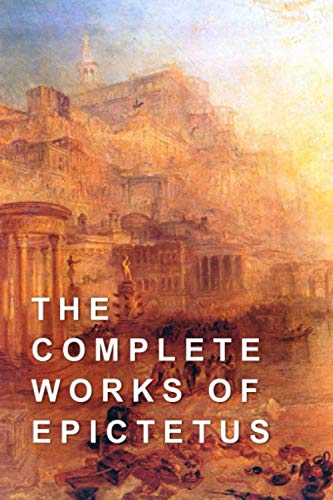
This title appears to be a modern reprint or ebook using Elizabeth Carter’s translation, whose original work was published in 1758 as All the Works of Epictetus, Which are Now Extant. The genuine Carter collection included four books of Discourses preserved by Arrian, the Enchiridion, fragments, an introduction, and notes. Some recent independently published editions with this exact title have been criticized for being incomplete or for combining Carter’s translation with material by other translators, so the catalogue record should not be treated as proof of textual completeness.
Core ideas
What is genuinely ours
Epictetus distinguishes our judgments, desires, aversions, intentions, and use of impressions from external events, bodies, possessions, other people, and outcomes. The practical question is not simply “Can I control this?” but “What part of my response is up to me?”
Impressions require examination
An event first appears to the mind as an impression, often already carrying an evaluation—insult, disaster, loss, threat. Progress requires pausing before assent, testing the evaluation, and separating the event from the judgment added to it.
Character is the real self
Epictetus’s central ethical concept, prohairesis, is the faculty of choice or moral agency. External force may constrain action, but it cannot by itself make a person endorse a false judgment or choose badly. Freedom is therefore an achievement of disciplined agency, not merely political status.
Virtue, not preferred outcomes, is good
Health, wealth, status, comfort, and even survival may be worth choosing in ordinary circumstances, but they are not what makes a life morally good. Goodness lies in using circumstances intelligently and honorably; failure lies in corruption of judgment and character.
Philosophy is exercise
The Discourses repeatedly attack the gap between explaining Stoic doctrines and living them. Study matters only when it changes habits: reducing complaint, moderating desire, examining reactions, keeping commitments, and practicing principles under pressure.
Roles create duties
Stoic detachment is not permission to become indifferent to people. One must act appropriately as a parent, child, spouse, friend, citizen, teacher, or colleague. Universal reason supports concern for others, while particular relationships determine concrete obligations.
Acceptance is active, not passive
Accepting fate means recognizing the limits of one’s power and cooperating with reality rather than demanding that events conform to preference. Within those limits, one should still deliberate, act courageously, correct mistakes, and pursue appropriate aims.
Practical takeaways
- When upset, identify three layers: what happened, the immediate impression, and the judgment you added. Work on the third layer first.
- Before pursuing an outcome, define success as making the best available judgment and effort—not securing a result that depends on other people or circumstances.
- Treat possessions, praise, health, and status as things to use responsibly rather than as foundations of identity.
- Practice small voluntary pauses: delay assent to anger, fear, envy, or humiliation until the impression has been examined.
- Ask, “What role am I in here, and what conduct does that role require?” This prevents self-protection from masquerading as principle.
- Review the day by looking for failures of judgment and failures of duty, not merely unpleasant events.
- Read the Discourses for development and argument; use the Enchiridion as a compressed reminder or checklist.
Caveats and counterpoints
- The famous modern “dichotomy of control” is useful shorthand, but Epictetus’s framework is more exacting: it concerns the faculty of judgment, assent, desire, aversion, and intention, not unlimited control over every internal state.
- Stoic acceptance can be misread as quietism or submission. Epictetus still expects disciplined action, moral resistance, and fulfillment of social duties; the restraint concerns attachment to outcomes, not effort.
- The system depends on a strong Stoic worldview: providence, a rationally ordered cosmos, and virtue as the only true good. Readers who reject those metaphysical commitments may still use the psychological exercises, but the original justification will be missing.
- The Discourses were recorded by Arrian, and scholars disagree about how directly they preserve Epictetus’s own words and organization. The Enchiridion is a later abridgment rather than a complete presentation of the teaching.
- Carter’s translation is historically important and influential, but its eighteenth-century diction can obscure technical distinctions. More seriously, several modern books sold under this exact title appear bibliographically inconsistent; verify that the copy actually contains Carter’s complete Discourses, Enchiridion, and fragments rather than a selection or mixed translation.
Questions worth revisiting
- Which current frustration am I treating as an evil when it is actually an external circumstance or a preferred outcome?
- What judgment am I assenting to before I have examined the impression?
- What would acting well look like if success were defined by my conduct rather than by the result?
- Which role or relationship am I neglecting while defending my comfort or reputation?
- Am I using Stoic language to clarify responsibility—or to excuse passivity, emotional suppression, or indifference to injustice?
Return to this when…
Return to the Enchiridion before a stressful decision, conflict, loss, or public embarrassment; return to the Discourses when the basic principles feel familiar but your habits have not changed. Recheck the edition’s contents if you need Carter specifically, since some modern listings under this title are incomplete or textually mixed.
Highlights
Show me then your progress in this point. As if I should say to a wrestler, Show me your muscle; and he should answer me, “See my dumb-bells.” Your dumb-bells are your own affair: I desire to see the effect of them.
References
- goodreads.com
- books.google.com
- books.google.com
- scribd.com
- The Complete Works of Epictetus by Epictetus, Carter, Elizabeth (9781521800355)
- goodreads.com
- philpapers.org
- universityarchives.com
- upload.wikimedia.org
- en.wikipedia.org
- en.wikipedia.org
- goodreads.com
- plato.stanford.edu
- katalog.ub.uni-heidelberg.de
- plato.stanford.edu