
In one sentence
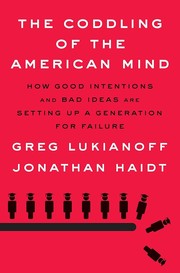
The authors argue that several well-intentioned cultural shifts are teaching young people to interpret discomfort as danger, trust immediate feelings over examination, and divide society into moralized camps. These habits can undermine mental health, learning, free speech, and democratic cooperation. Their preferred alternative is graduated exposure to challenge, cognitive self-correction, and viewpoint diversity.
Overview
The book develops an argument first presented in a 2015 Atlantic essay, then expands it into a broader account of childhood, technology, higher education, and political conflict. Its central concern is not kindness itself, but protective practices that deny people manageable risks and make them dependent on authorities to regulate discomfort. The authors connect campus disputes to wider changes in parenting, unsupervised play, social media, and institutional incentives. Critics generally acknowledge the book’s useful defense of open inquiry but question whether its anecdotes and selected campus cases justify its broad claims about a generation or American society.
Core ideas
The three Great Untruths
The book challenges three ideas: adversity reliably weakens rather than strengthens; feelings are dependable guides to truth and action; and social life is fundamentally a struggle between good people and evil people. The authors treat these as cognitive errors that encourage avoidance, emotional reasoning, and hostile polarization.
Antifragility and graduated challenge
People often develop strength by facing manageable difficulty, uncertainty, and failure. The practical principle is not reckless exposure or ignoring genuine harm, but calibrated challenge: protect people from serious danger while allowing ordinary discomfort to become practice in coping.
Cognitive distortions as a cultural problem
Drawing on cognitive-behavioral ideas, the authors apply familiar distortions—such as catastrophizing, overgeneralization, and mind-reading—to public controversies. Their claim is that institutions can reinforce distorted interpretations when they treat subjective offense as decisive evidence of objective harm.
Safetyism
“Safetyism” describes treating safety as a supreme value and expanding the meaning of harm to include many forms of emotional discomfort, disputed ideas, or symbolic offense. The authors argue that this can produce avoidance, moral dependency, and pressure to suppress discussion rather than build coping ability.
Why campus conflict matters
Universities are presented as laboratories for the effects of ideological homogeneity, weak leadership, fear of controversy, and demands for punishment or disinvitation. The authors defend universities as places where students should encounter difficult arguments under norms of evidence, charity, and intellectual freedom.
A multi-cause social story
The authors do not attribute the problem to one political faction or one technology. They describe interacting forces: more protective parenting, less independent play, changing childhood norms, social-media incentives, bureaucratic risk management, and political polarization. This makes the book’s explanation systemic rather than purely generational.
Institutional remedies
Suggested responses include restoring free-play and independence, teaching cognitive habits that challenge distorted thinking, resisting unnecessary trigger warnings and speech restrictions, encouraging viewpoint diversity, and establishing clear policies that distinguish genuine threats from offensive or merely uncomfortable expression.
Practical takeaways
- Ask whether a proposed protection prevents serious harm or merely prevents discomfort, embarrassment, disagreement, or failure.
- When distressed, separate the feeling from the conclusion: “I feel threatened” is not automatically evidence that an objective threat exists.
- Use graduated exposure: introduce manageable challenges rather than either eliminating difficulty or forcing people into overwhelming situations.
- In disagreements, test the strongest version of the opposing view before assigning motives or moral character.
- For parents and educators, increase age-appropriate autonomy, unsupervised problem-solving, and opportunities to recover from ordinary mistakes.
- For institutions, distinguish threats, harassment, discrimination, and disruption from unpopular ideas, satire, criticism, or emotional discomfort.
- Treat viewpoint diversity as an educational resource, not merely as a public-relations goal.
Caveats and counterpoints
- The book’s strongest insights concern cognitive habits, resilience, and the value of open inquiry; its broader causal story is more contestable.
- Critics argue that the authors rely too heavily on vivid anecdotes and highly visible elite-campus controversies, then extrapolate to American youth more generally.
- The “coddling” frame can obscure real harms, unequal exposure to danger, discrimination, and legitimate reasons students may seek support or limits on conduct.
- The authors’ critique of trigger warnings and safety practices should not be read as proof that all warnings, accommodations, or mental-health interventions are ineffective; the relevant question is their design and purpose.
- The book’s call for viewpoint diversity is normatively attractive, but critics note that institutions must still address power imbalances, targeted harassment, and conditions that make participation unequal.
- The book was published in 2018, so its analysis predates later developments in platform governance, pandemic-era education, and subsequent debates over academic freedom and campus protest.
Questions worth revisiting
- Which claims are supported by broad longitudinal evidence, and which depend mainly on selected campus episodes?
- When does emotional validation help someone engage with challenge, and when does it reinforce avoidance?
- How can institutions protect vulnerable students without converting disagreement into a safety violation?
- Does viewpoint diversity require ideological balance in numbers, or mainly norms that permit dissent and criticism?
- Which recommendations would still work in settings where students face genuine instability, discrimination, or economic insecurity?
- How should the book’s framework be updated for social-media environments that reward outrage from both political sides?
Return to this when…
Return to the book when evaluating debates about resilience, trigger warnings, free speech, campus protest, parenting, social-media effects, or the difference between emotional discomfort and genuine danger. Pair it with a critical review or higher-education perspective to test its generalizations against its evidence.
References
- kirkusreviews.com
- thecoddling.com
- The Coddling of the American Mind: How Good Intentions and Bad Ideas Are Setting up a Generation for Failure: Journal of College and Character: Vol 20 , No 3 - Get Access
- All Book Marks reviews for The Coddling of the American Mind: How Good Intentions and Bad Ideas Are Setting Up a Generation for Failure by Greg Lukianoff and Jonathan Haidt Book Marks
- theguardian.com
- publishersweekly.com
- goodreads.com
- journals.sagepub.com
- thenationalnews.com
- safs.ca
- thecoddling.com
- thecoddling.com
- theatlantic.com