
In one sentence
In complex work, expertise alone is insufficient because people overlook routine but crucial steps and fail to coordinate. A short, intelligently designed checklist can make essential actions visible, prompt communication, and create a pause before predictable errors become serious failures.
Overview
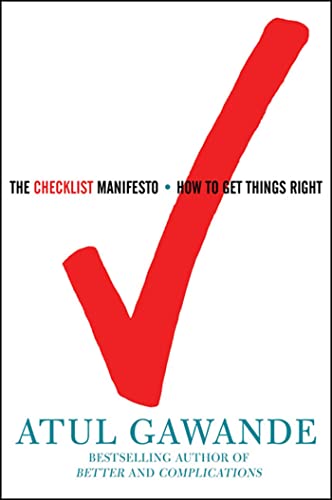
Gawande begins with the problem of “extreme complexity”: modern work contains more knowledge and interdependencies than any individual can reliably remember or control. He traces the checklist’s development in aviation and construction, then follows efforts to adapt it to medicine through the World Health Organization’s Safe Surgery Saves Lives program. The book is part reportage, part argument, and part design guide.
Core ideas
Expertise does not eliminate ordinary failure
Professionals can know what to do yet omit a basic step under pressure, distraction, fatigue, or rapidly changing conditions. The checklist addresses fallibility in attention and memory; it is not primarily a test of technical knowledge.
Checklists are coordination tools
The strongest checklists do more than remind individuals. They establish shared expectations, clarify who is responsible, surface problems early, and give team members permission to speak up. In surgery, this helps transform a collection of specialists into a coordinated team.
The checklist must be short and purposeful
A useful checklist identifies the few steps most likely to be missed or most dangerous to omit. It should fit the workflow, use clear language, specify a pause or trigger, and avoid becoming a miniature manual. Design requires observing actual work and revising the list with its users.
Two basic forms serve different situations
A “DO-CONFIRM” checklist lets people perform from memory and then pause to verify essentials. A “READ-DO” checklist guides actions sequentially. Choosing the wrong form can make the tool cumbersome or encourage superficial box-ticking.
Checklists can challenge professional hierarchy
Their value is partly cultural: a checklist can require introductions, invite questions, and make safety checks collective rather than dependent on the most senior person. This may feel bureaucratic or insulting, especially in professions that equate autonomy with competence.
Evidence is strongest for defined, repeatable processes
The book highlights striking improvements in surgical safety and infection prevention associated with checklist-based interventions, including the WHO initiative and Michigan’s central-line project. Those examples support checklists as part of a broader safety system, not as proof that every list produces dramatic results.
Practical takeaways
- Use a checklist for recurring, consequential work with multiple steps, handoffs, or participants—not for every trivial task.
- Start by asking: Which failures recur despite competent people knowing the right procedure? Those are checklist candidates.
- Keep the list short enough to use under real conditions; prioritize omissions that are common, costly, or hard to recover from.
- Decide whether the list should guide action step-by-step or prompt a verification pause after experienced people act.
- Build it with the people who perform the work, test it in practice, and revise it after near-misses and workarounds.
- Include communication checks where coordination matters: roles, goals, constraints, unresolved risks, and handoff information.
- Treat completion as a conversation or verification event, not merely a signature or a series of automatic ticks.
- Pair the checklist with training, competent staffing, feedback, and authority to stop or correct unsafe work.
Caveats and counterpoints
- The book’s most persuasive cases come from safety-critical, repeatable environments such as surgery and aviation. The argument is less directly transferable to exploratory, creative, or highly novel work.
- Observed improvements may reflect the wider implementation package—training, leadership, measurement, and team communication—not the paper list alone. The book’s anecdotes and case reporting are compelling but are not a universal causal guarantee.
- A badly designed checklist can increase friction, encourage compliance theater, or distract from judgment. More items can produce less attention, not more safety.
- Checklists cannot compensate for missing expertise, impossible workloads, poor incentives, inadequate equipment, or a culture that punishes people for raising concerns.
- The book is enthusiastic about the idea; readers should distinguish its advocacy and reported examples from a claim that checklists are equally effective in every domain.
Questions worth revisiting
- What important failures in my work are omissions rather than lack of knowledge?
- Where do handoffs or hierarchy prevent people from sharing critical information?
- What is the shortest list that would catch the most consequential recurring mistakes?
- Should my checklist be READ-DO or DO-CONFIRM, and what event should trigger it?
- How will I know whether the checklist improves outcomes rather than merely increasing documentation?
- Who has authority to revise the checklist—and to stop the process when a check fails?
Return to this when…
Return to this book when designing a recurring workflow, onboarding process, handoff, launch, review, or safety-critical procedure. The key reminder is not “make more lists,” but “design a brief shared pause that catches predictable omissions and improves coordination.”
References
- Reviews of "The Checklist Manifesto" by Atul Gawande | Harvard Magazine
- books.google.com
- The Checklist Manifesto: How to Get Things Right. | PSNet
- The Checklist Manifesto: How to Get Things Right by Atul Gawande
- us.macmillan.com
- schof.org
- openlibrary.org
- en.wikipedia.org
- books.google.com
- us.macmillan.com
- us.macmillan.com
- jacobandmarcia.com