
In one sentence
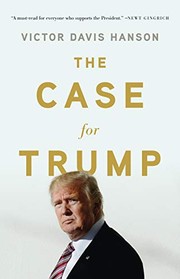
Hanson’s central claim is that Trump was not an inexplicable aberration but the product—and beneficiary—of long-running failures by both parties, media institutions, and coastal elites. Trump’s political effectiveness came from identifying neglected voters, violating establishment conventions, and forcing issues such as immigration, trade, globalization, national identity, and elite contempt into the center of national politics. Hanson presents Trump’s volatility as both a liability and a source
Overview
The book moves from Trump’s personality and political instincts to the conditions that made his candidacy possible. Its five-part structure examines “the two Americas,” Trumpism, Democratic and Republican failures, the political establishment, Trump’s historical and cultural meaning, the 2016 campaign, and his first years in office. Hanson argues that Trump’s victory reflected a counterrevolution against an entrenched ancien régime, not merely celebrity appeal or electoral accident. The original edition appeared in 2019; Basic Books issued a revised 2024 edition with a new introduction addressing the 2024 election.
Core ideas
A divided America created the opening
Hanson contrasts a prosperous, culturally influential coastal America with an interior whose working- and middle-class communities experienced deindustrialization, globalization, immigration pressures, social change, and declining political influence. Trump’s appeal, in this account, came from making these grievances visible and legitimate rather than treating them as backward or embarrassing.
Trumpism is political disruption, not a conventional ideology
The book treats Trumpism as a flexible populist coalition rather than a fully systematic doctrine. Its recurring elements are nationalism, tighter immigration controls, skepticism toward free-trade orthodoxy, opposition to progressive identity politics, demands for stronger borders, and hostility toward political correctness. Trump’s willingness to say what established politicians would not is part of the message.
Trump’s personal traits are politically functional
Hanson does not portray Trump as conventionally dignified or consistently disciplined. Instead, he argues that his aggression, self-promotion, improvisation, resilience, and resistance to shame helped him survive attacks that would have ended a normal candidacy. The same traits that create governing chaos also make Trump difficult for opponents to contain.
The establishment’s failures made the outsider credible
Democrats, Republicans, media organizations, universities, celebrities, and Washington institutions are presented as a mutually reinforcing elite culture. Hanson argues that these groups underestimated popular anger, mistook their own norms for national consensus, and responded to Trump supporters with moral condemnation rather than persuasion.
The 2016 campaign was a contest over legitimacy
Hanson interprets Trump’s victory over Republican rivals and Hillary Clinton as evidence that many voters prioritized perceived authenticity and disruption over experience, policy detail, or elite endorsements. Trump’s opponents, he argues, were stronger within established institutions but weaker at recognizing how thoroughly those institutions had lost trust.
The presidency should be judged by outcomes as well as temperament
Hanson acknowledges Trump’s vulgarity, pettiness, impulsiveness, and occasional incoherence, but emphasizes the policies he credits with economic growth before the COVID-19 disruption, deregulation, tax reduction, conservative judicial appointments, pressure on allies, confrontation with China, and a more restrictive immigration posture. His case is therefore outcome-oriented: an unpleasant messenger may still produce useful policy.
Historical analogies clarify, but also overstate
As a classicist and military historian, Hanson places Trump alongside outsider or disruptive political figures and sometimes casts him as a tragic or heroic type. These analogies illuminate the recurring conflict between popular resentment and established order, but reviewers have found them less persuasive when they substitute dramatic archetypes for institutional or empirical analysis.
Practical takeaways
- When evaluating a populist movement, distinguish the leader’s personality from the grievances and institutional failures that made the movement possible.
- Treat elite consensus as evidence of institutional agreement, not automatically as evidence of broad public agreement.
- Separate questions of political representation from questions of policy effectiveness: a movement can accurately express alienation while proposing flawed solutions.
- Political style can be instrumentally effective even when it damages deliberation, coalition-building, and administrative competence.
- Ask what a candidate’s opponents misunderstand about the voters they dismiss; contempt can become a political organizing force.
- Use historical analogies as interpretive tools, not as proof that a contemporary leader is equivalent to an ancient or earlier figure.
Caveats and counterpoints
- This is an advocacy book, not a neutral biography or balanced assessment of the Trump presidency. Its purpose is to explain and defend Trump’s appeal and record.
- Hanson’s account tends to foreground the grievances of white working- and middle-class voters and gives less weight to voters of other races, welfare-state concerns, and criticisms that Trump’s policies benefited groups beyond his core constituency.
- The argument often treats media, universities, Democrats, Republicans, and coastal elites as a unified establishment, which can flatten important differences among institutions and political factions.
- The book’s assessment of Trump’s success is bounded by its publication period: the original edition focuses on the 2016 campaign and first two years of his presidency. The 2024 revised edition adds later framing, but it should not be confused with the original 2019 text.
- Claims about an “extremely successful” presidency reflect Hanson’s judgment. They are not an uncontested historical conclusion; readers should compare the book with critical accounts of Trump’s governance, institutions, and consequences.
Questions worth revisiting
- Which grievances Hanson identifies are materially grounded, and which are primarily cultural or status-based?
- Does Trump represent neglected voters, or does he mainly convert their resentment into personal loyalty?
- Can outsider rhetoric produce durable institutional reform, or does it depend on continual conflict?
- Which of Hanson’s policy claims would remain persuasive if Trump’s temperament and conduct were evaluated separately?
- Do the historical analogies explain Trump, or mainly elevate a contemporary political argument into a grander narrative?
- What evidence would distinguish a genuine realignment of working-class voters from a temporary reaction to Democratic and Republican failures?
Return to this when…
Return to this book when you want a concise, historically framed statement of the sympathetic conservative case for Trump’s rise and first presidency—especially the argument that institutional contempt and political neglect helped create his coalition. Pair it with a critical history of the same period to test Hanson’s selection of evidence, causal claims, and judgments.