
In one sentence
The events that most shape history, markets, and personal lives are often outliers that ordinary forecasts cannot anticipate. Because humans prefer orderly explanations, we underestimate such events beforehand and construct convincing stories afterward. Good judgment therefore requires humility about prediction, attention to asymmetric consequences, and protection against catastrophic exposure.
Overview
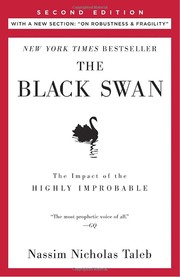
Taleb develops the “black swan” as a three-part phenomenon: it is an outlier, it has extreme consequences, and people retrospectively make it seem predictable. The book critiques induction—the assumption that the future will resemble the past—along with overconfident experts, elegant but fragile models, and narratives that compress messy causation into simple explanations. Its major conceptual contrast is between “Mediocristan,” where individual observations have limited influence, and “Extremistan,” where a few observations dominate the total. The second edition adds a section on robustness and fragility.
Core ideas
Black swans and epistemic blindness
A black swan is not merely an unlikely event; it is an event whose possibility was insufficiently represented in the observer’s model. Its importance comes from the combination of surprise and consequence. The central warning is that absence of evidence is not evidence that a major possibility is absent.
Induction is weaker than it feels
Repeated past observations can support a belief without proving it will continue. A long history of stability may conceal vulnerability rather than demonstrate safety. Taleb uses the problem of the “turkey” to illustrate how accumulated confirmation can be overturned by one decisive event.
Narrative fallacy
After an event occurs, people select facts that fit it and arrange them into a coherent causal story. This makes the past look more predictable than it was and encourages unjustified confidence about the future. Explanations can be useful without being reliable forecasts.
Silent evidence and survivorship bias
Visible successes are not a representative sample: failures, abandoned projects, bankrupt firms, and unrecorded alternatives often disappear from view. Judging a strategy only by survivors exaggerates skill and understates luck.
Mediocristan versus Extremistan
In Mediocristan, extreme observations are rare enough that averages are informative—for example, many ordinary physical measurements. In Extremistan, a small number of observations can dominate the aggregate—such as wealth, book sales, market losses, or the reach of a technology. Statistical methods suited to the first setting can fail badly in the second.
The ludic fallacy
Clean games with known rules and bounded outcomes encourage false confidence about real life. Real-world uncertainty includes unknown variables, changing rules, dependence between events, and uncertainty about the probability model itself.
Prediction versus exposure
Taleb’s practical emphasis is less “forecast better” than “design decisions that survive being wrong.” Limit ruinous downside, avoid excessive dependence on a single model, and seek situations where modest losses are paired with occasional large gains. This is an application of the book’s argument, not a guarantee that black swans can be identified in advance.
Robustness and fragility
The added second-edition material extends the argument from recognizing uncertainty to managing it. A robust system tolerates shocks; a fragile one is damaged by variability, even when average outcomes look favorable. Some arrangements can benefit from disorder, but The Black Swan mainly establishes the problem that later Incerto books develop further.
Practical takeaways
- Ask whether the situation is closer to Mediocristan or Extremistan before trusting averages, forecasts, or normal-distribution assumptions.
- Separate the probability of an event from the size of its consequences. A low-probability event may still deserve attention if ruin is possible.
- When hearing a post hoc explanation, ask what competing explanations, failed predictions, and unseen cases were omitted.
- Treat expert forecasts skeptically when the forecaster lacks relevant feedback, has no meaningful stake in being wrong, or operates in a domain dominated by outliers.
- Prefer decision rules that cap downside and preserve upside; avoid strategies that produce steady small gains while exposing you to occasional ruin.
- Record predictions and assumptions before outcomes occur. This makes hindsight and narrative reconstruction easier to detect.
- Do not confuse uncertainty with total ignorance: even when precise probabilities are unavailable, you can often identify vulnerabilities, asymmetries, and unacceptable losses.
Caveats and counterpoints
- Taleb’s critique is strongest against overconfident prediction and poorly specified statistical models, not against all forecasting, statistics, or expertise. Some reviewers and statisticians argue that he understates the usefulness of probability theory and Bayesian methods when assumptions are explicit and tested.
- The book’s examples and polemical style are not always organized as a systematic argument; critics note that the rhetoric can outrun the formal evidence.
- “Black swan” is sometimes used loosely to mean any surprising event. Taleb’s stricter sense requires an outlier, major impact, and retrospective predictability—not simply rarity.
- The recommended posture of extreme skepticism can itself become unhelpful if applied indiscriminately. Institutions still need forecasts, models, and plans; the relevant question is how much reliance and exposure they should carry.
Questions worth revisiting
- Which decisions in my life are exposed to Extremistan rather than Mediocristan outcomes?
- What evidence has disappeared because only successful cases remain visible?
- Am I explaining an outcome after the fact more confidently than I predicted it beforehand?
- What assumptions would have to be wrong for this plan to cause ruin?
- Can I redesign the decision so that being wrong is survivable and being unexpectedly right is valuable?
Return to this when…
Return to these notes when evaluating forecasts, investment or career choices, historical explanations, expert advice, or any plan that appears safe because it has worked repeatedly. The key reminder is not that surprises are common in every domain, but that their frequency and impact are often badly misestimated.
References
- The Black Swan: Second Edition by Nassim Nicholas Taleb: 9780812973815 | PenguinRandomHouse.com: Books
- goodreads.com
- doi.org
- librarycatalog.folsom.ca.us
- en.wikipedia.org
- vitalsource.com
- airuniversity.af.edu
- (PDF) Nassim Nicholas Taleb: The black swan: The impact of the highly improbable
- sciencedirect.com
- app.thestorygraph.com
- onlinelibrary.wiley.com
- mathshistory.st-andrews.ac.uk