
In one sentence
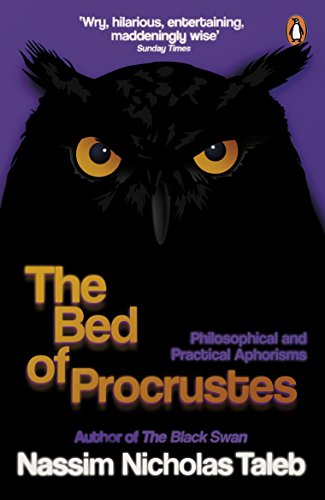
People repeatedly distort reality to fit simplified intellectual, institutional, and technological frameworks. Better judgment comes from recognizing limits to knowledge, distrusting elegant explanations, preserving freedom of action, and choosing habits and systems that remain sound when predictions fail.
Overview
This is not a linear philosophical argument but a deliberately discontinuous collection of aphorisms, arranged under themes including counter-narratives, the sacred and profane, sucker problems, letters and learning, randomness, aesthetics, robustness and antifragility, prediction, wisdom, and love. The form is part of the method: short statements invite resistance, rereading, and independent judgment rather than passive acceptance.
Core ideas
The Procrustean error
A Procrustean bed is any framework that makes reality conform to its dimensions. Taleb applies the metaphor to economic models, standardized measures of intelligence, professional jargon, technology, social narratives, and other systems that simplify by cutting away inconvenient evidence.
Uncertainty is structural, not temporary
The problem is not merely that we lack enough data. Rare events, hidden variables, model error, and changing conditions make confident prediction intrinsically fragile. Treating uncertainty as a permanent feature of life is more useful than pretending it can be eliminated.
Robustness beats precision
When forecasts are unreliable, prefer choices that tolerate error: avoid ruin, keep options open, maintain slack, and build systems that function across many possible futures. A precise prediction is less valuable than a position that does not require one.
Antifragility and exposure to disorder
Some things do more than resist shocks: they improve through variability, stress, experimentation, and small failures. Taleb’s practical orientation favors decentralized trial and error over centralized optimization, while recognizing that not every exposure is beneficial—large, irreversible risks can destroy rather than strengthen.
Beware narrative and hindsight
Humans retrofit events into coherent stories and mistake explanations produced after the fact for genuine foresight. Ask what was knowable beforehand, what alternative outcomes were plausible, and whether the story predicts anything—or merely makes the past feel orderly.
Skin in the game
Judgment should be tested against consequences. Distrust advisers, experts, managers, and commentators whose recommendations expose others to downside while preserving their own comfort. Responsibility, personal risk, and demonstrated practice are better credibility tests than credentials alone.
Classical virtues versus modern status games
Taleb repeatedly contrasts independence, courage, elegance, erudition, and self-command with credentialism, fashion, bureaucratic conformity, and performative sophistication. His ideal is not withdrawal from society but resistance to incentives that reward appearance over substance.
Aphorism as intellectual friction
The compressed form is designed to unsettle. Aphorisms can reveal a pattern faster than an extended argument, but they also depend on context and can overstate for effect. They are prompts for examination, not a substitute for evidence or systematic reasoning.
Practical takeaways
- When making an important decision, identify what would cause irreversible ruin and protect against that first.
- Prefer reversible experiments, optionality, and small bets when you cannot estimate probabilities reliably.
- Treat forecasts as fragile inputs; evaluate whether the decision remains acceptable if the forecast is badly wrong.
- Separate explanation from prediction: a compelling story about why something happened may have little forward-looking value.
- Look for hidden asymmetries: who gains if advice succeeds, who pays if it fails, and whether the adviser shares the downside.
- Keep slack in schedules, finances, institutions, and plans; maximum efficiency often removes the buffer that absorbs shocks.
- Be suspicious of categories and metrics that are easy to measure but may not represent what actually matters.
- Read the aphorisms slowly and selectively. The book is better used as a recurring provocation than as a one-sitting argument.
Caveats and counterpoints
- The book’s claims are intentionally compressed, provocative, and sometimes aphoristic rather than demonstrated. They should not be mistaken for universal laws.
- Taleb’s criticism of experts, academia, modernity, and prediction is insightful when incentives and model uncertainty matter, but it can become overly sweeping; expertise and formal models remain valuable in bounded, stable domains.
- Robustness and antifragility are not identical: avoiding harm is different from benefiting from volatility, and some shocks are too large or irreversible to serve as useful learning experiences.
- The rhetoric often favors classical ideals and personal independence, which may understate the benefits of specialization, coordination, institutions, and collective expertise.
- Because this is a thematic aphorism collection rather than a cumulative treatise, readers looking for definitions, evidence, or a step-by-step method may find the presentation impressionistic. A serious review likewise describes it as a rapid restatement of Taleb’s familiar targets, offering both more—and less—than his longer works.
Questions worth revisiting
- Where am I forcing a person, project, or problem to fit a preferred category or metric?
- Which of my decisions depend on a forecast, and how bad is the outcome if that forecast is wrong?
- What risks am I taking that are hidden, nonlinear, or capable of causing ruin?
- Do the people influencing this decision have meaningful skin in the game?
- Which apparent successes may be luck, survivorship, or favorable randomness rather than skill?
- Am I preserving optionality, or optimizing so aggressively that I have no room to adapt?
- Which of Taleb’s provocations expose a real bias, and which rely mainly on rhetorical exaggeration?
Return to this when…
Return when you are overconfident in a model, seduced by a neat narrative, optimizing for efficiency, or evaluating advice from people insulated from its consequences. Revisit the sections on randomness, robustness and antifragility, prediction, and “sucker problems” before making decisions under deep uncertainty.
Highlights
Your brain is most intelligent when you don’t instruct it on what to do—something people who take showers discover on occasion.
The three most harmful addictions are heroin, carbohydrates, and a monthly salary.
With regular books, read the text and skip the footnotes; with those written by academics, read the footnotes and skip the text; and with business books, skip both the text and the footnotes.
Corollary to Moore’s Law: every ten years, collective wisdom degrades by half.
When conflicted between two choices, take neither.
Robust is when you care more about the few who like your work than the multitude who dislike it (artists); fragile when you care more about the few who dislike your work than the multitude who like it (politicians).
- The best way to spot a charlatan: someone (like a consultant or a stockbroker) who tells you what to do instead of what not to do.
For Seneca, the Stoic sage should withdraw from public efforts when unheeded and the state is corrupt beyond repair. It is wiser to wait for self-destruction.
There are designations, like “economist,” “prostitute,” or “consultant,” for which additional characterization doesn’t add information.
A mathematician starts with a problem and creates a solution; a consultant starts by offering a “solution” and creates a problem.
In the past, only some of the males, but all of the females, were able to procreate. Equality is more natural for females.
We expect places and products to be less attractive than in marketing brochures, but we never forgive humans for being worse than their first impressions.
References
- goodreads.com
- The Bed of Procrustes: Philosophical and Practical Aphorisms - Nassim Nicholas Taleb - Google Books
- bedofprocrustes.com
- goodreads.com
- alexjhughes.com
- bedofprocrustes.com
- The Bed of Procrustes, By Nassim Nicholas Taleb | The Independent | The Independent
- penguinrandomhouse.com
- goodreads.com
- williammeller.com
- en.wikipedia.org
- penguin.co.uk