
In one sentence
Epicurus’s answer to the good life is not indulgence but intelligent simplification: understand nature, eliminate groundless fears, limit desires to what is genuinely needed, cultivate dependable friendships, and choose pleasures by their long-term consequences. Happiness is chiefly stable freedom from bodily pain and mental disturbance—tranquility rather than constant stimulation.
Overview
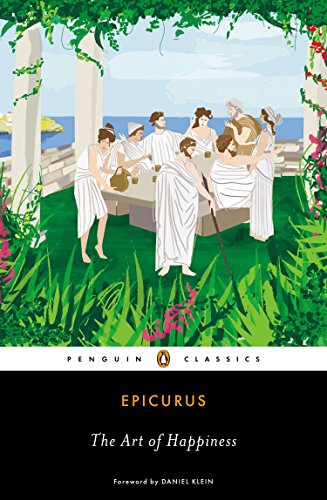
This exact 2012 Penguin Classics edition is a curated collection rather than a single book authored in its present form. It includes Epicurus’s surviving letters, Principal Doctrines, Vatican Sayings, Strodach’s introduction and commentary, parallel passages from Lucretius, extracts from Diogenes Laertius’s biography, and Daniel Klein’s foreword. The edition descends from Strodach’s 1963 translation, originally published as The Philosophy of Epicurus.
Core ideas
Pleasure means an undisturbed life
Pleasure is the end of life, but Epicurus does not primarily mean intense consumption. The highest condition is freedom from bodily pain and psychic disturbance—often described as tranquility or ataraxia, alongside aponia, freedom from bodily pain. Positive enjoyments still matter, but they are safest when they do not generate new dependence or anxiety.
Classify desires before pursuing them
Natural and necessary desires—such as food, shelter, and basic security—are limited and worth satisfying. Natural but unnecessary desires, such as luxuries, may be enjoyed without becoming necessities. Vain or empty desires—especially limitless demands for wealth, status, power, or fame—are socially produced, difficult to satisfy, and major sources of anxiety.
Reason is a pleasure-selection tool
Epicurus does not say every pleasure should be chosen or every pain avoided. Some pleasures create greater later pain; some pains produce greater long-term benefits. Practical wisdom therefore calculates consequences, distinguishes needs from conditioned wants, and favors durable security over short-lived intensity.
Natural science is psychological therapy
Atomism and the material nature of the soul are not merely abstract physics. They help dissolve fear of divine punishment and the afterlife. The gods, if they exist, do not govern human affairs; death cannot harm us as an experience because where death is present, sensation is absent.
Friendship is central, not decorative
A secure circle of friends supplies pleasure, mutual aid, trust, and protection from fear. Epicurean withdrawal from competitive public ambition is therefore not simple isolation: the ideal is a modest, cooperative community insulated from status competition and political turmoil.
Justice is a practical agreement
Justice is treated less as an eternal cosmic property than as a mutual arrangement not to harm or be harmed. Its value depends on circumstances and shared benefit. Acting unjustly is psychologically costly because fear of discovery and retaliation disturbs tranquility.
The four-part therapeutic sequence
The collection can be remembered as a four-part cure: do not fear the gods; do not fear death; recognize that the good is relatively easy to obtain; recognize that severe troubles are limited or bearable. The wider system—desire-management, friendship, and natural explanation—makes that cure practicable.
Practical takeaways
- Audit a recurring want: Is it natural and necessary, natural but optional, or empty and socially manufactured?
- Before pursuing a pleasure, include its likely after-cost: dependence, expense, distraction, anxiety, or loss of freedom.
- Define “enough” for food, money, status, and possessions. A desire with no stopping point cannot reliably produce tranquility.
- When anxiety concerns death or cosmic judgment, separate the physical event from the imagined future experience and examine the assumptions producing fear.
- Invest deliberately in a small number of reliable friendships; Epicurean happiness is communal and security-oriented, not merely solitary.
- Use philosophy diagnostically: identify the belief generating distress, then test whether it reflects nature, evidence, or an unbounded social expectation.
- Prefer stable pleasures that remain available under changing circumstances—conversation, reflection, simple food, memory, and companionship—over pleasures requiring continual escalation.
Caveats and counterpoints
- The book’s title can make it sound like a modern self-help manual. It is instead an edited anthology of fragmentary ancient material, supplemented by later witnesses and modern editorial commentary.
- The volume’s Epicurean physics is historically important but not scientifically reliable by modern standards. Its practical value lies more in the psychological function of naturalistic explanation than in accepting its ancient cosmology.
- Epicurus’s hedonism is easy to misread as either consumerist pleasure-seeking or total abstinence. His position is more demanding: pleasure is the criterion, but prudence often recommends simplicity and restraint.
- The recommendation to avoid politics reflects Epicurus’s concern with status competition, insecurity, and disturbance; it may be difficult to apply where political participation is necessary to protect oneself or others.
- Friendship is partly explained in terms of security and pleasure. Readers who regard friendship as intrinsically valuable may find this instrumental framing incomplete or reductionist.
- The death argument removes fear of being dead, but it does not by itself settle every concern about dying, grief, unfinished responsibilities, or the suffering involved in the process of dying.
Questions worth revisiting
- Which of my desires have a natural stopping point, and which become larger as they are fed?
- What pleasures do I currently mistake for necessities?
- Which fear would lose force if I understood its natural causes more clearly?
- Am I pursuing status or wealth for practical security, or because the desire itself has become limitless?
- What would a deliberately sufficient life look like in concrete weekly habits?
- Does Epicurus’s account of friendship explain the whole value of friendship, or mainly one important dimension of it?
- Where would withdrawal from competition protect tranquility, and where might it amount to avoiding civic responsibility?
Return to this when…
Return to the sections on the Letter to Menoeceus, the Principal Doctrines, and the Vatican Sayings when you need a compact reminder that happiness depends less on acquiring more than on correcting beliefs, reducing unnecessary desire, and protecting time with trusted friends. Revisit Strodach’s commentary when a maxim seems to conflict with Epicurus’s broader materialist and therapeutic system.
Highlights
Epicurus’s notion of happiness has a decidedly Buddhist quality. Happiness is tranquility, and tranquility comes principally from putting aside worldly “hankerings”—ambitions for power, status, involvement in government, the pursuit of voluptuous sensory experiences, and the accumulation of material goods. Two of Epicurus’s most quoted maxims distill this idea: “Not what we have, but what we enjoy, constitutes our abundance” and, in its more admonitory form, “Nothing is enough for the man to whom enough is too little.”
Stranger, here you will do well to tarry; here our highest good is pleasure. The caretaker of that abode, a kindly host, will be ready for you; he will welcome you with bread, and serve you water also in abundance, with these words: “Have you not been well entertained? This garden does not whet your appetite, but quenches it.”