
In one sentence
Wealth and happiness are developable capacities. Wealth comes from judgment applied through specific knowledge, accountability, ownership, and leverage—not merely from working harder or earning a higher salary. Happiness comes less from acquiring conditions than from training attention, reducing unnecessary desire, and becoming less psychologically dependent on outcomes.
Overview
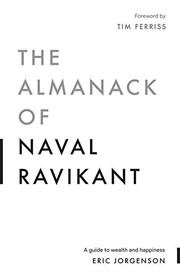
This is a curated compilation, not a linear argument, memoir, or step-by-step investing manual. Jorgenson organizes Naval’s public thinking into sections on building wealth, building judgment, and learning happiness, with a reading list and supplementary material. The book’s distinctive move is to connect external freedom with inner freedom: ownership and leverage can reduce financial dependence, while disciplined desire and clear thinking can reduce emotional dependence.
Core ideas
Seek wealth, not money or status
Money is a means of transferring value; wealth is owning assets, businesses, or systems that can produce value without requiring a proportional exchange of your hours. Status is a relative ranking game, while wealth creation is presented as a positive-sum activity.
Use the wealth equation
Naval’s central model combines specific knowledge, accountability, and leverage. Specific knowledge is difficult to train directly and tends to emerge from genuine curiosity, unusual combinations of skills, and work that feels intrinsically engaging. Accountability means attaching your name and reputation to outcomes. Leverage multiplies judgment through capital, people, code, media, or other scalable tools.
Own a piece of the upside
Trading time for wages can provide income but usually limits scale. The stronger long-term position is ownership: equity, products, intellectual property, or an audience. The idea is not that employment is worthless, but that ownership changes the relationship between effort and potential reward.
Choose games that compound
Relationships, reputation, knowledge, capital, and good judgment can compound over long periods. Prefer trustworthy partners, durable skills, and repeated interactions over short-term wins, constant resets, or adversarial games where someone else’s loss is central to your gain.
Develop judgment through first principles
Rather than copying tactics, reduce problems to fundamentals, distinguish facts from narratives, and learn to reason independently. Reading foundational works, thinking clearly, and forming opinions slowly are treated as ways to improve decision quality.
Happiness is an internal practice
The book presents happiness less as a prize delivered by success than as a trainable state of reduced inner conflict. Desire, comparison, anxiety, and attachment to outcomes create dissatisfaction; meditation, presence, acceptance, and deliberate habits can weaken those patterns.
Use wealth to buy freedom
The purpose of wealth is primarily autonomy: control over one’s time, attention, and choices. More consumption or status may not produce corresponding well-being, so financial progress should be judged partly by how much unnecessary dependence it removes.
Practical takeaways
- Inventory activities that feel unusually natural or absorbing; look for combinations of interests and abilities that are difficult to outsource or automate.
- Build one valuable skill deeply, then pair it with communication, sales, technology, or distribution so it can reach more people.
- Prefer projects in which you can retain ownership, royalties, equity, or an audience rather than receiving only one-time payment.
- Make your reputation legible: take responsibility for outcomes and let repeated, reliable work become an asset.
- Choose long-horizon relationships and projects where trust, learning, and capital can accumulate.
- Separate financial goals from status goals; define the level of security and autonomy you actually need.
- Experiment with reducing inputs that intensify comparison or craving, including compulsive media and unnecessary consumption.
- Treat happiness as a daily maintenance problem: notice dissatisfaction, question the desire beneath it, and practice attention without immediately acting on every impulse.
Caveats and counterpoints
- The book is Naval Ravikant’s worldview arranged by Eric Jorgenson, not a balanced survey of personal finance, economics, psychology, or entrepreneurship. Its aphoristic source material often compresses complex issues into memorable rules.
- The wealth advice is especially shaped by technology entrepreneurship, investing, and scalable digital businesses. Code, media, equity, and leverage are not equally available or safe for every worker, and ownership can involve substantial risk, delayed rewards, and failure.
- The claim that wealth is broadly learnable can understate luck, family resources, education, health, discrimination, immigration status, economic cycles, and structural barriers. The framework is most useful as a way to identify opportunities—not as a guarantee that effort will produce wealth.
- The happiness section emphasizes personal responsibility and mental training. That can be useful, but it may underweight material hardship, illness, trauma, social isolation, and political conditions that cannot be solved by changing one’s mindset alone.
- Because the book is curated from earlier public remarks, repetition and apparent tension are possible. Read the principles as prompts for judgment rather than as a fully specified system.
Questions worth revisiting
- Which of my current activities could become valuable specific knowledge rather than merely more credentials?
- Where am I trading time for money without building ownership, reputation, or reusable assets?
- What kind of leverage fits my actual advantages, resources, and risk tolerance?
- Which of my goals are about freedom, and which are mainly about comparison or status?
- What recurring desire or source of comparison most reliably disturbs my peace?
- Which long-term relationships, skills, or projects deserve more consistent investment?
- What evidence would show that a Naval-style opportunity is genuinely scalable rather than merely fashionable?
Return to this when…
Return when evaluating a career pivot, business idea, ownership opportunity, or attempt to simplify your life. The wealth frameworks are useful as a pre-decision checklist; the happiness material is best revisited when ambition has begun turning into comparison, anxiety, or compulsive wanting.