
In one sentence
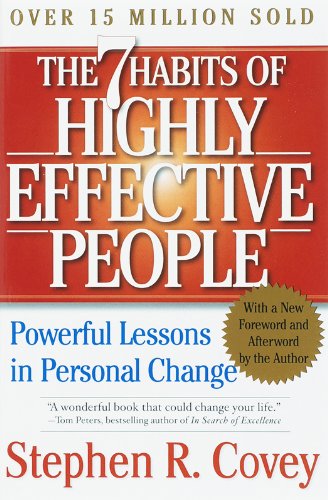
Effectiveness is an inside-out process: durable external results depend on changing one’s paradigms, motives, and repeated behaviors—not merely adopting better techniques. Covey organizes this progression from dependence, through independence, to interdependence, with renewal sustaining the whole system.
Overview
The book begins by contrasting a “personality ethic” of image, tactics, and quick fixes with a “character ethic” grounded in principles such as integrity, fairness, responsibility, and human dignity. Its seven habits form a sequence: private victory (Habits 1–3), public victory (Habits 4–6), and balanced renewal (Habit 7). The framework is intended for work, family, leadership, and personal decision-making.
Core ideas
1. Be proactive
Treat yourself as responsible for your response, choices, and commitments rather than as a product of circumstances. Covey distinguishes the “circle of concern” from the smaller “circle of influence”: effectiveness grows by acting first on what you can influence.
2. Begin with the end in mind
Define the values and contribution you want your life to express before letting immediate demands set your direction. Covey’s practical device is a personal mission statement: a written compass for roles, priorities, and decisions.
3. Put first things first
Translate values into time and attention. The central distinction is between what is urgent and what is important; effectiveness requires protecting important, non-urgent activities such as preparation, relationship-building, planning, and prevention.
4. Think win/win
Approach relationships as opportunities for mutually beneficial agreements rather than domination, submission, or zero-sum bargaining. Covey presents win/win as an abundance-oriented mindset, but also allows that some situations call for “win/win or no deal.”
5. Seek first to understand, then to be understood
Listen empathically before presenting your own position. The habit is less about passive politeness than about accurately understanding another person’s frame of reference, which makes later explanation and problem-solving more credible.
6. Synergize
Use genuine differences—not merely consensus—to produce better alternatives. Synergy depends on trust, respectful communication, and the willingness to treat disagreement as information rather than as a threat.
7. Sharpen the saw
Regularly renew four dimensions of capacity: physical, mental, spiritual, and social/emotional. Renewal is not an optional reward after productivity; it is the maintenance process that preserves the other six habits.
Practical takeaways
- When overwhelmed, list concerns, mark what is influenceable, and choose one concrete action within your influence.
- Write a short personal mission statement, then test weekly commitments against it.
- Plan important-but-not-urgent work before filling the calendar with other people’s urgencies.
- For a difficult conversation, summarize the other person’s position until they recognize it as accurate before arguing your own.
- Look for agreements that preserve both parties’ dignity and interests; if none is possible, explicitly acknowledge that rather than forcing a pseudo-compromise.
- Treat exercise, learning, reflection, and relationship maintenance as scheduled inputs to effectiveness, not leftovers.
Caveats and counterpoints
- Covey presents principles such as fairness, integrity, and mutual benefit as broadly valid, but readers may reasonably disagree about which principles should govern contested decisions. The framework is normative, not a neutral scientific theory.
- The advice assumes meaningful personal agency. It can understate structural constraints—poverty, discrimination, illness, exploitative workplaces, or unequal power—where changing one’s response cannot by itself produce a fair outcome.
- The habits are memorable but broad. “Be proactive,” “synergize,” and “think win/win” do not specify enough on their own for every organizational, clinical, or political problem; situational expertise and evidence are still needed.
- The book’s examples and managerial vocabulary reflect its late-20th-century setting. Its ideas remain usable, but some applications require adaptation to remote work, cultural difference, power asymmetries, and modern knowledge of burnout.
- Critics have also noted that the book can make principled self-command sound like a general solution to human problems and can be more inspirational than empirically demonstrated. Treat its models as useful lenses to test, not guaranteed causal laws.
Questions worth revisiting
- Which of my current commitments reflect my values, and which merely reflect urgency or other people’s expectations?
- Where am I blaming circumstances when I still have a small but meaningful area of influence?
- What important activity am I repeatedly postponing because it produces no immediate reward?
- In my next disagreement, what would it take for the other person to feel genuinely understood?
- When might “win/win” be inappropriate because the power relationship or incentives are fundamentally unequal?
- Which form of renewal—physical, mental, spiritual, or relational—is currently most neglected?
Return to this when…
Return to the book when your productivity system is becoming reactive, when a relationship is stuck in positional argument, or when goals feel disconnected from values. The most useful reread is usually targeted: Habits 1–3 for personal direction and priorities, Habits 4–6 for collaboration, and Habit 7 when effectiveness is turning into depletion.
References
- The 7 habits of highly effective people : powerful lessons in personal change - Free Library Catalog
- The 7 Habits of Highly Effective People: Summary & Review — Covey | Huffman Writes
- managementtoday.co.uk
- shortform.com
- simonandschuster.com
- utoread.com
- en.wikipedia.org
- goodreads.com
- reiprime.com
- discover.knoxcountylibrary.org
- luvembooks.com
- researchgate.net