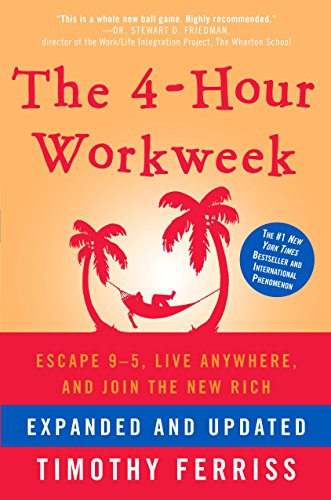

In one sentence
The book’s central argument is that conventional work is organized around outdated assumptions: constant availability, delayed gratification, and measuring effort rather than results. Ferriss proposes designing work around desired experiences, then using selective focus, automation, outsourcing, and geographic flexibility to reduce dependence on one’s own labor. The “four hours” is best understood as an aggressive direction, not a dependable universal outcome.
Overview
Ferriss presents a four-part framework: Define the life and income you actually want; Eliminate low-value activity; Automate a narrowly tested business or income stream; and Liberate yourself from location and conventional schedules. The expanded 2009 edition added more than 100 pages and reader case studies, but the core premise remained lifestyle design rather than ordinary time management.
Core ideas
Define the goal before optimizing work
Ferriss distinguishes income from the “currencies” of time and mobility. Start with concrete desired experiences, costs, and timelines rather than assuming a promotion or retirement is the objective. His “dreamlining” approach turns vague aspirations into testable financial and logistical targets.
Use selective ignorance
Productivity comes less from doing everything faster than from refusing low-value inputs. Reduce meetings, interruptions, routine communications, and information consumption; protect attention for tasks that materially affect results.
Apply the 80/20 rule aggressively
Look for the small number of customers, products, tasks, and channels producing most of the value. Ferriss treats concentration as a way to simplify operations, not merely as a minor efficiency improvement.
Eliminate before automating
Automation can make a bad process run faster. First remove unnecessary obligations and establish boundaries—such as limited communication windows—then delegate or systematize what remains.
Test demand before building
For a new product, use a low-cost market test—such as advertising or taking orders around a clearly defined offer—before investing heavily in inventory, infrastructure, or a full business. The underlying mental model is rapid validation and reversible experimentation.
Outsource outcomes, not vague labor
Delegation works best when the task, desired result, quality standard, decision authority, and escalation path are explicit. Ferriss emphasizes creating systems that require fewer personal decisions, though his low-cost outsourcing examples can understate training, coordination, privacy, and labor concerns.
Liberation is gradual, not merely geographic
Remote work, travel, and “mini-retirements” are presented as ways to practice the desired lifestyle now rather than defer it indefinitely. The practical sequence is to reduce dependence on a single workplace or operator—not simply to relocate.
Practical takeaways
- Write down what “enough” income, free time, and mobility mean for you; include actual costs and a target date.
- Track one week of activity, then delete, defer, batch, or delegate anything that does not support a priority.
- Check email and messages at predetermined times instead of treating them as an always-open task queue.
- Identify the highest-value customers, products, or responsibilities and concentrate effort there.
- Before building a business, test whether a specific audience will respond to a specific offer.
- Document recurring processes so another person can execute them without constant clarification.
- Run a small, reversible lifestyle experiment—remote days, a short work-abroad period, or a reduced-availability schedule—before making a major career change.
Caveats and counterpoints
- The title overpromises. Even favorable assessments describe the four-hour target as misleading or unrealistic for many readers; the book is more useful as a provocation to redesign work than as a literal formula.
- Many examples assume entrepreneurial control, a marketable skill, savings, favorable geography, and tolerance for income volatility. Employees in regulated, care-based, physical, or team-dependent work may have far less flexibility.
- The book relies heavily on Ferriss’s own successes and selected case studies. Those examples can generate hypotheses, but they do not establish typical outcomes; survivorship bias is a substantial limitation.
- Outsourcing and labor arbitrage raise ethical and practical questions that the book treats comparatively lightly, including fair pay, privacy, accountability, and the cost of managing delegated work.
- Aggressive elimination can damage learning, relationships, craftsmanship, or long-term career development when activities have delayed or hard-to-measure value.
- The business tactics are historically situated. Specific platforms, advertising methods, virtual-assistant markets, and communication tools from the 2007–2009 context should be updated before use; retain the principles of testing, simplification, and leverage rather than copying the examples.
Questions worth revisiting
- What would I do with substantially more discretionary time—and have I tested whether I actually want that life?
- Which activities create measurable results, and which merely signal busyness or responsiveness?
- What is the smallest experiment that could disprove my current career or business assumption?
- Where would automation improve my life, and where would it merely transfer hidden costs to customers, coworkers, or contractors?
- What valuable work, relationships, or skills might I accidentally eliminate by optimizing only for short-term freedom?
Return to this when…
Return to the DEAL framework when work expands without clearly improving income, autonomy, or life quality. The most reusable sections are the exercises on defining “enough,” eliminating low-value activity, validating demand before building, and designing systems that reduce dependence on your constant involvement.
References
- goodreads.com
- The 4-Hour Workweek, Expanded and Updated by Timothy Ferriss: 9780307465351 | PenguinRandomHouse.com: Books
- thedeepdish.org
- The 4-Hour Workweek Free Review by Timothy Ferriss
- The 4-Hour Workweek Review: Does it Really Work?
- Book Review: The 4-Hour Workweek? You Should Be So Lucky | WIRED
- successbooks.com
- tim.blog
- rhett.blog
- ybrikman.com
- thetestedhub.com
- cpcglobal.org