
In one sentence
Successful startups rarely begin with a perfect idea. They emerge when founders turn uncertain hypotheses into experiments, learn quickly from evidence, adapt the business model, and keep working through long periods when failure remains more likely than success.
Overview
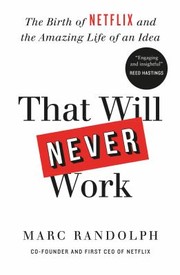
Randolph recounts Netflix’s early history from his perspective as co-founder and first CEO. The company did not begin with a single lightning-bolt insight: Randolph and Reed Hastings generated many proposals before exploring online movie rentals. Because videotapes were too costly to mail, the arrival of DVDs created a promising test. Early tactics included selling DVDs, promotional rentals, and eventually a subscription model without late fees. Netflix survived repeated financial, operational, and strategic crises, including layoffs, failed partnership efforts, and unsuccessful attempts to sell to Amazon and Blockbuster. Randolph presents the story as a memoir with embedded startup advice, not as a comprehensive corporate history.
Core ideas
Ideas are hypotheses, not verdicts
The useful question is not whether an idea sounds brilliant or foolish; it is what inexpensive test could reveal whether customers actually want it. Netflix’s early concept changed repeatedly as the founders encountered technical and economic constraints.
Generate broadly, then test narrowly
Randolph’s brainstorming process produced many bad ideas alongside promising ones. This reframes ideation as a volume-and-selection process: create possibilities freely, then use evidence—not enthusiasm—to eliminate them.
Focus on the problem, not the initial solution
The underlying problem was convenient access to movies, not specifically “DVD rental by mail.” The eventual service emerged through several iterations, including delivery experiments, rental mechanics, and the subscription/no-late-fee combination. Library Journal highlights this as one of Randolph’s closing lessons.
Small experiments beat abstract debate
The founders used prototypes and market tests to investigate mailing media, customer response, fulfillment, and pricing. The lesson is not to build a polished version first; it is to identify the riskiest assumption and test that assumption directly.
Persistence is necessary but not sufficient
Netflix remained close to failure for years. Persistence mattered because it created time for learning, but survival also required changing tactics, confronting weak economics, trimming the organization, and accepting that some approaches were not working.
Founding roles and leadership can change
Randolph portrays himself as especially suited to creating and developing an early-stage company, while Reed Hastings ultimately became CEO as Netflix sought investment and scale. The transition illustrates that founder identity and executive role are not necessarily the same thing.
Origin stories are usually messier than the legend
The familiar story of Netflix as one founder’s response to a video-rental late fee is incomplete. Randolph emphasizes multiple people, discarded ideas, luck, timing, and accumulated experiments rather than a solitary flash of genius.
Practical takeaways
- Keep an idea log, but treat every idea as provisional.
- For each proposed business, write down the customer problem, the riskiest assumption, and the cheapest credible test.
- Use customer behavior—purchases, repeat use, retention, referrals—as stronger evidence than compliments or survey enthusiasm.
- When a product is struggling, test whether the problem is the audience, pricing, delivery mechanism, or business model before abandoning the broader customer need.
- Combine partial solutions when each solves a different obstacle; Netflix’s durable model was not identical to its earliest concept.
- Protect experimentation from premature scaling: prove demand and unit economics before adding complexity.
- Be willing to change responsibilities as the company’s needs change.
- Expect setbacks to be diagnostic. A failed partnership, launch problem, or weak offer should produce information, not merely discouragement.
Caveats and counterpoints
- This is a founder memoir, so it is necessarily selective and shaped by Randolph’s perspective; it should not be treated as a neutral, complete history of Netflix.
- The book’s lessons are drawn from a particular late-1990s technology and media context. DVD distribution, internet adoption, and venture financing created conditions that may not exist in the same form today.
- Persistence can become sunk-cost thinking. The book celebrates staying with a difficult problem, but persistence is valuable only when paired with learning, changing assumptions, and evidence of improving economics.
- Netflix’s eventual scale may make the experiments look more predictive than they were. Many tests produced ambiguous or temporary signals, and luck and timing were important.
- The narrative ends before Netflix’s streaming transformation; Randolph left after the company went public and before streaming became central.
Questions worth revisiting
- What customer problem am I solving independently of my current product idea?
- Which assumption, if false, would make the business impossible?
- What test can I run this week without building the full product?
- Am I interpreting encouragement as demand, or do I have behavioral evidence?
- Which parts of my plan are based on evidence, and which are simply convenient stories?
- Do I need more persistence—or a sharper change in direction?
- What role does the company need from me now, and is it still the role I am best suited to perform?
Return to this when…
Return to this book when an idea feels either obviously brilliant or obviously impossible; when you are tempted to overbuild before testing demand; or when a startup setback is making you mistake an early failed approach for proof that the underlying problem is unsolvable.