
In one sentence
Good decisions come less from brilliance than from disciplined habits: build broad knowledge, reason from incentives and probabilities, avoid predictable mistakes, wait patiently for favorable opportunities, and develop a character that supports sound judgment over decades.
Overview
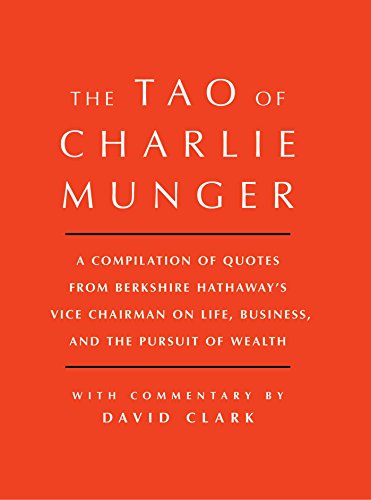
The book is a curated collection rather than a continuous argument. Its four sections cover: successful investing; business, banking, and the economy; applying Munger’s philosophy to business and investing; and advice on life, education, and happiness. Clark’s commentary connects the quotations to investing and practical conduct, but the primary voice is Munger’s.
Core ideas
Use a latticework of mental models
Munger’s central intellectual habit is multidisciplinary thinking. Problems should be examined through several useful models—economics, psychology, mathematics, incentives, probability, and business analysis—rather than forced into one familiar framework. The aim is not encyclopedic knowledge for its own sake, but fewer blind spots and better judgment.
Invert before acting
Ask how a decision could fail, what would reliably produce a bad outcome, and which risks are unacceptable. Avoiding stupidity is often more dependable than trying to display brilliance. This shifts attention from prediction to prevention.
Study incentives and human misjudgment
People respond to rewards, pressures, status, fear, and social imitation. A business or institution can look rational on paper while its incentives quietly produce bad behavior. Before trusting plans or statements, identify who benefits, who bears the cost, and what behavior the system rewards.
Prefer quality, durability, and understandable businesses
Munger’s investing approach favors businesses with durable advantages, capable and trustworthy management, understandable economics, and strong returns on capital. A merely cheap asset may be inferior to an excellent business bought at a sensible price. Quality, however, does not eliminate the need to consider valuation.
Concentrate when the odds are unusually favorable
Diversification is not automatically wisdom if it merely spreads money across mediocre or poorly understood opportunities. Concentration can make sense when an investor has unusual knowledge, a large margin of safety, and favorable probabilities. The necessary condition is selectivity—not confidence alone.
Wait for the fat pitch
Investing rewards patience because attractive opportunities may be rare. The discipline is to remain inactive when the evidence is weak and act decisively when price, quality, and understanding align. This is psychologically difficult because markets and careers encourage constant activity.
Respect opportunity cost and compounding
Every commitment of money, time, attention, or reputation prevents other commitments. Long-term results depend on preserving capital, avoiding major errors, and allowing sound decisions to compound. Frequent switching, unnecessary complexity, and ego-driven activity interrupt that process.
Keep learning throughout life
Reading widely, acquiring a few important ideas deeply, and continuously updating one’s understanding are treated as practical necessities. Education is not separated from investing: better knowledge improves the ability to recognize competence, business quality, risk, and one’s own ignorance.
Practical takeaways
- Before making an important decision, write down the incentives, the likely failure modes, the opportunity cost, and the assumptions that would have to be true.
- Maintain a personal checklist of recurring errors: overconfidence, confirmation bias, envy, social proof, commitment to a prior decision, and action for action’s sake.
- For an investment, explain in plain language how the business makes money, why its advantage can persist, what could damage it, and why the price leaves room for error.
- Distinguish a good company from a good investment: quality matters, but the purchase price and expected return still matter.
- Create deliberate periods of inactivity in investing and decision-making; lack of action can be evidence of discipline rather than indecision.
- Read outside finance. Economics, psychology, history, mathematics, biology, and biography can supply models that ordinary financial commentary lacks.
- Treat reputation and trustworthiness as economic assets. A brilliant operator with poor character can create risks that spreadsheets understate.
- Use the book as a prompt for primary-source reading—Munger’s speeches, Berkshire letters, and meeting remarks—rather than treating Clark’s summaries as the final word.
Caveats and counterpoints
- This is a quotation anthology with commentary, not a systematic exposition of Munger’s investment process. Its organization gives the material coherence, but it can make scattered remarks seem more like a unified theory than they originally were.
- The commentary is selective and interpretive. A reader review describes some explanations as useful but others as sketchy, so important claims should be checked against Munger’s original speeches and Berkshire materials.
- Munger’s success reflects unusual circumstances, temperament, partners, access, time horizon, and business environment. His principles are portable, but his results should not be treated as evidence that concentrated investing is generally suitable for every investor.
- The book’s emphasis on rationality can understate structural constraints: taxes, liquidity needs, employment risk, regulation, professional obligations, and the practical value of low-cost diversification.
- The source material is retrospective and aphoristic. Memorable maxims can conceal trade-offs—for example, between concentration and risk control, quality and valuation, or patience and the danger of rationalizing inaction.
Questions worth revisiting
- Which of Munger’s mental models do I actually use, and which do I merely admire?
- What incentives are shaping the people, institutions, and information sources I currently trust?
- What is the strongest argument that my current investment thesis is wrong?
- Am I buying quality at a reasonable price, or using the word “quality” to excuse overpayment?
- Which recurring psychological bias has cost me the most in money, time, or relationships?
- What would disciplined inactivity look like in my current portfolio and decision process?
- Which non-finance subject would most improve my ability to understand businesses and human behavior?
- Where might Munger’s advice fail because my goals, risk capacity, or time horizon differ from his?
Return to this when…
Return when you need a quick reset toward patience, independent thinking, incentive analysis, and error avoidance—especially before making an investment or business decision. For a deeper and more contextual study of Munger, pair it with his original speeches and writings, particularly the material later associated with Poor Charlie’s Almanack.
Highlights
“People are trying to be smart—all I am trying to do is not to be idiotic, but it’s harder than most people think.”
“Mimicking the herd invites regression to the mean.”
“If you buy something because it’s undervalued, then you have to think about selling it when it approaches your calculation of its intrinsic value. That’s hard. But, if you can buy a few great companies, then you can sit on your ass. That’s a good thing.”
“I think that one should recognize reality even when one doesn’t like it; indeed, especially when one doesn’t like it.”
“It is remarkable how much long-term advantage people like us have gotten by trying to be consistently not stupid, instead of trying to be very intelligent. There must be some wisdom in the folk saying: ‘It’s the strong swimmers who drown.’ ”
“When I came out to California, there was this playboy and he spent all his time drinking heavily and chasing movie stars. His banker called him in and said that he was very nervous about his behavior. He told his banker, ‘Let me tell you something: my municipal bonds don’t drink.’ ”
“At Berkshire there has never been a master plan. Anyone who wanted to do it, we fired because it takes on a life of its own and doesn’t cover new reality. We want people taking into account new information.”
“Three rules for a career: (1) Don’t sell anything you wouldn’t buy yourself; (2) Don’t work for anyone you don’t respect and admire; and (3) Work only with people you enjoy.”
“We all are learning, modifying, or destroying ideas all the time. Rapid destruction of your ideas when the time is right is one of the most valuable qualities you can acquire. You must force yourself to consider arguments on the other side.”
“Life is always going to hurt some people in some ways and help others. There should be more willingness to take the blows of life as they fall. That’s what manhood is, taking life as it falls. Not whining all the time and trying to fix it by whining.”
References
- goodreads.com
- Tao of Charlie Munger | Book by David Clark | Official Publisher Page | Simon & Schuster
- simonandschuster.com
- goodreads.com
- ebooks.com
- openlibrary.org
- The tao of Charlie Munger by David Clark | Open Library
- books.apple.com
- simonandschuster.co.uk
- Tao of Charlie Munger: A Compilation of Quotes from Berkshire Hathaway's Vice Chairman on Life, Business, and the Pursuit of Wealth With Commentary by David Clark by David Clark | Goodreads
- vitalsource.com
- discover.cuyahogalibrary.org