
In one sentence
Feynman presents curiosity as an active discipline: investigate directly, distrust credentials and received explanations, learn by doing, and preserve the freedom to ask apparently foolish questions. The memoir’s energy comes from showing this attitude in ordinary, comic, and scientific situations rather than stating it as a formal philosophy.
Overview
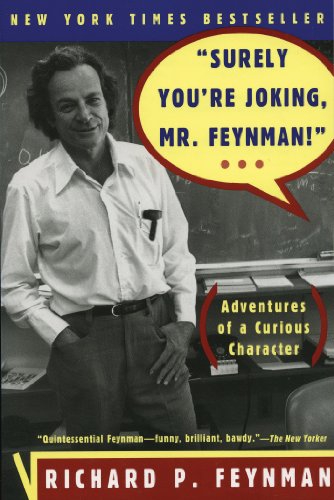
This is not a comprehensive autobiography or conventional biography. It is an edited selection of reminiscences, originally told in recorded conversations with Ralph Leighton and shaped into book form by Leighton and Edward Hutchings. The episodes range from Far Rockaway, MIT, and Princeton to the Manhattan Project, Cornell, Caltech, music, art, lock-picking, travel, and encounters with famous scientists. The final material turns more explicitly toward scientific honesty and public responsibility, including the ideas associated with “Cargo Cult Science.”
Core ideas
Curiosity is a method, not merely a personality trait
Feynman repeatedly learns by direct contact: taking things apart, testing assumptions, trying unfamiliar activities, and asking how something actually works. His curiosity is productive because it leads to experiments, skills, and revised beliefs—not just novelty-seeking.
First-hand understanding outranks reputation
The book’s recurring intellectual posture is skepticism toward authority, status, and impressive language. Feynman prefers an explanation he can reconstruct and test over one accepted because it comes from a celebrated person or institution.
Play can support serious thinking
Bongo drumming, drawing, safecracking, practical jokes, and social experimentation are not presented as separate from his scientific identity. They illustrate his appetite for patterns, mechanisms, improvisation, and the pleasure of figuring things out.
Science requires intellectual honesty
The memoir’s strongest general lesson is that researchers must avoid fooling themselves, distinguish evidence from appearance, and report methods and uncertainty honestly. This is more substantial than the book’s better-known adventure stories.
A life can be self-directed without being orderly
Feynman’s career is shown as a series of intense interests rather than a carefully managed personal brand. The implicit model is to follow genuine questions and abilities, though the book also reveals how this freedom can coexist with egotism and disregard for others.
Practical takeaways
- When confronted with an explanation, restate it in your own words and identify what observation or test would distinguish it from alternatives.
- Use small experiments and firsthand trials to replace vague impressions with workable knowledge.
- Keep some noninstrumental play in your life; new domains can sharpen observation and reveal transferable patterns.
- Treat credentials, consensus, and polished presentation as evidence to examine—not substitutes for understanding.
- When communicating technical work, make it possible for others to see what was done, what could go wrong, and how confident they should be.
Caveats and counterpoints
- The book is a curated, comic self-portrait, not a balanced account of Feynman’s life or character. Its selection favors memorable exploits and reinforces the image of the brilliant eccentric.
- Because the material comes from remembered stories told conversationally and then edited, it should be read as literary memoir rather than a fully verified chronology.
- Feynman’s confidence and charm can make arrogance, sexual opportunism, and insensitivity seem harmless. Those episodes are part of the historical record of the persona the book constructs, not necessarily behavior to imitate.
- The book offers limited sustained treatment of his scientific work; readers seeking the physics, the Manhattan Project’s wider history, or a critical biography need supplementary sources. A contemporary review describes its coverage as spanning childhood, education, Los Alamos, teaching, and research, but its form remains anecdotal.
- The famous lesson of curiosity is strongest when paired with humility and ethical awareness. Taken alone, “question everything” can become performative contrarianism rather than disciplined inquiry.
Questions worth revisiting
- Which episodes show genuine curiosity, and which mainly show Feynman enjoying an audience?
- Where does skepticism improve his understanding, and where does it become dismissiveness toward other people?
- What is the difference between learning through play and merely seeking stimulation?
- How should the book’s self-presentation be compared with a critical biography or accounts by colleagues?
- Which practical habit is most transferable: direct experimentation, explaining simply, resisting authority, or admitting uncertainty?
Return to this when…
Return to this book when you need a reminder to investigate rather than posture, especially before accepting an impressive explanation. Revisit the caveats alongside it when you find yourself romanticizing the “eccentric genius” persona or treating a vivid anecdote as a complete account of a person.
References
- en.wikipedia.org
- wwnorton.co.uk
- books.google.com
- Details for "Surely you're joking, Mr. Feynman!" : adventures of a curious character / › Stewart Library catalog
- catalog.cclsny.org
- catalog.mercyhurst.edu
- goodreads.com
- ahml.info
- librarycatalog.centralpenn.edu
- books.apple.com
- catalog.library.nashville.org
- library.cca.edu
- latimes.com