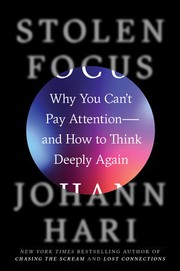

In one sentence
The book’s central claim is that attention has been systematically degraded by powerful social, economic, technological, and physical forces. Personal tactics may help, but durable improvement requires collective changes to how technology, work, education, food, childhood, and public information are organized.
Overview
Hari begins with his own difficulty concentrating and a three-month retreat from phones and computers in Provincetown, where reading, sleep, and creative thought improve—but deteriorate again after he reconnects. He then travels internationally, interviewing more than 200 experts and organizing the book around roughly twelve interacting threats to attention. His preferred explanation is systemic rather than moralistic: people are not simply failing to use willpower against neutral tools; many environments are engineered to fragment attention and monetize engagement.
Core ideas
Attention is an ecosystem, not a character trait
Focus depends on sleep, stress, nutrition, workload, emotional security, physical surroundings, and the design of information systems. Treating distraction as a defect in self-control hides the conditions producing it.
The attention economy rewards interruption
Platforms compete for engagement, so notifications, recommendation systems, rapid novelty, and emotionally provocative material are favored. The result is not only lost time but reduced capacity for deep reading, reflection, and sustained problem-solving.
Task-switching carries a cognitive cost
Constantly alternating between messages, tabs, feeds, and tasks creates the feeling of productivity while preventing immersion. Hari connects this fragmented mode of work with shallow processing and difficulty returning to demanding activities.
Stress and exhaustion narrow attention
Overwork, insecurity, inadequate sleep, and chronic anxiety consume the mental resources required for concentration. A person cannot reliably solve an attention problem with productivity tricks while the underlying environment keeps them depleted.
Children need protected conditions for deep attention
Hari links childhood attention difficulties to factors including stress, reduced free play, overstimulation, and institutional pressures. His broader point is that children develop concentration through stable, exploratory environments—not simply through obedience or restriction.
Collective attention has political importance
A distracted public is less able to evaluate complex evidence, sustain democratic discussion, or respond to long-term threats such as climate change. Attention is therefore treated as a civic resource, not merely a private wellness issue.
Individual changes are useful but insufficient
Removing notifications, creating screen-free periods, protecting sleep, and setting boundaries can restore some control. But Hari warns against presenting these as complete solutions when commercial systems continue to manufacture distraction at scale.
His proposed remedy is structural reform
The book points toward regulation of persuasive technology, changes to work and schooling, stronger protections for children, healthier physical environments, and collective action to reduce incentives for attention extraction. The exact policy program is less developed than the diagnosis.
Practical takeaways
- Audit the conditions around your attention before blaming your discipline: sleep, workload, stress, food, noise, interruptions, and device design.
- Turn off nonessential notifications and make uninterrupted blocks easier by changing the environment rather than relying on moment-to-moment willpower.
- Single-task when depth matters; keep distracting devices physically out of reach and avoid treating rapid switching as efficient work.
- Protect activities that train sustained attention: long-form reading, conversation, walking, creative work, and undistracted rest.
- Use digital detoxes as experiments or resets, not as proof that the problem is solved permanently; Hari’s own retreat was beneficial but difficult to sustain.
- Think politically as well as personally: support workplace, educational, and technology practices that reduce compulsory interruption and protect shared attention.
Caveats and counterpoints
- The book is a journalistic synthesis and advocacy argument, not a systematic review or a controlled study. Its vivid interviews and case studies do not establish that every proposed cause has equal evidential support.
- Critics have argued that Hari sometimes gives disputed or outdated claims too much weight and does not adequately present counterarguments. The book is strongest as a framework for asking better questions, not as a definitive account of attention science.
- The diagnosis is broader and more convincing than some of the remedies: structural change is presented as essential, yet several recommendations still depend on individuals or small groups creating unusually protected environments.
- The book can understate variation among people and contexts. Technology may impair attention in some circumstances while also supporting accessibility, learning, connection, and organization; the effects are not uniformly negative.
- Hari’s personal screen-free retreat is memorable but privileged and atypical. It demonstrates that environment matters, but it is not a realistic template for most people.
Questions worth revisiting
- Which parts of my concentration problem are caused by devices, and which by sleep, stress, workload, or unresolved anxiety?
- Where am I confusing responsiveness and activity with meaningful progress?
- Which interruptions are genuinely necessary, and which are imposed by platform or workplace defaults?
- What attention practices could I protect collectively with family, colleagues, classmates, or friends?
- Where does Hari’s systemic explanation illuminate the problem, and where might it overlook personal differences or benefits of technology?
- Which claims in the book would I want to verify against primary research before treating them as established fact?
Return to this when…
Return to the thesis and core ideas when distraction starts to feel like a personal moral failure, when redesigning your work or study environment, or when evaluating claims that a new app, habit, or detox can solve attention problems by itself.