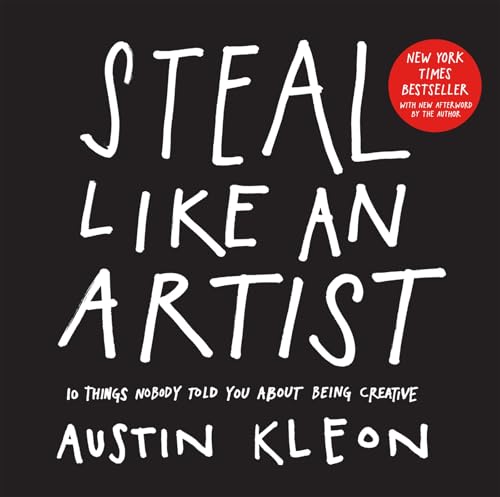

In one sentence
Creative work is cumulative: instead of waiting for an entirely original idea or a fully formed identity, collect influences, transform them through practice, make the work you wish existed, and share it consistently. A recognizable voice develops through repeated choices, not prior self-discovery.
Overview
Kleon developed the book from a 2011 talk for students and organizes it around ten principles: embrace influence; begin before you feel ready; make the work you want to encounter; work physically as well as digitally; maintain side projects; share your work; use geography and networks strategically; be kind and visible; create under constraints; and make creative work a sustainable part of everyday life.
Core ideas
Influence is raw material, not evidence of fraud
No creative work emerges from a vacuum. Study creators you admire, identify what specifically attracts you, and combine or transform those elements rather than merely duplicating a surface style. Kleon’s “stealing” is selective learning and recombination—not plagiarism, unattributed copying, or passing off another person’s work as your own.
Start before you know your identity
You do not need to discover a fixed artistic self before beginning. Copying, imitating, and making small experiments can teach you what you value; your style is an outcome of sustained practice and selection, not a prerequisite.
Make the work you want to see
Use your own taste as a brief. When existing books, images, music, or tools leave a gap, treat that dissatisfaction as a direction for making—not merely as a reason to criticize.
Separate generating from editing
Kleon recommends physical, hands-on activity because screens are powerful for revising but can encourage premature judgment. Analog materials, movement, and making can help ideas develop before they are optimized.
Protect side projects and productive detours
A creative life need not be organized around one prestigious project. Parallel interests can cross-pollinate, relieve pressure, and reveal work that deserves more attention. The useful question is what you repeatedly return to when nobody requires it.
Share the process, not only the finished product
Showing work in progress can attract collaborators, feedback, and an audience over time. The emphasis is on regular, generous visibility: document what you are learning and make it easy for interested people to follow.
Use constraints, routine, and ordinary life
Limits can make decisions easier and help creativity survive alongside employment, family, and practical obligations. The book treats a sustainable creative practice—supported by routines, relationships, and basic self-care—as more valuable than occasional bursts of inspiration.
Practical takeaways
- Create an influence map: list several artists, writers, or makers you admire and note the specific techniques, subjects, formats, or attitudes you want to study.
- Keep a swipe file or commonplace book for images, phrases, problems, and references; revisit it when starting a project.
- Choose one small project that imitates a method you admire, then deliberately alter its subject, context, combination, or constraint.
- Work in two modes: an analog space for generating and experimenting, and a digital space for organizing, editing, and publishing.
- Maintain at least one low-stakes side project alongside your main work.
- Share useful progress regularly—notes, drafts, experiments, or lessons—not just polished outcomes.
- Define a modest recurring schedule and a constraint such as time, format, materials, or audience.
- Before calling something ‘inspiration,’ ask whether you have transformed it enough and credited the relevant source.
Caveats and counterpoints
- The book’s aphoristic style is energizing but not a complete theory of creativity; it gives principles and examples more than systematic evidence or detailed instruction.
- ‘Nothing is original’ can be liberating, but taken literally it can blur important distinctions between influence, fair use, cultural borrowing, plagiarism, and copyright. Ethical attribution and meaningful transformation remain necessary.
- Advice about sharing publicly assumes access to time, platforms, safety, and an audience. Private experimentation, paid work, or delayed publication may be better choices in some circumstances.
- The emphasis on individual habit underplays structural barriers such as money, disability, discrimination, caregiving, gatekeeping, and unequal access to creative communities.
Questions worth revisiting
- Which influences am I currently hiding instead of studying openly and crediting clearly?
- What work do I wish existed badly enough to make a small version of it?
- Which side project keeps returning despite having no obvious practical payoff?
- What constraint would make my next project easier to finish?
- Am I sharing enough process to build connection, but still protecting the parts of my practice that need privacy?
- Where does ‘influence’ end and imitation or appropriation begin in my field?
Return to this when…
Return when you are waiting for permission, originality, confidence, or ideal conditions. Skim the influence, side-project, sharing, and constraints sections when a creative practice has become overly precious, screen-bound, isolated, or dependent on inspiration.
Highlights
The manifesto is this: Draw the art you want to see, start the business you want to run, play the music you want to hear, write the books you want to read, build the products you want to use—do the work you want to see done.
“The work you do while you procrastinate is probably the work you should be doing for the rest of your life.”
Write a blog post about someone’s work that you admire and link to their site. Make something and dedicate it to your hero. Answer a question they’ve asked, solve a problem for them, or improve on their work and share it online.
Not everybody will get it. People will misinterpret you and what you do. They might even call you names. So get comfortable with being misunderstood, disparaged, or ignored—the trick is to be too busy doing your work to care.
“Be regular and orderly in your life, so that you may be violent and original in your work.”
In this age of information abundance and overload, those who get ahead will be the folks who figure out what to leave out, so they can concentrate on what’s really important to them. Nothing is more paralyzing than the idea of limitless possibilities. The idea that you can do anything is absolutely terrifying. The way to get over creative block is to simply place some constraints on yourself.
Talk a walk Start your swipe file Go to the library Buy a notebook and use it Get yourself a calendar Start your logbook Give a copy of this book away Start a blog Take a nap
Linda Barry, What It Is Hugh MacLeod, Ignore Everybody Jason Fried + David Heinemeier Hansson, Rework Lewis Hyde, The Gift Jonathan Lethem, The Ecstasy of Influence David Shields, Reality Hunger Scott McCloud, Understanding Comics Anne Lamott, Bird by Bird Mihaly Csikszentmihalyi, Flow Ed Emberley, Make a World