
In one sentence
Tidying is not primarily a storage problem; it is a one-time process of deciding what deserves a place in your life. Gather possessions by category, keep what contributes to the life you want, discard the rest respectfully, and assign every retained item a visible, deliberate home.
Overview
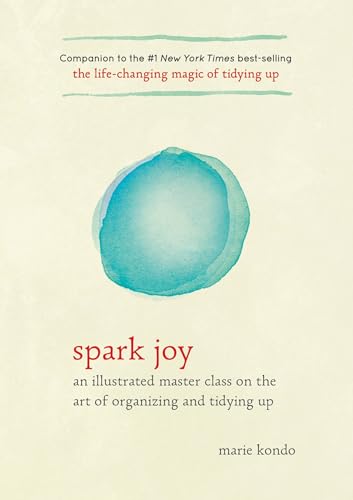
Spark Joy is a practical, illustrated “master class” expanding the KonMari method. It begins with six basic rules and advice on recognizing joy, then moves through clothing, books, papers, miscellaneous items, and sentimental belongings. Later guidance addresses kitchens, bathrooms, closets, drawers, folding, storage, and common questions—including necessary objects that do not produce obvious pleasure.
Core ideas
Decide by category, not by room
Collect all items of one type before choosing. This reveals duplicates, prevents possessions from remaining invisible in scattered rooms, and makes the decision about the category rather than the nearest storage space.
Choose what to keep by positive response
The central test is whether an item “sparks joy”—a felt sense of usefulness, affection, or rightness when handling it. The emphasis is on selecting a meaningful remainder, rather than trying to optimize disposal.
Tidying is identity work
Kondō presents possessions as connected to past choices and an imagined future. Sorting therefore clarifies preferences and the kind of daily life the home should support, rather than merely producing visual neatness.
Discard first; organize second
Storage is not the cure for excess. Once the keepers are chosen, give each item a designated place, return things after use, and use simple containment—drawers, boxes, upright storage—rather than elaborate systems.
Vertical, visible, respectful storage
Her practical instructions favor folding clothes into compact upright rectangles, storing items so they can be seen and accessed, and treating possessions as objects that should be handled and returned carefully. The book’s illustrations make these techniques easier to visualize.
Necessary things require a modified judgment
Not everything useful will feel exciting. For essentials, Kondō shifts the question toward whether the item performs its role well and supports the life you want; poor, uncomfortable, or redundant versions can be replaced rather than automatically retained.
Practical takeaways
- Picture the lifestyle you want before sorting; use it as a decision standard, not a décor fantasy.
- Work in the broad sequence of clothes, books, papers, miscellaneous items, and sentimental possessions.
- Put every item of a category in one place before deciding what remains.
- Handle each object individually; avoid a permanent “maybe” category that postpones the decision.
- Thank unwanted possessions for their service, then remove them from the home promptly.
- After discarding, assign each retained object one home and make returning it part of ordinary use.
- Treat sentimental items last, when your decision-making has become more practiced.
- Use the illustrations for folding and drawer organization, but adapt the techniques to the objects, space, accessibility needs, and people in your household.
Caveats and counterpoints
- “Joy” is a powerful but subjective criterion; it may be difficult for people dealing with grief, depression, disability, poverty, caregiving demands, or culturally shared possessions.
- The method assumes that a large sorting session and substantial discarding are feasible. That is not equally realistic for renters, families, people with limited storage or money, or households whose possessions are shared rather than individually owned.
- Kondō’s strong preference for a one-time, comprehensive reset can understate the ongoing effects of acquisition, busy schedules, children, maintenance, and changing material needs.
- The book’s spiritual and relational language about possessions will resonate with some readers but may feel anthropomorphic or overly moralized to others; its organizing claims are practical recommendations, not established psychological laws.
- Because Spark Joy is a companion and expansion, it can repeat the foundational argument of The Life-Changing Magic of Tidying Up. Its distinct value is the item-specific, room-specific, and illustrated instruction rather than a wholly new theory.
Questions worth revisiting
- What concrete daily activities should the home make easier or more pleasant?
- Am I keeping this because I value it, because it is genuinely useful, or because replacing it would be difficult?
- Would this item still earn space if I encountered it today rather than remembering what I paid for it?
- Which recommendations need adapting for other household members, accessibility, climate, work, or caregiving?
- After the initial reset, what purchasing or return-home habit would prevent the same accumulation from recurring?
Return to this when…
Return to the book when you need a category-by-category reset, especially for clothing, papers, miscellaneous household goods, folding, drawers, closets, or sentimental objects. It is most useful as a visual reference during sorting—not as a substitute for deciding what your household actually needs.
Highlights
“It might come in handy.” Believe me, it never will. You can always manage without it. For those embarked upon a tidying marathon, this phrase is taboo.
“Dear old screwdriver, I may not use you much, but when I need you, why, you’re a genius. Thanks to you, I put this shelf together in no time. You saved my fingernails, too. I would have ruined them if I had used them to turn the screws. And what a design! Strong, vigorous, and cool to the touch, with a modern air that makes you really stand out.”
No matter how messy your house may be, tidying deals with physical objects. No matter how much stuff you may own, the amount is always finite. If you can identify the things that bring you joy and decide where to keep them, the job of tidying must inevitably come to an end.
You don’t need to put things in a separate bag.” Instead of waiting to see if you’ll use something in the next three months, why not just look back on the past three months and decide right now?
There are only two choices: keep it or chuck it. And if you’re going to keep it, make sure to take care of it.
Balling your socks and stockings, or tying them into knots, is cruel. Please put an end to this practice today.
Gradate the colors so that you can see at a glance where everything is and also grasp the color trend of your wardrobe. In general, dark colors should be in the back of the drawer and light colors in the front.
Since the day I first left home, I have never kept my kitchen scraps out in a container. Consequently, my kitchen never smells like raw garbage. So what do I do with the kitchen scraps? I keep them in my freezer. I set aside a corner of the freezer for kitchen scraps and, after thoroughly draining them, I plop any fruit and vegetable peelings, chicken bones, etc., in a bag as I cook. Twice a week, on regular pickup days, I remove the bag of scraps.
When storing things in the fridge, you want to keep it about 30 percent empty. You can use the extra space for leftovers from the evening meal or any food you might receive that day. Store things by category so that it is clear at a glance where things are.
The same goes for the words “Power Pressure!” emblazoned on a rice cooker, the moving company logo stamped across the cardboard boxes in the cupboard, or the words “Cotton Swabs” in large print on the cotton swab carton. The more textual information you have in your environment, the more your home becomes filled with noise. Just by eliminating these elements from your home, you can create an elegant space. The effects are immense. If you’re aiming for the pinnacle of joy, I highly recommend it.
Secondly, if you cannot bring yourself to throw something away, keep it with confidence.
When tidying up digital data, the same principle applies: choose what you wish to keep, not what you are going to discard.
Make your bedroom a space to recharge your batteries and refresh yourself for another day. Keep lighting soft and indirect, play relaxing music, and feature items and scents that spark joy. Wash sheets and pillowcases frequently.
Tidying is naturally contagious, but if you try to force it on someone else, you’ll only be met with harsh resistance. Recall Aesop’s fable about the north wind and the sun: the wind failed to blow off the traveler’s coat while the sun got him to remove it simply by shining. It is far more effective to be like the sun.
There are only three steps involved in daily tidying: returning things to their proper place, thanking them every time you use them, and taking good care of them. After that comes cleaning.
Therefore, I urge you once again: finish putting your things in order as soon as you can, so that you can spend the rest of your life surrounded by the people and things that you love most.
References
- goodreads.com
- books.google.com
- Spark Joy by Marie Kondo on Apple Books
- books.google.com
- search.worldcat.org
- Spark Joy | Penguin Random House Higher Education
- catalog.eulesstx.gov
- openlibrary.org
- search.worldcat.org
- catalog.pascolibraries.org
- penguinrandomhousehighereducation.com
- penguinrandomhouseretail.com
- time.com