
In one sentence
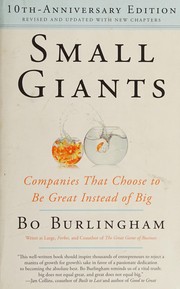
A company does not have to become as large as possible to become great. Leaders can deliberately choose a different definition of success—one centered on excellence, autonomy, meaningful relationships, a strong workplace, and contribution—then align ownership, growth, culture, and operating decisions with that choice.
Overview
Burlingham reports on fourteen privately held companies across varied industries rather than presenting a single formula. The cases show leaders making explicit trade-offs: limiting scale, preserving control, investing in people, protecting quality, and treating the company as part of a community. The book’s chapter structure moves from choice and control toward culture, continuity, and the art of business.
Core ideas
Define greatness before pursuing growth
The central decision is not whether to grow, but what growth is for. Revenue and profit can support greatness, but they are not sufficient definitions of it. The featured companies prioritize goals such as being excellent at a craft, serving customers unusually well, creating a stimulating workplace, or contributing locally.
Growth is a choice, not a duty
The companies challenge the assumption that every successful business should pursue maximum scale. Remaining private or deliberately limiting expansion can preserve independence, quality, intimacy, and the founders’ preferred way of working. This is not anti-growth; it is growth subordinated to purpose.
Ownership shapes strategy
Concentrated, private, or employee-oriented ownership can give leaders more freedom to optimize for long-term aims instead of quarterly expectations or an eventual sale. The trade-off is that owners accept less liquidity, slower expansion, and greater responsibility for the consequences of their choices.
Culture is built through operating decisions
A distinctive culture is not mainly a slogan. It emerges from hiring, training, standards, information-sharing, compensation, customer policies, physical settings, and what leaders repeatedly choose not to compromise. Intimacy and trust become competitive advantages when they are embedded in daily work.
Relationships are productive assets
Employees, customers, suppliers, owners, and communities are treated as relationships to develop rather than inputs to optimize. Strong relationships can improve loyalty, service, learning, and resilience—but require time, consistency, and leaders willing to value qualitative returns.
Preserve the company’s identity through intentional continuity
A founder’s challenge is not merely to start a distinctive company but to pass on its values without freezing it in place. Continuity may involve succession planning, employee ownership, carefully chosen partners, or expanding capabilities while protecting the underlying character.
The model is pluralistic, not universal
The cases demonstrate possibilities, not a universal recipe. A small, private company may suit leaders who value control, craft, or lifestyle; another founder may rationally choose scale to reach more customers, fund innovation, or create wealth. The book’s argument is about choice and fit, not a moral rule against becoming big.
Practical takeaways
- Write a one-page definition of what “great” means for your company, including what you are unwilling to sacrifice for growth.
- Separate healthy growth from growth pursued because investors, competitors, advisors, or ego make it feel obligatory.
- List the company’s nonfinancial sources of value—craft, trust, employee development, customer intimacy, independence, and community contribution—and track decisions against them.
- Identify the operating practices that actually create your culture; strengthen those practices instead of relying on values statements.
- Decide in advance which opportunities you will decline because they would damage quality, autonomy, relationships, or the company’s desired way of working.
- Treat ownership and succession as strategic design questions, not administrative issues to postpone until a crisis.
- Use the featured companies as prompts for comparison, not templates: ask which trade-offs fit your market, ambitions, capital needs, and personal definition of success.
Caveats and counterpoints
- The book is primarily a reported set of company portraits, so its evidence is illustrative rather than comparative or statistically representative.
- Many examples are privately held and founder-led; their autonomy and patience may be difficult to reproduce in venture-backed, highly regulated, capital-intensive, or rapidly consolidating industries.
- The narrative can make values-driven choices appear more coherent than they are in practice. Small companies can still have internal conflict, uneven employee experiences, financial vulnerability, or dependence on charismatic leaders.
- Resisting scale can protect quality and culture, but it can also limit wages, career paths, market reach, bargaining power, and the resources available for innovation.
- The companies profiled belong largely to an earlier business era; the principles may endure, but the competitive, technological, labor, and financing conditions surrounding them have changed. The 10th-anniversary edition was published in 2016.
Questions worth revisiting
- What would “great instead of big” mean in my current work or business?
- Which forms of growth would strengthen our purpose, and which would undermine it?
- What sacrifices are we already making for scale without having explicitly chosen them?
- Which relationships—employees, customers, suppliers, or community—are central to our identity but poorly measured?
- What decisions, systems, or leaders would be needed to preserve the company’s character after the founder leaves?
- Where does this philosophy fit my ambitions, and where might scale be the more responsible choice?
Return to this when…
Return to this book when growth pressure starts dictating strategy, when considering outside capital or an acquisition, when redesigning culture, or when planning succession. Its most useful reminder is that business size is an outcome; the more important prior decision is what kind of company you intend to build.
Highlights
“I’ve made much more money by choosing the right things to say no to than by choosing things to say yes to,” said restaurateur Danny Meyer of Union Square Hospitality Group, and he could have been speaking for others. “I measure it by the money I haven’t lost and the quality I haven’t sacrificed.”
First, I could see that, unlike most entrepreneurs, their founders and leaders had recognized the full range of choices they had about the type of company they could create. They hadn’t accepted the standard menu of options as a given. They had allowed themselves to question the usual definitions of success in business and to imagine possibilities other than the ones all of us are familiar with.
Second, the leaders had overcome the enormous pressures on successful companies to take paths they had not chosen and did not necessarily want to follow. The people in charge had remained in control, or had regained control, by doing a lot of soul searching, rejecting a lot of well-intentioned advice, charting their own course, and building the kind of business they wanted to live in, rather than accommodating themselves to a business shaped by outside forces.
Third, each company had an extraordinarily intimate relationship with the local city, town, or county in which it did business—a relationship that went well beyond the usual concept of “giving back.” That was part of it, to be sure, and all of these companies were model corporate citizens, but the relationship was very much a two-way street. The community helped mold the character of the business, just as the companies played an important role in the life of the community.
Finally, I noticed the passion that the leaders brought to what the company did. They loved the subject matter, whether it be music, safety lighting, food, special effects, constant torque hinges, beer, records storage, construction, dining, or fashion. Though they were consummate businesspeople, they were anything but professional managers. Indeed, they were the opposite of professional managers. They had deep emotional attachments to the business, to the people who worked in it, and to its customers and suppliers—the sort of feelings that are the bane of professional management.
Inevitably, people began approaching him about doing another restaurant. Some of the offers were tempting, but he was nervous about overreaching. So he came up with three tough standards that any new place would have to meet. First, it would have to be capable of becoming as extraordinary a restaurant as Union Square Café. Second, it would have to enhance the value of Union Square Café. Third, it would have to bring more balance to his life, not less.
“For example, we’re in the wine business, and we need more wine. We’re selling a thousand cases of wine per year, and it’s not enough. Next year, we’ll need a hundred more cases to meet the demand. For that, we’ll need an extra ton and a half of grapes. You get about three tons per acre of vineyard. So we need half an acre more. Well, it costs $200,000 easy to plant an acre in Napa Valley. Depending on where you are, it might be a little more. But let’s say $200,000, meaning we’ll need $100,000 to make a hundred more cases. But we’re only making $10 a case, which gives us $10,000 in profit per year. Unless we get an additional $90,000 somewhere else, we won’t be able to meet next year’s demand. “The point is, your growth is absolutely limited by your capital, or your ability to borrow capital. That was an eye-opening realization for me. They probably teach this on the first day of business school, but I’d never seen it so clearly before. Every unit of growth needs new capital if you’re in a capital-intensive business. Just one more case needs capital. Not only that, but it’s almost impossible to grow in tiny little units. You can’t grow one case at a time, or even a hundred cases at a time. You probably need a minimum of ten acres of vineyard—otherwise you can’t justify buying a tractor. So there are these giant steps you have to take.
Those were the easy calls, however. In order to keep the company at the size he wanted, Butler also had to say no to good customers, the ones he wanted to continue doing business with. “To me, a good client is a good corporate citizen, honest and good to the community,” he said. “Some of these companies don’t care about the communities they do business in, and they don’t do win-win. I want to work with clients who see us as their partners. I’d rather lose money than lose a good client.”
For lack of a better term, we might refer to the process as building a sense of community—that is, a sense of common cause between the company, its employees, its customers, and suppliers. That sense of community rests on three pillars. The first is integrity—the knowledge that the company is what it appears, and claims, to be. It does not project a false image to the world. The second pillar is professionalism—the company does what it says it’s going to do. It can be counted on to make good on its commitments. The third pillar is the one we’ve been discussing—the direct, human connection, the effect of which is to create an emotional bond, based on mutual caring.
At one end of the spectrum is Anchor Brewing, whose owner and CEO, Fritz Maytag, has consciously strived to keep the number of employees as low as possible. For most of the past twenty years, the head count has hovered around fifty full-time people, plus five or ten part-timers, depending on their availability and the company’s needs. He has never felt tempted to hire more. “I’ve always thought it was more fun and satisfying to have all chiefs and no Indians,” he once said in an interview with Harvard Business Review (HBR). “That was one of my ideas—to have a small group of people, where everyone knows they’re all interrelated and where, as far as possible, everybody is in charge and nobody is looking over anyone’s shoulder and there are no time clocks.”
It was a management philosophy he’d learned growing up in Newton, Iowa. “That’s the way my father raised our family, from the earliest moment. Lots of responsibility. We’re counting on you. We trust you. And if you screw up, just tell us about it; don’t worry about it. We’re not encouraging you to screw up, but for heaven’s sake, if you do, don’t worry. We’re all in this together, and we don’t know what we’re doing either, so come on and join in. And I always liked the idea of a small number of people. I just don’t like what happens in large groups.”
He believed that the smaller the staff, the better chance he had of creating such an environment. In the early years, he had only four full-time employees. It took all of them—and sometimes a couple of other people—to do the bottling. On bottling days, Maytag would put up a “closed” sign and lock the door, and they would all go to work on the bottling line. Later, as the demand for Anchor’s beers grew, he invested in equipment that would allow the company to produce more beer while minimizing the need for additional people. Among other things, Maytag believed that the quality would suffer if the staff got too big. For the same reason, he wanted to have only one shift, five days a week, and designed the brewery accordingly. “I’m sure this directly relates to quality,” he told HBR. “You can never come in and look at your tools and say, ‘Ugh, look what the night shift has done. Where’s the hammer? Look, those jerks spilled something.’ Here, it’s all us. Everybody who works here can go home and say, ‘I made the beer.’ And when they go to a restaurant somewhere and see a bottle, they know they produced it. And I think that kind of pride tends to improve quality. Real quality control takes place every minute. It has to be done right now, not later. A smaller group tends to be more quality oriented. There’s an enthusiasm here, a spirit of being on the leading edge of beers and brewing styles. There’s a feeling of creativity. Partly that comes from being small, a little team where we all know what’s going on.”
To give good service, after all, you really do have to “1. Figure out what the customer wants. 2. Get it for them—accurately, politely, enthusiastically. 3. Go the extra mile.” What’s more, it’s important for employees to know that. “Of course, if you’re already great at service, you’ll say, ‘It’s not that simple,’ which is true,” said Weinzweig, who readily acknowledges that Danny Meyer’s enlightened hospitality is on a different plane. “But we can’t wait until people get all the subtleties of great service. We need a recipe people can use right away.”
ZingTrain began by distilling various practices into easily understandable and teachable concepts and principles. “We already had the 3 Steps to Great Service,” said Weinzweig. “We just kept building from there.” One by one, additional rules and tools were developed: the 5 Steps to Handling Customer Complaints, the 4 Steps to Order Accuracy, the 3 Steps to Great Finance, the 4 Steps to Productive Resolution of Differences, the 5 Steps to Bottom-Line Change, and on and on.
When pressed to summarize how that fit into his overall management philosophy, Maytag refused. “Actually, I’m quite uncomfortable talking about all this, pinning it down, because it’s all very mysterious,” he said. “I think there’s a certain amount of magic to all this, and the more you understand it, or think you do, the more you may lose it. Good management in a small company involves a certain freshness and responsiveness and natural feeling that is by definition partly unspoken, unarticulated, undefined.”
Chouinard told him the company had gone though several CEOs before finding a mix that worked. But as Erickson looked more closely at Patagonia—and at Clif Bar—he became convinced that there was more to it than finding the right CEO, or even the right management team. Just as important was having a clear, well-articulated vision that was ingrained in the day-to-day life of the business. He and Kit eventually came up with five “aspirations” that encompassed their vision for Clif Bar: sustaining the brands, sustaining the business, sustaining the people, sustaining the community, and sustaining the planet.
References
- Small Giants: Companies that Choose to be Great Instead of Big - Bo Burlingham - Google Books
- smallgiants.org
- openlibrary.org
- Small Giants: Companies That Choose to Be Great Instead of Big by Bo Burlingham – The Rabbit Hole
- summary.com
- overdrive.com
- penguin.co.uk
- blog.smallgiants.org
- smallgiants.org
- Small Giants: Companies That Choose to Be Great Instead of Big
- Small Giants by Bo Burlingham - Penguin Books Australia
- podcasts.apple.com