
In one sentence
Modern knowledge work is organized around pseudo-productivity: activity that is easy to observe—emails, meetings, rapid responses, and full calendars—rather than valuable outcomes. Newport’s alternative is not lower ambition but a different operating system: reduce obligations, allow work to develop at a natural pace, and prioritize quality over constant visible motion.
Overview
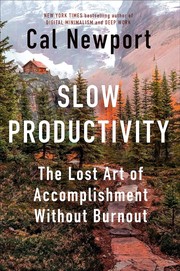
Published by Portfolio on March 5, 2024, the book develops three principles: Do Fewer Things, Work at a Natural Pace, and Obsess Over Quality. Newport supports them with examples involving scientists, writers, artists, and other “traditional knowledge workers,” then translates the patterns into advice for modern professional life.
Core ideas
Pseudo-productivity confuses motion with progress
In digitally mediated work, people often demonstrate productivity through observable activity rather than completed, valuable work. Email, meetings, notifications, and task-switching become substitutes for deciding what deserves attention. This produces overload while making it difficult to tell whether important work is advancing.
Do fewer things
Limit the number of active commitments instead of trying to manage an unlimited task list more efficiently. Fewer simultaneous projects reduce context switching, clarify priorities, and create enough attention for substantial work. The principle requires saying no, sequencing projects, and accepting that not every worthwhile opportunity can be pursued now.
Work at a natural pace
Meaningful cognitive and creative work does not improve indefinitely with added pressure. Newport favors sustainable rhythms, seasonal variation, and longer time horizons over permanently operating at maximum intensity. The historical examples are used to show that important accomplishments often emerged through concentrated periods separated by slower or more exploratory periods.
Obsess over quality
Quality is treated as the central source of professional value, not as an optional refinement after speed and volume. Once fewer commitments create room, invest that room in making the important work substantially better. Quality can also provide a more defensible basis for evaluating contribution than hours, responsiveness, or busyness.
Productivity is partly a workplace-design problem
The book is aimed at individual workers but identifies systems—clogged schedules, constant communication, and unclear demands—that individuals cannot fully solve through personal discipline. Newport’s approach therefore implies changing team norms and managerial expectations, not merely improving private time management.
Historical models are patterns, not formulas
Figures such as Galileo, Isaac Newton, Jane Austen, and Georgia O’Keeffe serve as illustrations of slower, quality-centered accomplishment. Their value is heuristic: they suggest alternative ways to organize work, but they are not directly reproducible templates for every modern job.
Practical takeaways
- Keep a short list of active projects; move additional ideas into a waiting list rather than treating them as current obligations.
- Define what “done” and “high quality” mean for each important project before filling the week with supporting tasks.
- Batch or constrain communication so email and messaging do not determine the shape of the day.
- Protect recurring blocks for concentrated work, while recognizing that many roles require negotiated—not unilateral—control over time.
- Use project sequencing: finish or substantially advance one priority before adding another.
- Judge a week by meaningful outcomes and quality improvements, not by responsiveness, hours online, or the number of tasks cleared.
- Discuss workload and priority tradeoffs explicitly with managers or teammates; slow productivity is difficult to sustain when every request is treated as urgent.
Caveats and counterpoints
- The strongest criticism is that the advice assumes more autonomy than many workers possess. Employees with fixed schedules, high customer demands, precarious employment, or manager-controlled priorities may be unable simply to reduce commitments or protect focus time.
- Reviewers found the book’s core ideas sensible but not wholly original, especially for readers familiar with Newport’s earlier work on deep work, digital minimalism, and email-free collaboration.
- The framework gives limited attention to caring responsibilities and the unequal ability to control one’s workload outside formal working hours.
- Historical examples can make the argument memorable, but famous creators often had unusual autonomy, status, resources, or life circumstances; their work rhythms should not be treated as universal evidence.
- Doing fewer things can become avoidance if priorities are never chosen, deadlines are ignored, or quality becomes perfectionism. The principles work best when paired with clear commitments and deliberate tradeoffs.
Questions worth revisiting
- Which current commitments are genuinely important, and which remain active mainly because I have not decided to stop them?
- What visible activity in my work is being mistaken for progress?
- What project would improve most if I gave it uninterrupted attention for several weeks?
- Where do I have real autonomy, and where would I need a team or manager to change the system?
- What does “high quality” mean for my most important work, and how will I know when it is achieved?
- Am I slowing down to produce better work—or using “slow productivity” to postpone difficult decisions?
Return to this when…
Return to the three-part framework when your calendar is full but important work is stagnant: fewer active commitments, a sustainable pace, and deliberate investment in quality. Revisit the caveats when applying it in a job with low autonomy, heavy care demands, or organizational incentives that reward constant availability.
References
- My new book: Slow Productivity - Cal Newport
- All Book Marks reviews for Slow Productivity: The Lost Art of Accomplishment Without Burnout by Cal Newport Book Marks
- calnewport.com
- Slow productivity : : the lost art of accomplishment without...
- REVIEW: Slow Productivity
- markwk.com
- Slow Productivity by Cal Newport: 9780593544853 | PenguinRandomHouse.com: Books
- calnewport.com
- nationalgeographic.com
- calnewport.com
- catalog.wake.gov
- scholarsvoice.org