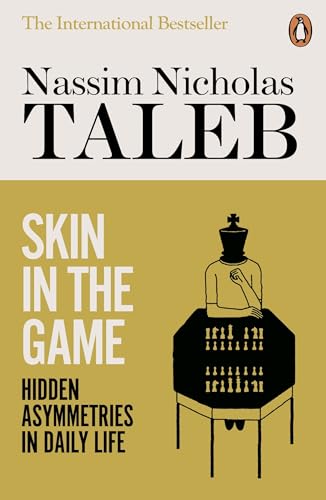

In one sentence
Fairness, reliable knowledge, and sound institutions require symmetry between exposure to risk and access to reward. Taleb’s central test is simple: distrust advice, authority, or power when the person offering it can keep the upside while transferring the downside to others.
Overview
Published in 2018 as part of Taleb’s Incerto, the book is less a linear theory than a series of aphoristic arguments and examples connected by one idea: consequence-bearing improves judgment and constrains harm. It extends his earlier concerns with uncertainty and robustness into ethics, institutional design, and everyday conduct.
Core ideas
Skin in the game is an anti-asymmetry rule
A person should not receive benefits from a decision while someone else bears its meaningful risks. This applies to financiers, executives, consultants, policymakers, academics, and anyone whose errors are paid for by others. Exposure to loss is meant to align incentives better than elaborate regulation alone.
The minority rule
A small, inflexible minority can shape the behavior of a much larger but more accommodating majority. If the majority is indifferent and accommodation is inexpensive, the stubborn group’s preference becomes the social default. Taleb treats this as a mechanism of cultural and political change—not automatically as a force for good.
Survival outranks optimization
Systems should first avoid ruin; attractive average outcomes do not justify exposure to catastrophic downside. Taleb favors arrangements that can survive uncertainty over plans that look efficient under a narrow model of probabilities.
Knowledge comes from consequences
Practical experience, reputation, and the possibility of failure can discipline judgment in ways credentials and abstract expertise may not. His target is the ‘intellectual idiot’: someone who sounds informed but has little exposure to the consequences of being wrong.
Via negativa and the Silver Rule
Taleb prefers improvement by removing harmful or fragile elements rather than confidently designing a perfect system. His ethical emphasis is correspondingly negative: avoid imposing on others what you would reject for yourself, especially when you are insulated from the damage.
Ethics are local and embodied
Moral obligations work most reliably where people are identifiable, reputation matters, and consequences are reciprocal. Taleb is skeptical of universal principles applied abstractly across large populations, arguing that general rules can erase particular circumstances.
Practical takeaways
- When evaluating advice, ask: What happens to this person if they are wrong?
- Do not confuse a financial stake, professional status, or reputation with genuine downside exposure.
- Prefer decision-makers whose incentives include visible, personal consequences for failure.
- In organizations, make risks legible and shared; do not reward people for exporting losses to customers, taxpayers, employees, or the public.
- Use small, reversible experiments instead of large commitments based on fragile forecasts.
- Look for stubborn minorities: they may reveal neglected preferences, but they may also impose harmful or intolerant demands.
- When uncertain, remove practices that create obvious harm before adding complicated interventions.
- Treat credentials as evidence of training, not proof of sound judgment.
Caveats and counterpoints
- The principle is powerful as a heuristic but difficult to apply precisely: some decisions necessarily distribute risks across people who cannot individually consent or share the same exposure.
- Taleb’s examples often illustrate rather than establish his claims; the book’s rhetorical force exceeds its systematic empirical demonstration.
- His critique of experts and institutions can become too sweeping, since expertise, regulation, and collective action sometimes reduce risks that individuals cannot manage alone.
- The minority-rule argument explains how influence spreads, but it does not by itself distinguish legitimate accommodation from coercion or extremism.
- Reviewers have noted that Taleb’s political and cultural conclusions can be polemical, and at times appear inconsistent with his own demand that arguments be grounded in direct exposure to consequences.
Questions worth revisiting
- Where in my work do people receive credit while others absorb the downside?
- Which recommendations would I still make if I had to bear the consequences personally?
- Am I mistaking confidence, credentials, or complexity for competence?
- Which minority preferences shape my environment because most people are merely indifferent?
- What can be safely removed rather than optimized or redesigned?
- When is shared risk unavoidable, and what substitute accountability is appropriate?
Return to this when…
Return to this book when assessing advisers, institutions, incentives, or political proposals—especially when someone claims authority without bearing the consequences of error. Its most useful refresher is the test: who gets the upside, who bears the downside, and what happens if the decision-maker is wrong?
References
- Frontiers | Book Review: Skin in the Game
- Skin in the Game | Deep Notes
- Skin in the Game by Nassim Nicholas Taleb review – how risk should be shared | Philosophy books | The Guardian
- ‘Skin in the Game’ by Nassim Nicholas Taleb | Middle Way Society
- goodreads.com
- researchgate.net
- glasp.co
- grahammann.net
- cpcglobal.org
- fourminutebooks.com
- inquiryreviews.com
- Skin in the Game by Nassim Nicholas Taleb: 9780425284643 | PenguinRandomHouse.com: Books