
In one sentence
Baudrillard argues that modern societies have moved beyond simple representation. Signs and models increasingly precede experience, producing a “hyperreal” world in which the distinction between reality and representation becomes unstable or operationally irrelevant. Simulation is therefore not just deception; it is a system that generates what counts as real.
Overview
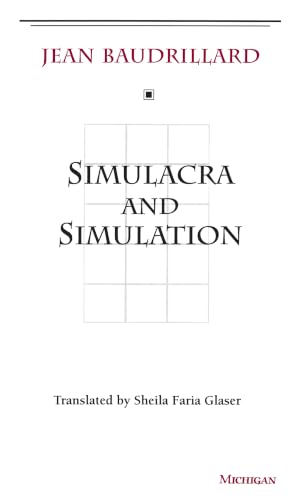
Originally published in French in 1981 and translated into English by Sheila Faria Glaser in 1994, the book is a sequence of connected essays rather than a linear argument. It begins with “The Precession of Simulacra,” then applies the same logic to history, mass media, architecture, advertising, cloning, holograms, film, animals, value, and nihilism.
Core ideas
Simulacra replace representation
A representation presumes some underlying reality to which a sign refers. A simulacrum is different: it circulates without a stable original, referring primarily to other signs. The result is not simply a false picture of reality but a self-reinforcing sign system.
The image passes through stages
Baudrillard sketches a movement from images that reflect reality, to images that distort it, to images that conceal the absence of reality, and finally to images with no meaningful relation to an original. This progression explains how representation can become simulation.
The hyperreal
The hyperreal is produced when models, classifications, media narratives, and designed environments become more authoritative than any supposedly underlying reality. Disneyland, for example, is not merely an artificial place; its artificiality helps define the “real” world outside it as natural and authentic by contrast.
Precession: models come first
In simulation, the model precedes the event. Political opinion polls, media scripts, advertising categories, and institutional scenarios do not simply describe social life; they help format expectations and behavior. Reality becomes an effect of prior codes.
Implosion of meaning
When information, images, and communication proliferate without producing shared understanding, meaning does not necessarily expand. Baudrillard describes an implosion: distinctions such as public/private, active/passive, reality/image, and information/meaning collapse into one another.
Media and deterrence
Media systems can absorb or neutralize opposition by representing every conflict, critique, or scandal within the same circulating system of signs. Visibility may therefore function less as liberation than as containment: everything is shown, but nothing necessarily changes.
History as a constructed scenario
The essays on history and media suggest that the past is increasingly reconstructed through retrospective images, cinematic conventions, commemorations, and documentary formats. Historical “reality” becomes difficult to separate from the ways it is packaged and consumed.
Consumption is cultural expenditure
The book shifts emphasis away from culture as the production of useful objects and toward expenditure: circulation, display, excess, spectacle, and the consumption of signs. Commodities matter not only for what they do but for what their codes signify socially.
Practical takeaways
- When assessing a media narrative, ask what prior model or code is organizing the event before asking whether the narrative is accurate.
- Separate three questions: What happened? How was it represented? What behaviors did the representation make possible or expected?
- Treat brands, political labels, metrics, rankings, and online identities as systems of signs—not transparent descriptions of underlying value.
- Notice when more information produces less intelligibility. Baudrillard’s point is not that information is false, but that circulation can neutralize meaning.
- Use “hyperreality” precisely: it names a condition in which representations and models become more consequential than any clear original, not merely something vivid, fake, or technologically advanced.
- Read the book as cultural diagnosis and conceptual provocation, not as a practical method for verifying facts.
Caveats and counterpoints
- Baudrillard writes aphoristically and often moves by analogy, reversal, and provocation rather than by empirical demonstration. His claims are difficult to test as stated.
- The book’s examples are rooted largely in late twentieth-century France, television, mass consumption, nuclear deterrence, and cinema. Applying the framework to digital platforms or artificial intelligence is an interpretation, not something directly argued in this volume.
- His language can sound as if reality has disappeared completely. A more careful reading is that access to reality is increasingly mediated and that models acquire practical priority; physical events, institutions, and material inequalities do not simply cease to exist.
- The book can flatten important differences among media, institutions, and audiences. Critics may object that people interpret, resist, and repurpose signs rather than merely circulate within a closed system.
- Do not reduce the argument to the popular idea that we literally live inside a computer simulation. Baudrillard’s simulation concerns social signs, models, and cultural codes; the later film association is an adaptation of the vocabulary, not a faithful summary of the book.
Questions worth revisiting
- Which of Baudrillard’s examples still illuminates contemporary media, and which depend too heavily on the media environment of the 1970s and 1980s?
- Does the concept of hyperreality explain how social media works, or does it obscure the material infrastructures and economic incentives behind platforms?
- If every critique is absorbed by the system, what would meaningful resistance look like? Does Baudrillard offer an answer, or mainly describe the difficulty?
- Can we distinguish between a sign having no original and a sign having multiple, contested, or socially constructed originals?
- Where does the book’s rhetoric clarify experience, and where does it become so totalizing that it prevents discrimination among different kinds of reality?
Return to this when…
Return to “The Precession of Simulacra” when a media image, political narrative, brand, or model seems to be shaping the event it claims merely to describe. Revisit “The Implosion of Meaning in the Media” when increased communication appears to produce passivity or confusion rather than understanding, and consult the chapter list when tracing the theory across advertising, film, science fiction, or consumer culture.
References
- Simulacra and Simulation | Jean Baudrillard & Sheila Faria Glaser | 9780472065219 | University of Michigan Press
- Simulacra and Simulation - Jean Baudrillard - Google Books
- web.stanford.edu
- en.wikipedia.org
- thetelos.org
- lib.ccsdetroit.edu
- dygest.co
- books.google.com
- ecampus.com
- archania.org
- The Jean Baudrillard Reader | JSTOR
- library.cca.edu