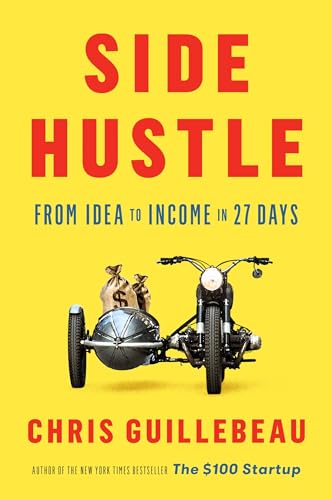

In one sentence
A side hustle is best developed as a small experiment: choose a feasible idea that solves a specific problem, put a simple offer in front of real customers quickly, and use actual sales—not enthusiasm or elaborate planning—to decide what deserves further investment.
Overview
The book presents a 27-day plan, generally organized into five stages: generate ideas, select the strongest opportunity, prepare the offer and launch materials, present it to the right audience, then refine based on results. Guillebeau favors projects that can begin alongside employment, use existing skills or resources, require limited upfront spending, and have a clear path to revenue.
Core ideas
Start with an offer, not a vague passion
Promising ideas are framed around a defined customer, a specific problem or desired outcome, and an understandable exchange of value for money. The useful question is not simply “What do I enjoy?” but “What can I offer that someone will pay for?”
Evaluate ideas on three dimensions
Guillebeau’s selection process emphasizes feasibility, profitability, and persuasiveness. An idea must be possible with available resources, capable of producing worthwhile revenue after costs, and easy enough to explain that potential customers understand why they should buy.
Prefer low-risk business models
The book highlights three broad routes: selling products, providing services, or acting as an intermediary who connects buyers and sellers. The common design principle is to avoid heavy inventory, complicated infrastructure, and large commitments before demand is demonstrated.
Use a short validation cycle
The 27-day schedule is designed to prevent endless preparation. Build the minimum credible version of the offer, identify likely buyers, make a direct pitch, and treat responses, purchases, and objections as evidence for improving or abandoning the idea.
A persuasive offer has several parts
The practical selling framework centers on the promise of a useful result, a pitch explaining why the offer matters now, and a price with a clear purchasing process. Clarity and relevance matter more than polished branding.
Launch before you feel ready
The plan deliberately favors action over certainty. A side hustle can remain small and part-time while it is tested; its first objective is not to become a full company but to establish whether strangers will exchange money for the proposed value.
Practical takeaways
- List several possible offers before committing to one; compare them by ease of execution, likely demand, margins, and how clearly they can be explained.
- Write the offer in one sentence: who it helps, what result it provides, and what the customer pays.
- Estimate revenue, direct costs, time required, and likely profit before building anything substantial.
- Identify a narrow first audience rather than marketing to everyone.
- Create a minimum viable version using tools and capabilities already available.
- Ask for a concrete action—purchase, booking, signup, or paid trial—rather than relying on compliments or hypothetical interest.
- Track objections and failed pitches as information; revise the offer, audience, price, or delivery method.
- Keep the side hustle separate from your assumptions about your identity: it can be a temporary experiment, a modest income stream, or a path to something larger.
Caveats and counterpoints
- The 27-day timetable is a forcing device, not a reliable promise of income. The book’s case studies demonstrate possibilities, but outcomes depend on skills, audience access, market conditions, legal constraints, and available time.
- The low-cost approach does not mean zero risk or zero labor. Customer service, marketing, taxes, insurance, compliance, and fulfillment can become substantial burdens once demand appears.
- The emphasis on rapid action may underweight businesses requiring licensing, specialized expertise, trust-building, safety checks, or longer sales cycles.
- Examples of successful hustles can create survivorship bias: failed experiments and the full amount of work required after initial traction are less visible than launch stories.
- A side hustle can increase financial resilience, but it can also become a second job and contribute to overload if boundaries, pricing, and capacity are not managed.
Questions worth revisiting
- Which of my skills or resources could solve a narrowly defined problem for a reachable group of people?
- What evidence would distinguish genuine demand from encouragement by friends?
- Can I deliver the first version profitably after counting my time and all direct costs?
- What is the smallest paid experiment I can run this week?
- If the idea works, do I want more customers—or a more efficient, limited-size business?
- What conditions would make this advice unsafe or impractical for my situation, such as licensing, debt, conflicts with employment, or inadequate capacity?
Return to this when…
Return to this book when you are stuck in idea-generation or preparation. Its most useful reminder is to convert an attractive concept into a small, paid test with a defined customer, clear offer, and short feedback loop; for detailed operations, accounting, legal compliance, or scaling, use more specialized sources.
References
- Summary of Side Hustle by Chris Guillebeau | Summaries.Com
- blinkist.com
- Summary of 'Side Hustle: From Idea to Income in 27 Days' by Chris Guillebeau
- "Side Hustle: From Idea to Income in 27 Days" - Summary & Review | Glasp
- Side Hustle: From Idea to Income in 27 Days by Chris Guillebeau | Goodreads
- goodreads.com
- Summary of "Side Hustle" by Chris Guillebeau
- goodreads.com
- Side Hustle: From Idea to Income in 27 Days - Chris Guillebeau - Google Books
- makeheadway.com
- summarypedia.org
- growthabit.com