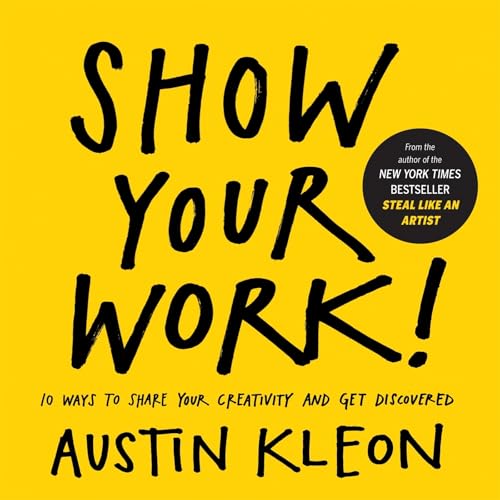

In one sentence
Creative careers become more discoverable when creators consistently share the work around the work—process, influences, lessons, experiments, and progress—in a generous, credible way. Kleon presents visibility less as advertising and more as participation in a creative community.
Overview
Published by Workman in 2014, the book is a compact, illustrated manual organized around ten rules: reject the myth of the solitary genius; show process rather than only finished products; share small updates; curate your influences; tell stories; teach; avoid “human spam”; absorb criticism; accept commerce without shame; and persist.
Core ideas
You do not need to be a genius
Stop waiting for a breakthrough identity or perfect originality. Creative work develops through participation, attention, and contribution within an “ecology of talent”—a network of people, ideas, references, and collaborators.
Think process, not product
Finished work is often less informative than the path toward it. Showing drafts, decisions, tools, failures, and revisions gives people a reason to follow and makes the work easier to understand.
Share something small every day
Use frequent, manageable acts of publishing to create a public record of practice. The point is not constant performance but making your work findable and building a habit of noticing what is worth sharing.
Open your cabinet of curiosities
Share what you are studying, collecting, admiring, or connecting. Curation reveals taste and helps others see the sources and questions shaping your work.
Tell good stories; teach what you know
Context increases the value of an artifact: explain what problem you faced, what you learned, or how something works. Teaching is framed as generosity and as a way to clarify your own understanding.
Do not become human spam
Visibility fails when every interaction is a disguised sales pitch. Participate, respond, recommend others, and contribute before asking for attention. Give credit accurately when sharing influences or other people’s work.
Learn to take a punch
Public work invites misunderstanding, indifference, and criticism. Develop enough emotional distance to learn from useful feedback without allowing strangers’ reactions to determine your identity or output.
Sell out—and stick around
Kleon separates earning money from betraying artistic values: selling work can support continued practice. Long-term discoverability depends less on a viral moment than on maintaining a body of work and a recognizable presence.
Practical takeaways
- Create one home base you control—such as a personal website or mailing list—and use social platforms as outposts rather than your entire archive.
- Post work-in-progress, annotated references, short lessons, rejected approaches, or before-and-after comparisons—not only polished announcements.
- Keep a running “cabinet” of books, artists, tools, questions, and links that are genuinely influencing you.
- When sharing someone else’s work, identify the source and add useful context instead of merely reposting it.
- Set a sustainable publishing rhythm. “Every day” is a prompt for consistency, not a reason to sacrifice deep work or privacy.
- Treat audience-building as relationship-building: acknowledge peers, answer questions, and make recommendations that do not directly benefit you.
- Decide in advance which parts of your life and unfinished work remain private; openness is a strategy, not an obligation.
Caveats and counterpoints
- The book’s online-sharing advice reflects the early-2010s web and cannot guarantee discovery; platforms, algorithms, and audience norms change.
- Frequent posting can reward quantity, immediacy, and personal branding over concentrated or private work. A slower cadence may suit researchers, novelists, or creators handling sensitive material.
- “Share the process” is not equally safe for everyone: revealing drafts, methods, or personal context can invite appropriation, harassment, or professional risk.
- Generosity and persistence improve the conditions for being noticed, but they do not overcome unequal access, gatekeeping, luck, or differences in platform reach.
- The book is strongest as a behavioral prompt and publishing philosophy, less as a detailed strategy for pricing, distribution, analytics, or sustainable business models.
Questions worth revisiting
- What part of my process could help, teach, or interest someone before the final product exists?
- Which influences am I willing to name publicly, and how can I credit them precisely?
- What is my minimum sustainable sharing rhythm during periods of intensive work?
- Which platform or format lets me be findable without making me dependent on a changing algorithm?
- What criticism would be useful evidence, and what criticism should I deliberately ignore?
Return to this when…
Return to the ten chapter headings when you are hiding unfinished work, waiting for permission, or confusing self-promotion with contribution. The most useful refresher is the distinction between broadcasting achievements and documenting a generous, sustained practice.
Highlights
“Autobiography is only to be trusted when it reveals something disgraceful.”
Strike all the adjectives from your bio. If you take photos, you’re not an “aspiring” photographer, and you’re not an “amazing” photographer, either. You’re a photographer. Don’t get cute. Don’t brag. Just state the facts. One more thing: Unless you are actually a ninja, a guru, or a rock star, don’t ever use any of those terms in your bio. Ever.
At some point, you might consider turning off comments completely. Having a form for comments is the same as inviting comments. “There’s never a space under paintings in a gallery where someone writes their opinion,” says cartoonist Natalie Dee. “When you get to the end of a book, you don’t have to see what everyone else thought of it.” Let people contact you directly or let them copy your work over to their own spaces and talk about it all they want.
“In our business you don’t quit,” says comedian Joan Rivers. “You’re holding on to the ladder. When they cut off your hands, hold on with your elbow. When they cut off your arms, hold on with your teeth. You don’t quit because you don’t know where the next job is coming from.”
“Every two or three years, I knock off for a while. That way, I’m constantly the new girl in the whorehouse.” —Robert Mitchum
“Anyone who isn’t embarrassed of who they were last year probably isn’t learning enough,” writes author Alain de Botton.
The comedian Louis C.K. worked on the same hour of material for 15 years, until he found out that his hero, George Carlin, threw out his material every year and started from scratch. C.K. was scared to try it, but once he did, it set him free. “When you’re done telling jokes about airplanes and dogs, and you throw those away, what do you have left? You can only dig deeper. You start talking about your feelings and who you are. And then you do those jokes and they’re gone. You gotta dig deeper.” When you get rid of old material, you push yourself further and come up with something better. When you throw out old work, what you’re really doing is making room for new work.