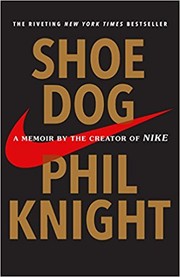

In one sentence
Shoe Dog presents Nike’s creation as a prolonged act of commitment under uncertainty: the company survives not through a perfect plan, but through a compelling mission, adaptive experimentation, trusted collaborators, relentless selling, and the willingness to endure repeated financial and personal crises. Knight’s account is a founder’s perspective, not a neutral corporate history.
Overview
Knight begins in 1962, at age twenty-four, with a business-school idea: import inexpensive, high-quality Japanese running shoes into the United States. He forms Blue Ribbon Sports, recruits his former coach Bill Bowerman, sells shoes directly to runners and retailers, and gradually builds a team of unusual, highly committed employees. The narrative follows the company’s recurring struggles with suppliers, banks, competitors, lawsuits, regulation, and cash flow. Blue Ribbon eventually develops its own brand, Nike, and reaches its 1980 public offering. The book largely ends there; it is primarily the origin story of Nike rather than an account of the company’s later global dominance.
Core ideas
Start with a direction, not a complete blueprint
Knight’s original idea is narrow and practical—bring Japanese running shoes to American consumers—but its larger meaning is personal: he wants work that feels like his own. The business develops through successive decisions rather than a fully specified master plan.
Persistence is operational, not merely inspirational
The company repeatedly faces shortages of money, inventory, credit, and reliable suppliers. Continuing means making uncomfortable calls, finding another financing route, repairing relationships, and selling the next shipment—not simply believing harder.
A mission can coordinate an unconventional team
Knight attributes much of Nike’s resilience to a group of “misfits and savants” united by enthusiasm for sport and shoes. Shared identity and commitment compensate for limited resources and create a culture stronger than formal process alone.
Product obsession creates strategic advantage
Bowerman’s experimentation and the company’s close contact with runners connect design to lived athletic experience. Nike’s early edge is not just distribution; it is learning what athletes need and translating that knowledge into distinctive products.
Cash flow can matter more than apparent success
Blue Ribbon grows while remaining financially vulnerable. Increasing sales do not automatically produce security when inventory, manufacturing commitments, bank credit, and payment timing pull cash in opposite directions. Growth can intensify fragility.
Control over the value proposition matters
The conflict with Japanese supplier Onitsuka helps push Blue Ribbon toward developing and selling its own brand. Knight’s story implies that dependence on another company’s product and terms can limit a distributor’s long-term freedom.
Luck and relationships are part of the explanation
Knight’s retrospective includes timing, chance encounters, supportive employees, athletes, retailers, and lenders alongside effort. The narrative is therefore less a formula for success than a demonstration of how persistence lets a company benefit from favorable opportunities.
The founder’s story is also a selective origin myth
Knight openly depicts fear, mistakes, conflict, and near-failure, but the story remains his interpretation. Critics note that the book is focused on 1962–1980, gives limited attention to Nike’s later history, and centers the company’s creation more than a balanced account of every contributor or consequence.
Practical takeaways
- Translate a broad ambition into a small initial transaction: a product, customer, supplier, and testable route to market.
- Treat liquidity as a daily management problem; revenue growth does not remove financing risk.
- Recruit for shared purpose and complementary judgment, not just conventional credentials.
- Stay close to users. Direct observation can reveal product improvements that formal market research misses.
- Build capabilities that reduce dependence on a powerful supplier or partner.
- Expect the plan to change as constraints reveal the real business.
- Separate useful lessons from survivorship bias: Nike’s success does not prove that extreme persistence alone produces success.
- When reading founder memoirs, ask who is missing, which events are compressed, and what the author has incentives to emphasize.
Caveats and counterpoints
- This is a memoir and should be read as Knight’s reconstructed perspective, especially regarding conflicts, motives, credit, and the meaning of particular turning points.
- It is much more about Nike’s early formation than about the mature company, its global supply chain, labor controversies, advertising machine, or later leadership.
- The book’s dramatic pacing can make persistence and personal loyalty appear more causally decisive than market conditions, capital access, timing, and luck.
- Its entrepreneurial lessons arose in a particular mid-century American sporting-goods and manufacturing context; they do not transfer mechanically to highly regulated, digital, or capital-intensive sectors.
- The emotional cost of obsession is present in the narrative, but the book can still romanticize endurance and understate the burdens placed on family and employees.
Questions worth revisiting
- Which parts of Nike’s success came from Knight’s decisions, and which came from Bowerman, early employees, athletes, suppliers, retailers, or historical timing?
- Where is persistence wise, and where would it be better interpreted as sunk-cost attachment?
- What evidence would a neutral history add about people and events Knight presents from his own viewpoint?
- How should the story change my view of growth when a company is profitable on paper but repeatedly short of cash?
- What is the smallest experiment I could run on an idea before committing substantial money or identity to it?
Return to this when…
Return to this book when evaluating founder stories, persistence advice, startup cash-flow risk, team culture, or the difference between an inspiring origin narrative and a complete business history.
Highlights
I went to Cairo, to the Giza plateau, and stood beside desert nomads and their silk-draped camels at the foot of the Great Sphinx, all of us squinting up into its eternally open eyes. The sun hammered down on my head, the same sun that hammered down on the thousands of men who built these pyramids, and the millions of visitors who came after. Not one of them was remembered, I thought. All is vanity, says the Bible. All is now, says Zen. All is dust, says the desert.
Even the Sistine Chapel. Alone under Michelangelo’s ceiling, I was able to wallow in my disbelief. I read in my guidebook that Michelangelo was miserable while painting his masterpiece. His back and neck ached. Paint fell constantly into his hair and eyes. He couldn’t wait to be finished, he told friends. If even Michelangelo didn’t like his work, I thought, what hope is there for the rest of us?
Don’t tell people how to do things, tell them what to do and let them surprise you with their results.
went to Vienna, that momentous, coffee-scented crossroads, where Stalin and Trotsky and Tito and Hitler and Jung and Freud all lived, at the same historical moment, and all loitered in the same steamy cafés, plotting how to save (or end) the world. I walked the cobblestones Mozart walked, crossed his graceful Danube on the most beautiful stone bridge I ever saw, stopped before the towering spires of St. Stephen’s Church, where Beethoven discovered he was deaf. He looked up, saw birds fluttering from the bell tower, and to his horror . . . he did not hear the bells.
Then, walking up those bleached steps, another thought: This is where it all begins. On my left was the Parthenon, which Plato had watched the teams of architects and workmen build. On my right was the Temple of Athena Nike. Twenty-five centuries ago, per my guidebook, it had housed a beautiful frieze of the goddess Athena, thought to be the bringer of “nike,” or victory.
This is how I spent 1963. Quizzing pigeons. Polishing my Valiant. Writing letters. Dear Carter, Did you ever leave Shangri-La? I’m an accountant now and giving some thought to blowing my brains out.
up about an idea. I liked the sound of that. “But,” he added, “fifty-fifty is not so hot for the Coach. He
I’d been unable to sell encyclopedias, and I’d despised it to boot. I’d been slightly better at selling mutual funds, but I’d felt dead inside. So why was selling shoes so different? Because, I realized, it wasn’t selling. I believed in running. I believed that if people got out and ran a few miles every day, the world would be a better place, and I believed these shoes were better to run in. People, sensing my belief, wanted some of that belief for themselves. Belief, I decided. Belief is irresistible.
Equity—I reached the point where I refused to even say it aloud, because it wasn’t a real word, it was bureaucratic jargon, a euphemism for cold hard cash, of which I had none. Purposely. Any dollar that wasn’t nailed down I was plowing directly back into the business. Was that so rash? To have cash balances sitting around doing nothing made no sense to me. Sure, it would have been the cautious, conservative, prudent thing. But the roadside was littered with cautious, conservative, prudent entrepreneurs. I wanted to keep my foot pressed hard on the gas pedal.
And then Adidas threatened to sue. Adidas already had a new shoe named the “Azteca Gold,” a track spike they were planning to introduce at the same Olympics. No one had ever heard of it, but that didn’t stop Adidas from kicking up a fuss. Aggravated, I drove up the mountain to Bowerman’s house to talk it all over. We sat on the wide porch, looking down at the river. It sparkled that day like a silver shoelace. He took off his ball cap, put it on again, rubbed his face. “Who was that guy who kicked the shit out of the Aztecs?” he asked. “Cortez,” I said. He grunted. “Okay. Let’s call it the Cortez.”
AS I GRADUALLY moved my inventory out of my apartment, into my new office, the thought crossed my mind that it might make more sense to give up the apartment altogether, just move into the office, since I’d basically be living there anyway. When I wasn’t at Price Waterhouse, making the rent, I’d be at Blue Ribbon, and vice versa. I could shower at the gym. But I told myself that living in your office is the act of a crazy person. And then I got a letter from Johnson saying he was living in his new office.
I opened by telling Strasser that it was all a foregone conclusion, really. “You’re one of us,” I said. One of us. He knew what those words meant. We were the kind of people who simply couldn’t put up with corporate nonsense. We were the kind of people who wanted our work to be play. But meaningful play. We were trying to slay Goliath, and though Strasser was bigger than two Goliaths, at heart he was an utter David. We were trying to create a brand, I said, but also a culture. We were fighting against conformity, against boringness, against drudgery. More than a product, we were trying to sell an idea—a spirit. I don’t know if I ever fully understood who we were and what we were doing until I heard myself saying it all that day to Strasser.
I slid my eyes toward Hayes. I tried not to smile. I tried very hard. I failed. Then I looked right at Holland. It was all there in his unblinking eyes. He knew the bank had overplayed its hand. He knew the bank’s officers had overreacted. I could see, in that moment, there would be no more FBI investigation. He and the bank wanted this matter closed, over, done with. They’d treated a good customer shabbily, and they didn’t want to have to answer for their actions. We would never hear of them, or him, again. I looked at the suits on either side of Holland. “Gentlemen,” I said, standing. Gentlemen. Sometimes that’s Business-ese for: Take your FBI and shove it.
WHEN WE WERE all outside the bank, I bowed to Ito. I wanted to kiss him, but I only bowed. Hayes bowed, too, though for a moment I thought he was pitching forward from the stress of the last three days. “Thank you,” I said to Ito. “You will never be sorry that you defended us like that.” He straightened his tie. “Such stupidity,” he said. At first I thought he was talking about me. Then I realized he meant the bank. “I do not like stupidity,” he said. “People pay too much attention to numbers.”
“No brilliant idea was ever born in a conference room,” he assured the Dane. “But a lot of silly ideas have died there,” said Stahr. —F. Scott Fitzgerald, The Last Tycoon
Now that we’d gotten past our bank crisis, now that I was reasonably sure of not going to jail, I could go back to asking the deep questions. What are we trying to build here? What kind of company do we want to be? Like most companies, we had role models. Sony, for instance. Sony was the Apple of its day. Profitable, innovative, efficient—and it treated its workers well. When pressed, I often said I wanted to be like Sony. At root, however, I still aimed and hoped for something bigger, and vaguer.
You are remembered for the rules you break.
JOHNSON COINED THE phrase, we think. At one of our earliest retreats he muttered: “How many multimillion-dollar companies can you yell out, ‘Hey, Buttface,’ and the entire management team turns around?” It got a laugh. And then it stuck. And then it became a key part of our vernacular. Buttface referred to both the retreat and the retreaters, and it not only captured the informal mood of those retreats, where no idea was too sacred to be mocked, and no person was too important to be ridiculed, it also summed up the company spirit, mission and ethos.
Despite our hijinks, despite our eccentricities, despite our physical limitations, I concluded in 1976 that we were a formidable team. (Years later a famous Harvard business professor studying Nike came to the same conclusion. “Normally,” he said, “if one manager at a company can think tactically and strategically, that company has a good future. But boy are you lucky: More than half the Buttfaces think that way!”)
Brown managed to dream up a campaign and a tagline that perfectly captured Nike’s philosophy. His ad showed a single runner on a lonely country road, surrounded by tall Douglas firs. Oregon, clearly. The copy read: “Beating the competition is relatively easy. Beating yourself is a never-ending commitment.” Everyone around me thought the ad was bold, fresh. It didn’t focus on the product, but on the spirit behind the product, which was something you never saw in the 1970s. People congratulated me on that ad as if we’d achieved something earth-shattering. I’d shrug. I wasn’t being modest. I still didn’t believe in the power of advertising. At all. A product, I thought, speaks for itself, or it doesn’t. In the end, it’s only quality that counts. I couldn’t imagine that any ad campaign would ever prove me wrong or change my mind.
And utterly empty. The interior decorator decided to go Japanese minimalist—with one touch of the absurd that everyone found hilarious. She thought it would be a hoot to set beside my desk a leather chair that was a giant baseball mitt. “Now,” she said, “you can sit there every day and think about your . . . sports things.” I sat in the mitt, like a foul ball, and looked out the window. I should have reveled in that moment, savored the humor and the irony. Getting cut from my high school baseball team had been one of the great hurts of my life, and now I was sitting in a giant mitt, in a swank new office, presiding over a company that sold “sports things” to professional baseball players. But instead of cherishing how far we’d come, I saw only how far we had to go. My window looked onto a beautiful stand of pines, and I definitely couldn’t see the forest for the trees. I didn’t understand what was happening, in the moment, but now I do. The years of stress were taking their toll. When you see only problems, you’re not seeing clearly. At just the moment I needed to be my sharpest, I was approaching burnout.
The first to get in would have a competitive advantage that could last decades, not only in China’s production sector, but in its markets, and with its political leaders. What a coup that would be. In our first meetings on the subject of China we’d always say: One billion people. Two. Billion. Feet.
For some, I realize, business is the all-out pursuit of profits, period, full stop, but for us business was no more about making money than being human is about making blood. Yes, the human body needs blood. It needs to manufacture red and white cells and platelets and redistribute them evenly, smoothly, to all the right places, on time, or else. But that day-to-day business of the human body isn’t our mission as human beings. It’s a basic process that enables our higher aims, and life always strives to transcend the basic processes of living—and at some point in the late 1970s, I did, too. I redefined winning, expanded it beyond my original definition of not losing, of merely staying alive. That was no longer enough to sustain me, or my company. We wanted, as all great businesses do, to create, to contribute, and we dared to say so aloud. When you make something, when you improve something, when you deliver something, when you add some new thing or service to the lives of strangers, making them happier, or healthier, or safer, or better, and when you do it all crisply and efficiently, smartly, the way everything should be done but so seldom is—you’re participating more fully in the whole grand human drama. More than simply alive, you’re helping others to live more fully, and if that’s business, all right, call me a businessman. Maybe it will grow on me.
I turned out the light and went and sat in front of the TV with Penny. Neither of us was really watching. She was reading a book and I was doing calculations in my head. By this time next week Bowerman would be worth $9 million. Cale—$6.6 million. Woodell, Johnson, Hayes, Strasser—each about $6 million. Fantasy numbers. Numbers that meant nothing. I never knew that numbers could mean so much, and so little, at the same time. “Bed?” Penny said. I nodded. I went around the house, turning off lights, checking doors. Then I joined her. For a long time we lay in the dark. It wasn’t over. Far from it. The first part, I told myself, is behind us. But it’s only the first part. I asked myself: What are you feeling? It wasn’t joy. It wasn’t relief. If I felt anything, it was . . . regret? Good God, I thought. Yes. Regret. Because I honestly wished I could do it all over again.
I fell asleep for a few hours. When I woke it was cold and rainy. I went to the window. The trees were dripping water. Everything was mist and fog. The world was the same as it had been the day before, as it had always been. Nothing had changed, least of all me. And yet I was worth $178 million. I showered, ate breakfast, drove to work. I was at my desk before anyone else.
The theater is a new sixteen-screen colossus in the heart of Cathedral City, just outside Palm Springs. These days we spend much of the winter there, hiding from the chilly Oregon rains. Walking through the lobby, waiting for our eyes to adjust, we spot two familiar faces. At first we can’t place them. We’re still seeing Nicholson and Freeman in our minds. But these faces are equally familiar—equally famous. Now we realize. It’s Bill and Warren. Gates and Buffett. We stroll over. Neither man is what you’d call a close friend, but we’ve met them several times, at social events and conferences. And we have common causes, common interests, a few mutual acquaintances. “Fancy meeting you here!” I say. Then I cringe. Did I really just say that? Is it possible that I’m still shy and awkward in the presence of celebrities? “I was just thinking about you,” one of them says. We shake hands, all around, and talk mostly about Palm Springs. Isn’t this place lovely? Isn’t it wonderful to get out of the cold? We talk about families, business, sports. I hear someone behind us whisper, “Hey, look, Buffett and Gates—who’s that other guy?” I smile. As it should be. In my head I can’t help doing some quick math. At the moment I’m worth $10 billion, and each of these men is worth five or six times more. Lead me from the unreal to the real. Penny asks if they enjoyed the movie. Yes, they both say, looking down at their shoes, though it was a bit depressing. What’s on your bucket lists? I nearly ask, but I don’t. Gates and Buffett seem to have done everything they’ve ever wanted in this life. They have no bucket lists, surely. Which makes me ask myself: Have I?
I think of the countless Nike offices around the world. At each one, no matter the country, the phone number ends in 6453, which spells out Nike on the keypad. But, by pure chance, from right to left it also spells out Pre’s best time in the mile, to the tenth of a second: 3:54.6.
And yet I know that this regret clashes with my secret regret—that I can’t do it all over again. God, how I wish I could relive the whole thing. Short of that, I’d like to share the experience, the ups and downs, so that some young man or woman, somewhere, going through the same trials and ordeals, might be inspired or comforted. Or warned. Some young entrepreneur, maybe, some athlete or painter or novelist, might press on. It’s all the same drive. The same dream. It would be nice to help them avoid the typical discouragements. I’d tell them to hit pause, think long and hard about how they want to spend their time, and with whom they want to spend it for the next forty years. I’d tell men and women in their midtwenties not to settle for a job or a profession or even a career. Seek a calling. Even if you don’t know what that means, seek it. If you’re following your calling, the fatigue will be easier to bear, the disappointments will be fuel, the highs will be like nothing you’ve ever felt. I’d like to warn the best of them, the iconoclasts, the innovators, the rebels, that they will always have a bull’s-eye on their backs. The better they get, the bigger the bull’s-eye. It’s not one man’s opinion; it’s a law of nature. I’d like to remind them that America isn’t the entrepreneurial Shangri-La people think. Free enterprise always irritates the kinds of trolls who live to block, to thwart, to say no, sorry, no. And it’s always been this way. Entrepreneurs have always been outgunned, outnumbered. They’ve always fought uphill, and the hill has never been steeper. America is becoming less entrepreneurial, not more. A Harvard Business School study recently ranked all the countries of the world in terms of their entrepreneurial spirit. America ranked behind Peru. And those who urge entrepreneurs to never give up? Charlatans. Sometimes you have to give up. Sometimes knowing when to give up, when to try something else, is genius. Giving up doesn’t mean stopping. Don’t ever stop. Luck plays a big role. Yes, I’d like to publicly acknowledge the power of luck. Athletes get lucky, poets get lucky, businesses get lucky. Hard work is critical, a good team is essential, brains and determination are invaluable, but luck may decide the outcome. Some people might not call it luck. They might call it Tao, or Logos, or Jñāna, or Dharma. Or Spirit. Or God. Put it this way. The harder you work, the better your Tao. And since no one has ever adequately defined Tao, I now try to go regularly to mass. I would tell them: Have faith in yourself, but also have faith in faith. Not faith as others define it. Faith as you define it. Faith as faith defines itself in your heart.