In one sentence
Product teams ship more meaningful work when they make fewer, better-defined bets: clarify the problem and rough solution first, limit investment with a fixed appetite, then give a small team authority to solve the problem within a fixed cycle. The method is less a universal methodology than Basecamp’s opinionated operating model.
Overview
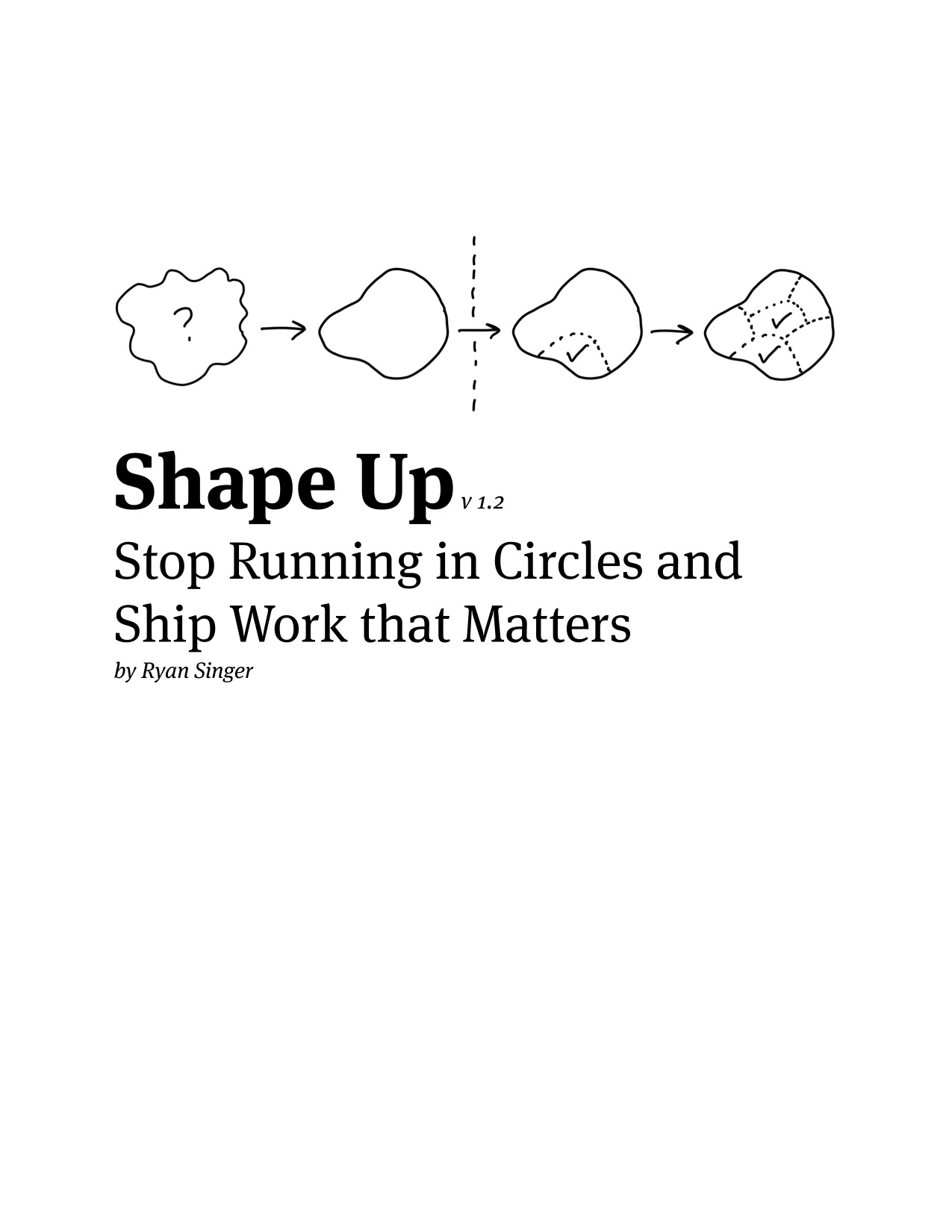
The book presents Basecamp’s alternative to backlog-and-sprint management. Work moves through shaping, betting, building, and shipping. “Shapers” turn raw ideas into pitches with boundaries and rough designs; leadership chooses which pitches receive a cycle; designers and programmers decide the detailed implementation. A typical rhythm is six weeks of focused work followed by two weeks of cooldown.
Core ideas
Shape before committing
Do the difficult discovery and design work before assigning a team. A useful pitch explains the problem, outlines a possible solution, identifies rabbit holes and non-goals, and shows enough structure to make the work discussable without prescribing every task. This reduces ambiguity while preserving implementation judgment.
Use appetite, not estimates
Ask, “How much time is this worth?” rather than pretending to know exactly how long the work will take. A small or large appetite sets the investment boundary; the team then shapes the scope to fit it. This shifts trade-offs from deadline negotiation to product judgment.
Fixed time, variable scope
A cycle is a firm commitment, commonly six weeks. When the scope is too large, the team cuts secondary pieces rather than automatically extending the deadline. The “circuit breaker” prevents projects from consuming indefinite time.
Autonomous, cross-functional teams
Once a bet is made, the team owns the solution. Work is not decomposed into centrally assigned tickets; designers and programmers collaborate on vertical slices and resolve details as they learn. Autonomy is intended to increase responsibility, speed, and coherence.
The hill chart
Progress is represented as moving from uphill uncertainty—figuring out the approach—to downhill execution. The model distinguishes “we have not solved the problem” from “we know what to do but still have work left,” which is more informative than percentage-complete reporting.
Cooldown is part of the system
After a cycle, teams have unstructured time to fix bugs, explore ideas, address technical issues, and recover before the next betting decision. Without this pause, planned work can become a continuous treadmill.
Betting replaces backlog accumulation
Instead of maintaining a large inventory of promises, stakeholders periodically choose a small set of pitches for the next cycle. Ideas that are not selected do not remain as obligations requiring constant grooming; they can be reconsidered when they become important again.
Practical takeaways
- Write a short pitch before starting substantial work: problem, appetite, rough solution, boundaries, risks, and non-goals.
- Set the time boundary first, then cut scope aggressively until the meaningful outcome fits.
- Give the team an outcome and constraints, not a complete task breakdown.
- Track unresolved decisions separately from remaining implementation; they have different risks and need different interventions.
- Use a circuit breaker: require an explicit new bet before extending a project beyond its original appetite.
- Reserve recurring capacity for cooldown, maintenance, exploration, and recovery rather than treating them as invisible overtime.
- Borrow the principles selectively—shaping, appetite, scope flexibility, and autonomy do not require copying Basecamp’s exact six-week calendar.
Caveats and counterpoints
- The book describes Basecamp’s own process and should not be treated as evidence that the framework is broadly superior. Its fit depends on organizational context, product type, team maturity, and leadership support.
- The model is strongest for discrete, cross-functional product bets. It is less obviously suited to high-volume support, interrupt-driven operations, regulatory work, platform maintenance, or projects requiring synchronized delivery across many teams.
- Autonomy assumes capable designers and engineers, clear product judgment, and enough technical and deployment infrastructure to ship within the cycle. Without those conditions, flexible scope can become late discovery or hidden coordination work.
- Critics may see the approach as a reframing of familiar agile ideas rather than a wholly new paradigm; the book’s distinctive contribution is the coherent operating package and vocabulary, not proof that every underlying idea is novel.
- A six-week cycle can provide focus but may reduce feedback frequency or create pressure when work cannot be meaningfully sliced. Adapt the cadence to the learning and risk profile of the product.
Questions worth revisiting
- Which current projects are commitments by habit rather than deliberate bets?
- What problem would be worth one cycle of investment, and what would we explicitly leave out?
- Where are we still estimating tasks instead of deciding how much appetite the outcome deserves?
- Which decisions must be made during shaping, and which should remain with the delivery team?
- What work is currently crowding out cooldown, maintenance, or exploration?
- Would our teams actually have the autonomy, skills, and deployment capability that this model presumes?
Return to this when…
Return to the sections on appetite, shaping, betting, and scope-cutting when a project feels vague, overcommitted, or trapped in estimation and backlog maintenance. Revisit the caveats before applying the method to large, highly coordinated, interrupt-driven, or maintenance-heavy environments.
References
- Shape Up by Ryan Singer | northstar
- overthinkingoutloud.net
- Shape Up review, Books
- jane.dallaway.com
- goodreads.com
- Book Review: Shape Up – Freedville Blog
- bastiangeneugelijk.com
- Book Review of Shape Up: The Hipster's Waterfall | Bytes and Bikes
- goodreads.com
- Place Your Bets | Shape Up
- bennadel.com
- chrisvaughan.me