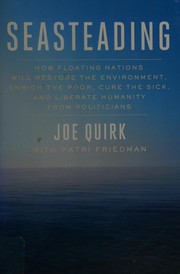

In one sentence
The book’s central claim is that humanity needs more experimentation in how societies are organized. Because land is divided among established states, the authors present the ocean as a frontier where floating communities could offer jurisdictional competition: people and businesses could choose among different rules, governments could learn from one another, and bad systems would face pressure to improve.
Overview
Quirk and Friedman frame seasteading as both a technological project and a political strategy. The book moves from the problems they associate with centralized, land-based government to the practical possibilities of ocean living: renewable energy, aquaculture, medical research, tourism, and new forms of citizenship. It also introduces entrepreneurs and designers attempting to turn floating settlements from speculative visions into prototypes. The tone is intentionally promotional—closer to a movement manifesto and entrepreneurial prospectus than a neutral feasibility study.
Core ideas
Jurisdictional competition
The strongest economic idea is “exit”: if communities can choose among competing legal and political systems, governments must attract residents, investment, and talent rather than take them for granted. Seasteads are imagined as laboratories for testing governance models in parallel, with successful arrangements copied and unsuccessful ones abandoned. This extends the logic of competition from firms and markets to governments.
The ocean as a frontier
The sea is valuable to the authors not merely because it offers physical space, but because it may loosen the territorial constraints that make political experimentation difficult on land. Mobility, modular construction, and proximity to existing states are presented as ways to begin incrementally rather than build a fully independent nation at once.
Incrementalism over grand utopia
The practical path is supposed to begin with relatively modest, revenue-generating ventures—such as resorts, residences, aquaculture, research facilities, or other offshore businesses—and develop toward larger communities. This makes the proposal more credible than immediately attempting a self-sufficient floating city, although the book’s ultimate claims remain much more ambitious than its near-term projects.
Eight moral and economic promises
The subtitle summarizes the book’s proposed benefits: environmental restoration, poverty reduction, medical innovation, and liberation from unwanted political authority. The underlying mechanism is not government spending but experimentation by entrepreneurs operating under different rules. The Seasteading Institute similarly describes its mission as enabling new communities to test social, political, and legal systems.
Environmental restoration through productive use
The authors argue that floating structures can be designed to support marine life and that ocean-based industries—especially aquaculture and renewable energy—could make human settlement compatible with ecological repair. This is an important shift in framing: development at sea is presented as potentially restorative rather than inherently extractive.
Entrepreneurs as institutional pioneers
“Aquapreneurs” are central characters. Their projects are meant to demonstrate that new communities can emerge from viable businesses rather than from purely political declarations. The book’s storytelling therefore emphasizes founders, prototypes, design concepts, and real-world experiments as evidence that seasteading is an actionable movement rather than only science fiction.
A libertarian theory of freedom
The political ideal is voluntary association: individuals should be able to select communities whose rules match their values, move elsewhere when dissatisfied, and avoid being trapped by one monopoly government. This places the book within a libertarian tradition that treats decentralized authority and competition as safeguards against coercion.
Practical takeaways
- Separate the book’s strongest question from its boldest forecast: the case for experimenting with governance is more defensible than the claim that floating nations will quickly cure poverty, illness, or political conflict.
- When assessing a proposed seastead, ask four questions: What problem does it solve better than a land-based alternative? Who pays for construction and maintenance? Which state’s laws and enforcement apply? What happens during storms, accidents, crime, medical emergencies, or financial failure?
- Treat modularity and incremental development as the most useful strategic lessons. A small, specialized offshore venture is easier to finance, regulate, test, and improve than a city-sized platform.
- The book encourages a useful economic analogy: government can be viewed as a service whose quality may improve when people have meaningful exit options.
- For environmental claims, demand lifecycle evidence—not just claims about artificial reefs or clean energy. Construction materials, maintenance, waste, shipping, fisheries, and ecological displacement all matter.
- Use seasteading as a case study in institutional entrepreneurship: changing the rules of association may be as consequential as inventing a new technology.
Caveats and counterpoints
- The book is advocacy, not an independent engineering, economic, medical, or environmental assessment. A serious review described it as reading more like a marketing pitch than a scientific inquiry.
- The subtitle overstates the evidentiary basis. Floating communities might create useful experiments, but the path from a small offshore business to sovereign, economically inclusive nations is politically, legally, and financially difficult.
- Environmental benefits are contested. Critics have argued that the book foregrounds benefits to humans while giving insufficient attention to effects on marine ecosystems and sea creatures.
- “Freedom from politicians” is not the same as freedom from governance. Seasteads would still require contracts, policing, dispute resolution, taxation or fees, emergency services, and relationships with coastal or flag states; international maritime law would remain relevant.
- The competitive-government model may favor wealthy, mobile residents and investors. The promise to enrich the poor depends on access, labor conditions, affordability, and whether new jurisdictions become inclusive communities or enclaves for capital.
- The authors’ optimism can obscure ordinary infrastructure problems: corrosion, storms, evacuation, fresh water, waste treatment, supply chains, insurance, communications, and long-term maintenance.
Questions worth revisiting
- Which parts of the argument depend on genuine jurisdictional autonomy, and which could be achieved through ordinary special economic zones or offshore businesses?
- What institutional safeguards would prevent a seastead’s owner or founding corporation from becoming an unaccountable private government?
- How would residents without wealth, specialized skills, or citizenship leverage exercise meaningful exit?
- What environmental measurements would demonstrate restoration rather than merely reduced damage?
- Which governance experiments should be attempted first in small, reversible communities?
- Does mobility create political freedom, or can it simply shift dependence from elected governments to platform owners and private security providers?
Return to this when…
Return to these notes when evaluating floating cities, charter cities, special economic zones, private governance, ocean technology, libertarian political proposals, or ambitious “frontier” solutions to institutional problems. The most durable takeaway is not that floating nations are inevitable, but that the book asks whether political systems should face more competition and experimentation.
Highlights
Water. According to Growing Blue, a gigantic consolidation of data from industry analysts, scientists, academia, and environmental professionals, 52 percent of the world population will be exposed to severe water scarcity by 2050, and continuing our current course will put at risk roughly $63 trillion US, or the equivalent to 1.5 times the size of today’s entire global economy. Food. Even assuming a 50 percent increase in agricultural efficiency, by 2050 we will need to increase the land space devoted to farmland 22 million square kilometers, or 8.5 million square miles, an area nearly equivalent in size to North America. Oil. Searching for consensus about “peak oil,” the point in time when the maximum global rate of crude oil extraction is reached became a fool’s errand when the hydrofracking revolution only further polarized the debate due to deep uncertainty about the actual size of undiscovered world oil reserves. Many of the most popular doomsdates refer to current economically available oil and not total physically existing oil, as if extraction technologies will never improve and prices never adjust. So let’s just say that the most pessimistic analysts say “peak oil” has already occurred, while the most optimistic analysts say 2050. Fish. In 2006 the journal Science published a four-year study written by an international group of ecologists from Canada, Panama, Sweden, Britain, and the United States, which predicted that, at prevailing trends, the world will run out of wild-caught seafood in 2048—though the assumptions behind these claims have been widely disputed. Fertilizer. The soil is running out of phosphate, a crucial ingredient in fertilizer required for farming. The most optimistic estimate for “peak phosphorus,” the point at which we reach the world’s maximum rate of phosphorus production, is 2050. Land. Eighty percent of the world’s expanding megacities are sinking on a coast or river plain while sea levels rise. More than 1 million people move to cities each week, and by 2050, about half of the human population will live within 100 kilometers of a coast. Humanity is poised to plunge in 2050. We can drown or we can float.
On fluid Planet Ocean, however, solutions would emerge from granting power to our political opponents. Much of civilization’s capital is stuck to land and easily monopolized by dominant states, but “seavilization” could be disassembled and reassembled fluidly according to the choices of those who own the units. Imagine a thousand floating Venices with waterways for roads, except the components are modular. When individuals possessed the technology to settle the seas, they’d discover an aquatic world more than twice the size of Planet Earth, where citizens would engage in such fluidity of movement that tyrants would have a very hard time getting a foothold, and political power would be radically decentralized and shared. Floating cities that best pleased their inhabitants would expand, while others which failed to do so would decline and disappear. Democracy, a system by which majorities outvote minorities, would be upgraded to a system whereby the smallest minorities, including the individual, could vote with their houses.
David Friedman described a machinery of freedom. Milton Friedman advocated the freedom of choose. Patri identified a machinery of freedom to choose. In his now defunct personal blog, he proposed an idea that became contagious: imagine ten thousand homesteads on the sea—“seasteads”—where ocean pioneers will be free to experiment with new societies. Aquatic citizens could live in modular pods that can detach at any time and sail to join another floating city, compelling ocean governments to compete for mobile citizens like companies compete for customers. A market of competing governments, a Silicon Valley of the sea, would allow the best ideas for governance to emerge peacefully, unleashing unimaginable progress in the rate at which we generate solutions to the oldest social problem: How do we get along? By such means, an economic and moral argument could become a technological experiment. On a blog called Let a Thousand Nations Bloom, Patri predicted in the essay “Dynamic Geography” that a process of trial and error on a fluid frontier will generate solutions we can’t even imagine today.
Tomorrow’s civilization may not be on the ocean, but next week’s is. Much of what you will consume next week is currently on the sea. More than a hundred thousand ships are crossing the ocean right now. It’s easier to move a cargo ship the size of a skyscraper across the ocean than it is to move your house to the next town. The amount of energy needed to move massive structures is a tiny proportion of what you would need on land, and the energy per ton required gets smaller as the structure gets larger. Ninety percent of all international trade occurs not on trains and trucks among bordering neighbors, but across vast distances on ships. The ocean isn’t the middle of nowhere, but a superhighway to everywhere. Someday seastead residents will ask inland people, “How do you truck in all those goods every day? You don’t even have barges!”
Hundreds of thousands of people like Kathi live on thousands of oil and gas platforms built to withstand hurricanes, which, unfortunately, is more than we can say for coastal cities. Modular floating cities could potentially move out of the path of advancing storms with a few days’ warning, while coastal cities are sitting ducks. Tsunamis are harmless on the deep seas; destructive only when they reach land. When the 2004 tsunami struck Thailand, deep-sea scuba divers reported a change in visibility and an undulation in the water, while a quarter mile away, the hotel where they’d eaten breakfast was destroyed. In the future, we expect citizens of floating cities to ask land-based people, “How do you handle earthquakes, tornadoes, and tsunamis? Isn’t it dangerous to be fixed to one spot?”
Why are people living in mobile shipping containers only on land? The largest assembly lines in the world serve cargo ships, which are built in a modular fashion to accommodate the bewildering array of goods they must transport. Each cargo ship must be assembled like a three-dimensional puzzle piece before it is launched. The infrastructure to endlessly reconfigure the interior space of cargo ships can be adapted to provide for modular living quarters. If we could combine cruise ship luxury with cargo ship modularity, we’d have plug-and-play apartments.
Let Freedom Float It’s not just capital spilling into the seas. Hundreds of thousands of desperate people are piling into makeshift boats to escape abusive countries. In 2015 more than a million arrived in Europe by sea. Not all poor people can swim to prosperous lands, but Koen Olthuis plans to float prosperous lands to poor people. To demonstrate that the rich infrastructure of Holland can be floated to the poorest people in coastal slums, he is working to transform shipping containers into “city apps”: floating kitchens, Internet cafés, health centers, garbage collectors, water purification units, and schools. These apps can be upgraded in a flexible system of plug-and-play philanthropy. “Just as you can download apps on your smartphone according to your changing needs,” said Koen in his interview with the blog Inhabitat, “you can adjust functionality in a slum by adding functions with city apps. These are floating developments based on standard sea-freight containers, and because of their flexibility and small size, they are suitable for installing and upgrading sanitation, housing, and communication.”
instead of 1929, we might have colonized the seas in 1969 and laughed at the futuristic notion of walking on the moon. In a world where space stations have been floating in the sky for almost a half century, we shouldn’t be incredulous that sea stations can float on water. Seasteading should have started soon after 1967, when designer and architect Buckminster Fuller revealed his detailed vision of Triton City, a floating city for five thousand residents designed to encourage people to share resources and conserve energy. Triton City is engineered in a tetrahedronal shape to resist tsunamis. Declaring “Three-quarters of our planet Earth is covered with water, most of which may float organic cities,” Fuller published his book Critical Path in 1981 to describe his ongoing aqua project,
References
- Seasteading | Book by Joe Quirk, Patri Friedman | Official Publisher Page | Simon & Schuster
- seasteading.org
- Seasteading by Joe Quirk, Patri Friedman (Ebook) - Read free for 30 days
- About – The Seasteading Institute
- en.wikipedia.org
- seasteading.org
- seasteading.org
- supportinglisteners.com
- seasteading.org
- api.repository.cam.ac.uk
- luminosoa.org
- seasteading.org
- seasteading.org
- gwern.net
- libraryjournal.com
- en.wikipedia.org