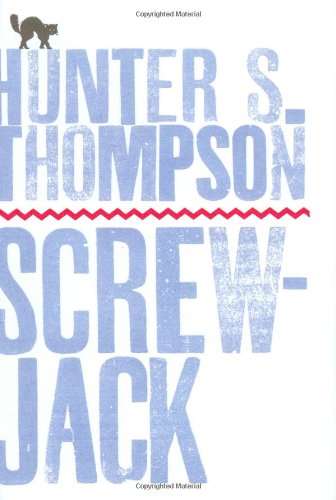

In one sentence
Screwjack turns altered consciousness, masculine panic, and outlaw performance into a deliberately unstable literary method: the narrator’s excess is both an exhilarating source of perception and a defense against vulnerability.
Overview
The book contains three pieces—“Mescalito,” “Death of a Poet,” and “Screwjack.” The first concerns Thompson’s fictionalized first mescaline experience in a Los Angeles hotel in February 1969; the second begins as a visit to a friend’s trailer and escalates into grotesque, violent absurdity; the title story is presented as a Raoul Duke text and becomes a strange, feverish love narrative. The existing catalogue description is broadly right, but “the death of a friend” is too reductive: “Death of a Poet” is better remembered as a destabilizing encounter whose violence and narrative unreliability matter as much as its premise.
Core ideas
Gonzo as psychic weather
Thompson does not use intoxication merely as subject matter. Drug effects, paranoia, sexual energy, disgust, and sudden comic jolts shape the prose itself, making consciousness feel volatile rather than neatly reportable.
Performance versus exposure
Raoul Duke and related narrating personae convert fear and shame into theatrical bravado. The performance protects the speaker, but the stories repeatedly reveal the loneliness and desperation underneath it.
Masculinity under pressure
The collection’s men respond to uncertainty through aggression, grotesque humor, drug use, sexual fantasy, and self-mythologizing. These behaviors are not simply celebrated; they expose the fragility of the identities they are meant to defend.
The comic and the appalling
Thompson’s central tonal mechanism is collision: a scene can be funny, repulsive, frightening, and oddly tender almost at once. The humor does not neutralize the violence; it makes the violence harder to domesticate.
Intimacy as estrangement
The title story treats desire as something uncanny and difficult to classify. Its emotional force comes less from conventional romance than from the collision between longing, fear, bodily strangeness, and the need to invent a usable self.
A deliberately minor, concentrated work
Screwjack is a very short collection rather than a major sustained narrative. Its value lies in concentrated experiments with voice and extremity, while its self-conscious grotesquerie can also feel repetitive or self-parodic.
Practical takeaways
- When rereading Thompson, track the shifts in tone rather than only the events: comic language may be carrying fear, and bravado may be signaling helplessness.
- Separate the narrator’s sensational claims from the book’s deeper emotional pattern. The persona is often least trustworthy when it sounds most confident.
- Notice how the collection makes form imitate mental instability: abrupt transitions, exaggeration, obsessive images, and escalating tempo are part of the meaning.
- “Gonzo” here is not just reckless subject matter; it is a refusal to keep observation, participation, confession, and invention in separate compartments.
Caveats and counterpoints
- The stories are intentionally offensive and include drug use, sexual material, violence, paranoia, and disturbing treatment of bodies and animals; the shock value is central to the method but will not work equally for every reader.
- The book’s biographical framing should be treated cautiously. “Mescalito” is described as fictionalized, and the collection’s narrators are constructed literary voices rather than transparent records of Thompson’s life.
- The title has appeared in materially different forms: the 1991 Neville edition was a limited collector’s book; Simon & Schuster issued a trade edition in 2000, and a 2023 edition added an introduction by Lars Ulrich.
- Readers and reviewers disagree about the third story’s emotional effect: some see an unnervingly poignant love story, while others find its obscurity and provocation merely juvenile or self-indulgent.
Questions worth revisiting
- Where does the persona’s comic aggression function as camouflage for fear or grief?
- Does the escalating structure produce genuine revelation, or mainly intensify the performance of transgression?
- What distinguishes Thompson’s critique of masculine violence from his fascination with it?
- In “Screwjack,” is intimacy discovered, imagined, or made impossible by the narrator’s language?
- Which effects remain after the shock wears off: images, emotional unease, formal invention, or mainly the memory of excess?
Return to this when…
Return to this when you want a brief reminder of Thompson’s fiction rather than his journalism: it is a concentrated study in unreliable bravado, altered perception, grotesque comedy, and the uneasy boundary between vulnerability and spectacle.
References
- en.wikipedia.org
- Screwjack | Book by Hunter S. Thompson, Lars Ulrich | Official Publisher Page | Simon & Schuster
- goodreads.com
- Screwjack eBook by Hunter S. Thompson | Official Publisher Page | Simon & Schuster
- goodreads.com
- books.google.com
- Screwjack | HST BOOKS
- goodreads.com
- cassiusandco.com
- abaa.org
- abaa.org
- perusethestacks.com