
In one sentence
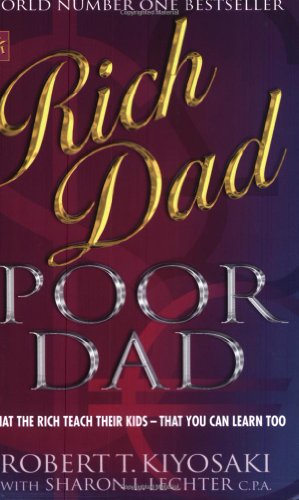
The book’s central argument is that people remain financially constrained when they exchange time for wages, increase consumption as income rises, and fail to understand cash flow. Kiyosaki urges readers to learn how money moves, acquire income-producing assets, and develop the confidence to pursue business and investing rather than relying exclusively on employment.
Overview
Kiyosaki presents the lessons as a contrast between two father figures: his academically successful biological father, who favors education, stable employment, and professional advancement, and his friend’s father, who emphasizes entrepreneurship, investing, financial statements, and ownership. The narrative is organized around lessons such as financial literacy, “minding your own business,” overcoming fear, choosing work for learning, and getting started.
Core ideas
Cash flow matters more than appearances
Judge a purchase or investment by what it does to monthly cash flow, not by its status, price, or conventional label. In Kiyosaki’s framework, an asset generates cash flowing toward you; a liability draws cash away. This is a behavioral lens, not the standard accounting definition.
Build an asset column
Direct surplus income toward things that may produce ongoing income—such as businesses, real estate, or investments—rather than allowing every raise to fund larger consumption. The intended destination is financial freedom: income from assets covering living expenses.
A primary home can be economically burdensome
Kiyosaki challenges the assumption that owning one’s residence automatically creates wealth. His point is that mortgage payments, taxes, insurance, maintenance, and other costs can make a home a cash-flow liability, even though it may also have accounting value or appreciate.
Financial literacy is a practical skill
Learn to read income statements and balance sheets, distinguish income from expenses, and understand how taxes, debt, and leverage affect outcomes. The book treats financial intelligence as learnable rather than as a consequence of high income or formal education.
Work to acquire skills, not only wages
Kiyosaki recommends choosing some jobs or experiences for the abilities they teach—sales, communication, accounting, management, and negotiation—even when they are not the highest-paying option immediately. The larger aim is to become capable of creating and evaluating opportunities.
Mindset and fear influence financial behavior
Fear of loss, desire for security, and social pressure can keep people in a cycle of earning, spending, and repeating. Kiyosaki wants readers to treat mistakes as tuition and to act more deliberately, while still learning enough to distinguish calculated risk from speculation.
The “rat race” is a reinforcing loop
Higher pay does not necessarily produce independence if expenses, debt, and lifestyle expectations rise alongside it. The book’s recurring loop is: work for income, increase consumption, require more income, and remain dependent on the next paycheck.
Practical takeaways
- Map your monthly cash flow: income, fixed costs, discretionary spending, debt payments, and savings.
- Classify purchases by function: does this reliably produce cash, preserve value, or consume cash? Use the classification as a decision aid, not as a substitute for accounting definitions.
- Increase savings and investable surplus before upgrading lifestyle after a raise.
- Learn basic financial statements, taxes, fees, interest, leverage, and investment risk before using debt or buying real estate.
- Treat entrepreneurship and active investing as specialized activities requiring research, capital, time, and tolerance for loss—not automatic shortcuts to wealth.
- Use the book for motivation and vocabulary; pair it with evidence-based guidance on diversification, emergency funds, insurance, retirement accounts, and debt management.
Caveats and counterpoints
- The book is more persuasive as a mindset narrative than as a detailed implementation manual. The New York Times specifically notes that it presents its tenets narratively rather than offering detailed financial advice.
- Its asset/liability language is intentionally simplified and differs from accounting usage; a residence can be both an asset on a balance sheet and a negative monthly cash-flow item.
- The repeated contrast between “rich,” “poor,” and “middle class” can overstate personal mindset and understate income, health, labor-market, housing, taxation, and structural constraints.
- Real estate, business ownership, and leverage can create cash flow, but they also introduce concentration, illiquidity, vacancies, operational burdens, legal exposure, and the possibility of large losses. The book’s encouragement to take risks should not be read as a risk-control strategy.
- The two-father framework is a rhetorical device for contrasting philosophies. These notes do not verify every autobiographical detail or treat the stories as representative evidence.
Questions worth revisiting
- Which of my expenses are essential, optional, or investments in future earning capacity?
- What would “buying assets” mean in my actual situation after accounting for liquidity, diversification, fees, taxes, and risk?
- Am I pursuing a business or investment because its numbers work, or because it symbolizes independence?
- Which skills—sales, accounting, communication, negotiation, or technical expertise—would most improve my financial options?
- Where does the book’s emphasis on individual mindset fail to explain outcomes caused by circumstances outside personal control?
Return to this when…
Return to this book when you need a reminder to examine cash flow, question lifestyle inflation, and think in terms of ownership and skills. Do not use it alone to choose investments, structure debt, plan retirement, or assess real-estate opportunities.
Highlights
An important distinction is that rich people buy luxuries last, while the poor and middle class tend to buy luxuries first. The poor and the middle class often buy luxury items such as big houses, diamonds, furs, jewelry or boats because they want to look rich. They look rich, but in reality they just get deeper in debt on credit. The old-money people, the long-term rich, built their asset column first. Then, the income generated from the asset column bought their luxuries. The poor and middle class buy luxuries with their own sweat, blood and children’s inheritance.
References
- Rich Dad Poor Dad - What the Rich Teach Their Kids About Money - Robert T. Kiyosaki - Google Books
- Rich Dad Poor Dad: What the Rich Teach Their Kids About Money-That the Poor ... - Robert T. Kiyosaki, Sharon L. Lechter - Google Books
- books.google.com
- richdad.com
- en.wikipedia.org
- richdad.com
- The Four Foundations of Financial Education | Rich Dad
- gradesaver.com
- Rich Dad Philosophy - Financial Freedom Principles | Rich Dad
- Rich Dad Scam #6: Your House is an Asset | Rich Dad
- richdad.com
- paradite.com
- vi.web-platforms-vi.nyti.nyt.net