
In one sentence
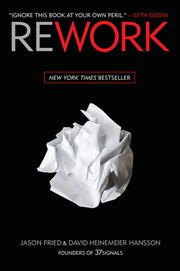
Many conventional business practices are treated as prerequisites when they are often liabilities. Start with a useful, focused product; work with constraints; communicate directly; avoid unnecessary coordination and complexity; and let actual customer demand—not ambition, investor expectations, or industry fashion—determine what happens next. The book is a provocative operating philosophy, not a universal startup formula.
Overview
Organized as short, forceful essays rather than a continuous argument, the book challenges familiar advice about business plans, competition, fundraising, hiring, meetings, productivity, and marketing. Its positive program is deliberately minimalist: make something real, keep the team and product small, explain your thinking publicly, and improve through repeated action. The style is memorable but sometimes reduces nuanced questions to slogans.
Core ideas
Start now; do not confuse preparation with progress
The authors reject elaborate startup rituals and encourage beginning with a real problem, a small product, and a clear reason for existing. A business plan should be treated as a set of assumptions to test, not a prediction deserving loyalty. This is strongest where planning has become bureaucratic performance.
Constraints can improve decisions
Limited money, time, staff, and features force prioritization. Rather than treating scarcity as a temporary defect, the book presents it as protection against overbuilding and unnecessary complexity. The implied discipline is to solve the essential problem before expanding the solution.
Build less, but make it useful
The product should do one important thing well instead of accumulating features for hypothetical customers. “Good enough” is presented as a practical starting point: release, observe use, and refine. This counters perfectionism, though quality, safety, and reliability still set non-negotiable floors.
Profitability and independence matter
The authors favor revenue and customer value over fundraising, prestige, or an eventual exit. Outside capital can create pressure to grow, hire, and pursue scale before the underlying business warrants it. This is particularly applicable to bootstrappable software businesses, not every capital-intensive venture.
Protect focused work
Meetings, interruptions, long status chains, and excessive collaboration consume the uninterrupted time needed for creative and technical work. Prefer asynchronous, written communication and smaller commitments. The useful principle is to reduce coordination costs—not to eliminate every meeting regardless of purpose.
Marketing is part of the work
Promotion should not be separated entirely from making the product. Teach, publish, explain decisions, and share useful knowledge so that attention is earned rather than merely purchased. The approach turns communication into a long-term relationship with an audience, not just a campaign.
Hire cautiously and resist growth theater
Add people when a genuine, persistent need exceeds the current team’s capacity—not because growth looks impressive or a role seems conventional. More staff can increase communication overhead and dilute responsibility. The book also argues for calm, sustainable work rather than treating exhaustion as commitment.
Learn from what works, not only from failure
Failure can teach, but it can also rationalize bad ideas after the fact. The authors emphasize studying successful decisions and repeating useful patterns. Their deliberately provocative framing should be read as a corrective: investigate both outcomes instead of automatically treating failure as more educational.
Practical takeaways
- Define the smallest useful version of the product or service and ship it before expanding the scope.
- Write down the few assumptions that must be true; test them through customer behavior rather than extended forecasting.
- Set explicit constraints: budget, staffing, features, work hours, and decision deadlines.
- Remove recurring meetings and interruptions that do not produce a clear decision, artifact, or necessary relationship.
- Prefer a short, decisive explanation over a large strategy document when the situation is changing quickly.
- Treat customer support, documentation, and public writing as product and marketing work.
- Ask of every proposed feature: which existing customer problem does it solve, and what will it displace?
- Hire only for a specific bottleneck that remains after simplification and process improvement.
Caveats and counterpoints
- The book generalizes from the authors’ experience building 37signals, a software company operating in a relatively bootstrappable environment; that is a narrow evidence base.
- Its aphoristic style often lacks data, detailed cases, and boundary conditions. Critics argue that claims such as “meetings are toxic” or “planning is guessing” are too sweeping; useful meetings and strategic horizons can exist without becoming bureaucracy.
- The advice fits small teams and focused products better than businesses requiring major capital, regulatory approval, network effects, 24-hour operations, or rapid capacity expansion. This limitation is an inference from the book’s bootstrapped operating model and reviewers’ observations about its internet-business orientation.
- “Do less” can become an excuse for underinvestment. Minimalism still requires sufficient research, accessibility, security, testing, customer service, and legal or safety compliance.
- The book’s confrontational rejection of conventional practice is most valuable as a forcing function, not as a complete replacement for accounting, risk management, hiring systems, or long-term strategy.
Questions worth revisiting
- Which parts of my work are genuinely necessary, and which are inherited business rituals?
- What is the smallest version that would create real value for a real customer?
- Where would constraints improve focus—and where would they create unacceptable risk?
- Am I pursuing growth because customers require it, or because status, investors, or competitors do?
- Which meetings could become written decisions, and which conversations genuinely need synchronous discussion?
- What evidence would make me change the product, pricing, staffing, or strategic direction?
Return to this when…
Return to the chapters on constraints, product focus, planning, meetings, hiring, and sustainable work when a project is becoming bloated or coordination-heavy. Pair the book with more evidence-based material when making decisions about regulated industries, large organizations, venture-scale growth, or complex operational risk.
Highlights
This real world sounds like an awfully depressing place to live. It’s a place where new ideas, unfamiliar approaches, and foreign concepts always lose. The only things that win are what people already know and do, even if those things are flawed and inefficient.
The real world isn’t a place, it’s an excuse. It’s a justification for not trying. It has nothing to do with you.
With so much failure in the air, you can’t help but breathe it in. Don’t inhale. Don’t get fooled by the stats. Other people’s failures are just that: other people’s failures.
Grow slow and see what feels right—premature hiring is the death of many companies. And avoid huge growth spurts too—they can cause you to skip right over your appropriate size.
Small is not just a stepping-stone. Small is a great destination in itself.
Have you ever noticed that while small businesses wish they were bigger, big businesses dream about being more agile and flexible? And remember, once you get big, it’s really hard to shrink without firing people, damaging morale, and changing the entire way you do business.
There was no need for focus groups, market studies, or middlemen. We had the itch, so we scratched it. When you build a product or service, you make the call on hundreds of tiny decisions each day. If you’re solving someone else’s problem, you’re constantly stabbing in the dark. When you solve your own problem, the light comes on. You know exactly what the right answer is.
When you build what you need, you can also assess the quality of what you make quickly and directly, instead of by proxy.
A strong stand is how you attract superfans. They point to you and defend you. And they spread the word further, wider, and more passionately than any advertising could. Strong opinions aren’t free. You’ll turn some people off. They’ll accuse you of being arrogant and aloof. That’s life. For everyone who loves you, there will be others who hate you. If no one’s upset by what you’re saying, you’re probably not pushing hard enough. (And you’re probably boring, too.)
When you don’t know what you believe, everything becomes an argument. Everything is debatable. But when you stand for something, decisions are obvious.
Anyone who takes a “we’ll figure out how to profit in the future” attitude to business is being ridiculous. That’s like building a rocket ship but starting off by saying, “Let’s pretend gravity doesn’t exist.” A business without a path to profit isn’t a business, it’s a hobby.
You want to get into the rhythm of making choices. When you get in that flow of making decision after decision, you build momentum and boost morale. Decisions are progress. Each one you make is a brick in your foundation. You can’t build on top of “We’ll decide later,” but you can build on top of “Done.”
Long projects zap morale. The longer it takes to develop, the less likely it is to launch. Make the call, make progress, and get something out now—while you’ve got the motivation and momentum to do so.
It’s the stuff you leave out that matters. So constantly look for things to remove, simplify, and streamline. Be a curator. Stick to what’s truly essential. Pare things down until you’re left with only the most important stuff. Then do it again. You can always add stuff back in later if you need to.
The core of your business should be built around things that won’t change. Things that people are going to want today and ten years from now. Those are the things you should invest in.
In business, too many people obsess over tools, software tricks, scaling issues, fancy office space, lavish furniture, and other frivolities instead of what really matters. And what really matters is how to actually get customers and make money.
When is your product or service finished? When should you put it out on the market? When is it safe to let people have it? Probably a lot sooner than you’re comfortable with. Once your product does what it needs to do, get it out there.
Think about it this way: If you had to launch your business in two weeks, what would you cut out? Funny how a question like that forces you to focus. You suddenly realize there’s a lot of stuff you don’t need. And what you do need seems obvious. When you impose a deadline, you gain clarity. It’s the best way to get to that gut instinct that tells you, “We don’t need this.”
If you’re constantly staying late and working weekends, it’s not because there’s too much work to be done. It’s because you’re not getting enough done at work. And the reason is interruptions.
Focus on competitors too much and you wind up diluting your own vision. Your chances of coming up with something fresh go way down when you keep feeding your brain other people’s ideas. You become reactionary instead of visionary. You wind up offering your competitor’s products with a different coat of paint.
Start getting into the habit of saying no—even to many of your best ideas. Use the power of no to get your priorities straight. You rarely regret saying no. But you often wind up regretting saying yes.
And there are always more people who are not using your product than people who are. Make sure you make it easy for these people to get on board. That’s where your continued growth potential lies. People and situations change. You can’t be everything to everyone. Companies need to be true to a type of customer more than a specific individual customer with changing needs.
How should you keep track of what customers want? Don’t. Listen, but then forget what people said. Seriously.
Being obscure is a great position to be in. Be happy you’re in the shadows. Use this time to make mistakes without the whole world hearing about them. Keep tweaking. Work out the kinks. Test random ideas. Try new things. No one knows you, so it’s no big deal if you mess up. Obscurity helps protect your ego and preserve your confidence.
It’s OK if it’s not perfect. You might not seem as professional, but you will seem a lot more genuine.
You’re better off focusing on getting your story into a trade publication or picked up by a niche blogger. With these outlets, the barrier is much lower. You can send an e-mail and get a response (and maybe even a post) the same day. There’s no editorial board or PR person involved. There’s no pipeline your message has to go through.
Marketing isn’t just a few individual
Marketing isn’t just a few individual events. It’s the sum total of everything you do.
Start building your audience today. Start getting people interested in what you have to say. And then keep at it. In a few years, you too will get to chuckle when people discuss your “overnight” success.
I have never let my schooling interfere with my education. —MARK TWAIN
Clear writing is a sign of clear thinking. Great writers know how to communicate. They make things easy to understand. They can put themselves in someone else’s shoes. They know what to omit. And those are qualities you want in any candidate.
Writing is today’s currency for good ideas.
When something bad happens, tell your customers (even if they never noticed in the first place). Don’t think you can just sweep it under the rug. You can’t hide anymore. These days, someone else will call you on it if you don’t do it yourself. They’ll post about it online and everyone will know. There are no more secrets.
So when people complain, let things simmer for a while. Let them know you’re listening. Show them you’re aware of what they’re saying. Let them know you understand their discontent. But explain that you’re going to let it go for a while and see what happens. You’ll probably find that people will adjust eventually. They may even wind up liking the change more than the old way, once they get used to it.
When everything constantly needs approval, you create a culture of nonthinkers. You create a boss-versus-worker relationship that screams, “I don’t trust you.”
As the saying goes, “If you want something done, ask the busiest person you know.” You want busy people. People who have a life outside of work. People who care about more than one thing. You shouldn’t expect the job to be someone’s entire life—at least not if you want to keep them around for a long time.
And when you’re writing, don’t think about all the people who may read your words. Think of one person. Then write for that one person. Writing for a mob leads to generalities and awkwardness. When you write to a specific target, you’re a lot more likely to hit the mark.
There are four-letter words you should never use in business. They’re not fuck or shit. They’re need, must, can’t, easy, just, only, and fast.
And these words are especially dangerous when you string them together: “We need to add this feature now. We can’t launch without this feature. Everyone wants it. It’s only one little thing so it will be easy. You should be able to get it in there fast!” Only thirty-six words, but a hundred assumptions. That’s a recipe for disaster.
When you turn into one of these people who adds ASAP to the end of every request, you’re saying everything is high priority. And when everything is high priority, nothing is. (Funny how everything is a top priority until you actually have to prioritize things.)
you’re inspired on a Friday, swear off the weekend and dive into the project. When you’re high on inspiration, you can get two weeks of work done in twenty-four hours. Inspiration is a time machine in that way. Inspiration is a magical thing, a productivity multiplier, a motivator. But it won’t wait for you. Inspiration is a now thing. If it grabs you, grab it right back and put it to work.
Frank Lloyd Wright Seth Godin Warren Buffett Jamie Larson Clayton Christensen Ralph Nader Jim Coudal Benjamin Franklin Ernest Kim Jeff Bezos Scott Heiferman Antoni Gaudi Carlos Segura Larry David
Steve Jobs Dean Kamen Bill Maher Thomas Jefferson Mies van der Rohe Ricardo Semler Christopher Alexander James Dyson Kent Beck Thomas Paine Gerald Weinberg Kathy Sierra Julia Child Marc Hedlund Nicholas Karavites Michael Jordan Richard Bird Jeffrey Zeldman Dieter Rams Judith Sheindlin Ron Paul Timothy Ferriss
References
- Rework by Jason Fried, David Heinemeier Hansson: 9780307463746 | PenguinRandomHouse.com: Books
- Rework — Jason Fried & David Heinemeier Hansson · Íñigo Medina
- Book review: Rework, by Jason Fried and David Heinemeier Hansson
- entrepreneur.com
- hendrixwiki.com
- find-mba.com
- seattlepi.com
- goodreads.com
- penguin.co.uk
- mybytenest.com
- ybrikman.com
- allbookstores.com