
In one sentence
Knowledge work often does not require a shared office; organizations can improve focus, widen access to talent, reduce commuting and office costs, and give employees more autonomy by making remote work a deliberate default. The authors argue that the main obstacles are cultural habits and managerial distrust, not technology.
Overview
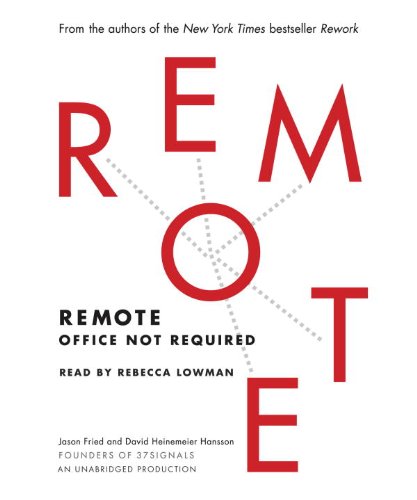
Published by Crown Business in 2013, the book draws heavily on the authors’ experience running the distributed software company 37signals/Basecamp. Its structure moves from the case for remote work to objections, then to implementation: recruiting, communication, collaboration, management, and sustaining a remote culture. The authors are advocates rather than neutral researchers, and reviewers found the argument persuasive but imbalanced and sometimes too brief.
Core ideas
The office is not the same thing as work
The authors separate productivity from physical presence. Offices can become “interruption factories”: environments optimized for visibility, meetings, and immediate responsiveness rather than sustained concentration. Remote work is presented as a way to let people choose conditions suited to the task.
Remote work expands the talent pool
Hiring need not be restricted to people who can commute to one location. A distributed company can recruit for ability and fit across regions, while also offering flexibility to people whose circumstances make conventional office work difficult.
Trust must replace surveillance
Managers should judge people by the quality and timeliness of outcomes, not by whether they appear busy at a desk. Remote work exposes weak management: unclear priorities, poor delegation, and dependence on constant supervision become harder to hide.
Asynchronous communication protects focus
Written, persistent communication is central to the model. Instead of interrupting colleagues for every question, teams should document decisions, provide context, and allow people to respond when they can give the issue proper attention. Meetings and real-time chat should be used selectively.
Remote collaboration needs intentional design
Distance does not eliminate collaboration, but it removes accidental contact. Teams therefore need explicit channels, shared information, regular check-ins, and occasional face-to-face time where it genuinely adds value. The goal is not to reproduce an office online.
Hiring for remote work requires judgment
Remote employees need self-direction, communication ability, and comfort with autonomy. The authors favor evaluating actual work and trial projects over relying too heavily on résumés or polished interviews.
Individuals must manage boundaries
Freedom creates risks: domestic distraction, loneliness, overwork, and difficulty separating work from personal life. A workable remote routine requires a dedicated environment where possible, deliberate availability norms, and the ability to stop working.
The argument is conditional, not universal
The book is strongest for software and other portable knowledge work. It is less applicable where work depends on physical equipment, in-person care, tightly coordinated physical operations, or customers who must be served on-site. Reviewers also note that the authors underdevelop legal, sector-specific, and organizational complications.
Practical takeaways
- Define work by deliverables, decisions, and service levels rather than hours spent visibly online.
- Make important information discoverable in writing; do not let decisions live only in meetings or private conversations.
- Use synchronous meetings for issues that truly benefit from immediate interaction; default routine updates to asynchronous communication.
- Recruit for autonomy, writing, reliability, and demonstrated ability—not merely proximity to headquarters.
- Set explicit norms for response times, working hours, time zones, emergencies, and uninterrupted focus.
- Treat occasional in-person gatherings as purposeful investments in trust and relationships, not proof that daily co-location is necessary.
- Pilot remote work with a team or workflow, measure outcomes, and revise the system instead of assuming either remote or office work is automatically superior.
Caveats and counterpoints
- This is an advocacy book built around the authors’ experience at a successful software company, not a balanced empirical study of all industries.
- Its short chapters and illustrated format favor memorable principles over detailed implementation, metrics, or policy templates; one review characterized it as more inspirational than operational.
- The authors’ case is relatively weak on service work, physical operations, unequal home working conditions, employment law, security, and the effects of isolation or weak onboarding.
- The book’s 2013 technology assumptions and pre-pandemic context limit its usefulness as a complete guide to contemporary hybrid-work policy.
Questions worth revisiting
- Which tasks in my organization require physical presence, and which merely inherit it from tradition?
- What would managers need to observe if visibility and desk time were no longer available as proxies for performance?
- Which information currently depends on hallway conversations or meetings, and how could it become persistent and searchable?
- What response-time and availability norms would protect both collaboration and focused work?
- Would a remote-first policy improve access to talent, or would it amplify inequities in home space, equipment, caregiving, or connectivity?
Return to this when…
Return to this book when questioning whether an office requirement is operationally necessary or merely habitual. Use it to generate hypotheses and design a remote-work experiment; pair it with current evidence and more detailed guidance on hybrid management, employment law, security, onboarding, and employee well-being.
Highlights
The big transition with a distributed workforce is going from synchronous to asynchronous collaboration. Not only do we not have to be in the same spot to work together, we also don’t have to work at the same time to work together.
Worth counting too is the number of days you spend at the office emailing someone who sits only three desks away. People go to the office all the time and act as though they’re working remotely: emailing, instant messaging, secluding themselves to get work done. At the end of the day, was it really worth coming to the office for it?
On Writing Well by William Zinsser The Elements of Style by William Strunk and E. B. White Revising Prose by Richard Lanham
References
- Remote: Office Not Required - Jason Fried, David Heinemeier Hansson - Google Books
- openlibrary.org
- Remote by Jason Fried, David Heinemeier Hansson: 9780804137508 | PenguinRandomHouse.com: Books
- <i>Remote: Office Not Required</i>—A Book Review
- openlibrary.org
- books.apple.com
- Remote: Office Not Required – Scott J. Pearson’s Book Review
- Remote: Office Not Required by Jason Fried, David Heinemeier Hansson
- kirkusreviews.com
- researchgate.net
- openlibrary.org
- penguin.co.uk