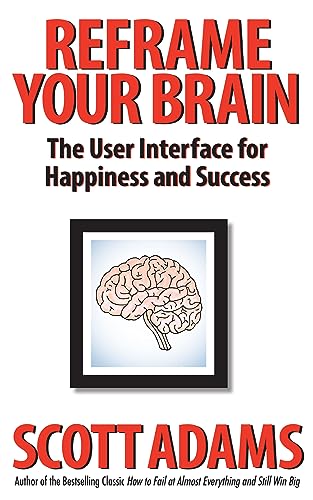

In one sentence
Your experience is shaped not only by events but by the mental frames used to interpret them. By replacing unhelpful frames with deliberately chosen alternatives—and reinforcing them through focus, repetition, and sometimes emotion—you can change behavior and subjective well-being. Adams treats reframes primarily as useful mental tools, not necessarily literal truths.
Overview
The book is a compact collection of perspective shifts rather than a conventional, evidence-heavy psychology manual. Adams introduces reframing through familiar sayings and then applies the method to personal fulfillment, business and career, mental health, social life, physical well-being, energy management, success, criticism, and luck. The 2023 editions vary in length and presentation: the Scott Adams, Inc. edition is listed at roughly 214–216 pages, while the Penguin edition is listed at 288 pages.
Core ideas
A frame is an interpretation filter
The same event can produce different feelings and actions depending on the story attached to it. A reframe changes the question or implication—for example, shifting attention from managing time to managing energy, or from avoiding critics to treating criticism as information or evidence of attention.
Utility can matter more than literal truth
Adams explicitly presents reframes as mental fictions that need not be perfectly true or logically complete; their value is whether they produce better decisions, emotions, or behavior. This makes the method closer to self-directed persuasion than to objective analysis.
Small shifts are easier to enact than total transformation
Instead of framing change as a huge life overhaul, look for the smallest action that moves in the desired direction. The reframe reduces psychological resistance by making progress concrete and immediate.
Manage energy, not merely time
A recurring practical distinction is that equal blocks of time do not produce equal output. Notice when your attention and motivation are strongest, then arrange demanding work around those conditions rather than relying only on calendars and hours.
Repetition installs the new frame
Adams emphasizes focus and repetition, with strong emotion presented as an optional aid. A reframe is therefore not a one-time insight; it becomes useful when repeatedly rehearsed until it is readily available under stress.
Luck can be approached strategically
Rather than treating luck as wholly random, Adams suggests moving toward environments with more activity, energy, and opportunities for favorable coincidence. The practical interpretation is to increase exposure to possibilities rather than waiting passively.
Practical takeaways
- When upset, write the automatic frame in one sentence, then generate three alternative interpretations that preserve the facts but change the implication.
- Convert vague goals into a smallest-next-step frame: ask, “What is the least demanding action that creates forward motion?”
- Track energy for a week—sleep, alertness, mood, and concentration—and schedule important work during high-energy periods.
- Use reframes as prompts for action, not substitutes for evidence. Ask whether the new frame improves the next decision.
- Create a short personal library of reframes for recurring problems such as criticism, procrastination, envy, rejection, and uncertainty.
- Rehearse useful reframes before stressful situations, because they are harder to invent when emotionally flooded.
Caveats and counterpoints
- The book’s central claim is presented as a practical philosophy and persuasion technique, not as a systematic review of cognitive-reframing research. Its examples should not be mistaken for clinical treatment or demonstrated psychological laws.
- A frame can be useful without being accurate, but that creates an ethical and practical limit: motivational reinterpretation can become denial, wishful thinking, or manipulation if it ignores evidence and consequences.
- Reframing cannot remove structural constraints, illness, grief, financial hardship, or interpersonal danger. In such cases, changing interpretation may help coping but does not replace material action, professional care, or boundary-setting.
- The large number of short examples makes the book easy to sample but can also make the method feel repetitive and underdeveloped compared with psychology texts that explain mechanisms and evidence in depth.
- The publisher-style description makes sweeping claims about lasting happiness and a complete “operating system”; those claims are promotional framing, not conclusions established by the bibliographic information or available previews.
Questions worth revisiting
- Which reframes produce better behavior rather than merely better feelings?
- Where is the line between a helpful fiction and self-deception?
- What evidence would show that a particular reframe works for me personally?
- Am I reframing a problem because it clarifies action—or because I am avoiding an uncomfortable fact?
- Which recurring situation in my life would benefit most from a prepared alternative frame?
Return to this when…
Return to the core list when stuck in a fixed interpretation, especially after criticism, failure, procrastination, or low energy. The most useful reread is not cover-to-cover: choose one problem, select one reframe, test it against reality, and keep it only if it improves both judgment and action.
Highlights
Your history and the dreams you remember have a lot in common in the sense that neither of them exists in the world of today. It makes no difference that your past happened in the real world and your dreams did not. From the perspective of right now, neither history nor dreams exist. They both round to zero. You probably already believe your dreams are not important. It’s a small step to say the same about your history; it once existed as events in the present, but today your history does not exist. And by virtue of not existing, it does not touch you.
I call that two movies playing on one screen. The power of this reframe is that it releases you from any obligation to make others bend to your way of thinking. Others are often aware of the same events and facts as you, but while they’re looking at the same screen at the same time, they see a different movie based on their biases and expectations. Once you understand this as the dominant model of all our disagreements, you won’t feel any pressure to “fix” people who disagree with you. Simply accept that you’re watching the same screen but a different movie. It is oddly freeing.
heard this reframe from Dr. Jordan Peterson. It matches one I’ve been using for a few years to great effect. Usual Frame: Life is about avoiding pain while pursuing happiness and meaning. Reframe: Life is an adventure. Life is full of discomforts. If you think your purpose is to avoid discomfort, you will be unhappy because there is no real hope of succeeding. Problems are part of life. But if you frame your life as an adventure, your temporary discomforts will feel as if they belong in the game to keep it interesting.
My take on the adventure frame is that we are computer simulations put here either to entertain our creators or to test strategies for their civilization. I go through my day as if I’m in a video game, which makes a lot of the stress disappear. Does it matter how unrealistic or dead-wrong I am about my reality? Nope. All that matters is that the reframe works in some identifiable way, and this one does. It makes me happy. I recommend it.
References
- Reframe Your Brain: The User Interface for Happiness and Success by Scott Adams - Books on Google Play
- wellsvillelibrary.org
- Reframe Your Brain: The User Interface for Happiness and Success - Scott Adams - Google Books
- Reframe Your Brain: The User Interface for Happiness and Success - Scott Adams - Google Books
- books.google.com
- Libby - Reframe Your Brain
- libcat.arlingtonva.us
- harvard.com
- openlibrary.org
- bookshop.org
- barnesandnoble.com
- books.apple.com